
You’re finally getting quotes for your steel building. Things are moving forward until the supplier asks: “What bay spacing are you thinking?”
You weren’t expecting that question. And now you’re wondering if your answer could cost you thousands.
It can.
Bay spacing is one of the most overlooked decisions in any steel building project. Most buyers focus on square footage, roof style, or cladding colour. But bay spacing? It quietly shapes your entire budget, your day-to-day workflow, and how easy (or painful) it is to expand later.
Make the wrong call and you might overpay on steel. Or end up with a building that fights you every time you try to move equipment through it. Or discover too late that your overhead door doesn’t fit where you need it.
This article will change that.
By the end, you’ll know exactly what bay spacing is, how it directly affects your costs, and how to choose the right spacing for the way you actually use your building.
This is precisely the kind of guidance Metal Pro walks through with every Canadian client before a single bolt is ordered.
What Is Bay Spacing And Why Does It Matter More Than You Think?
Let’s start simple.
A bay is the space between two consecutive rigid frames running along the length of your building. That’s it.
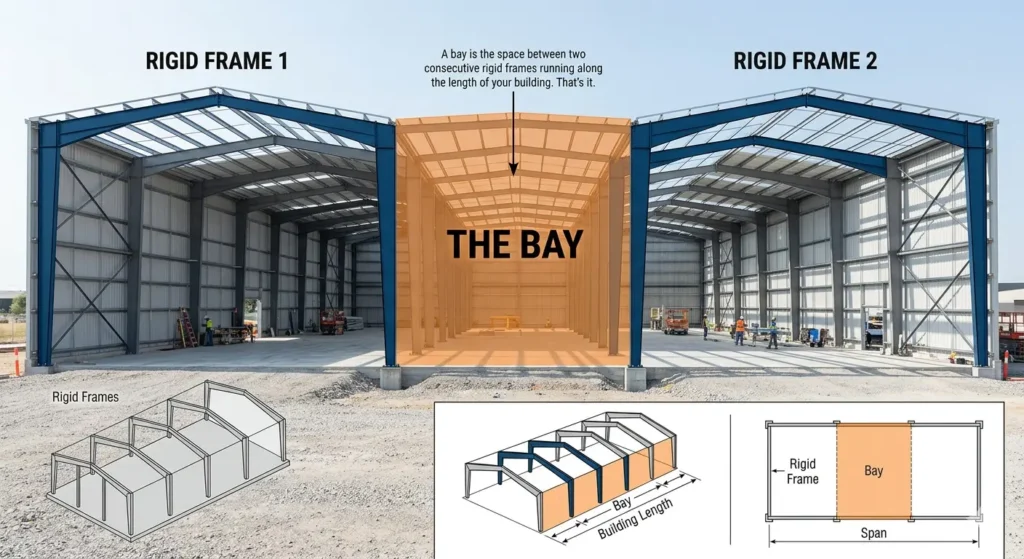
Your building’s total length is just the number of bays multiplied by the bay spacing dimension. Easy math but the implications run deep.
Here’s a quick example. Say you need a 100-foot-long building.
You could build it as 5 bays at 20 feet each. Or 10 bays at 10 feet each. Same footprint. Completely different structural profile and a very different cost picture.
That one decision touches your steel weight, your foundation, your labour, your door placement, and your ability to expand later.
A Few Key Terms Worth Knowing
You don’t need an engineering degree here. But a couple of terms will help you follow along:
- Clear span: No interior columns. The roof is supported entirely by the exterior walls. Maximum open floor space.
- Modular span: Interior columns are used to support the structure. More economical for very wide buildings , but columns interrupt your floor plan.
- Primary framing: The rigid frames (columns + rafters) that carry the main structural load.
- Secondary framing: The purlins and girts the horizontal members that connect frames and support your roof and wall panels.
Bay spacing directly affects the size of your primary frames and how your secondary framing is configured.
Change the bay spacing, and you change both.
Don’t Let This Overwhelm You
This isn’t as complicated as it sounds and you don’t need to figure it out alone.
But understanding the basics means you can ask better questions, evaluate quotes more confidently, and avoid decisions that seem fine on paper but create real problems once your building is up.
The next section is where it gets practical, let’s talk money.
How Bay Spacing Directly Affects Your Building Cost
Here’s the truth most suppliers won’t spell out upfront.
There’s no universally “cheapest” bay spacing. The right spacing for your budget depends on your building’s dimensions, your use case, and your site conditions. Getting this wrong doesn’t just affect your quote, it affects your wallet for years.
Let’s break down exactly how bay spacing moves the needle on cost.
Fewer Bays = Larger Frames = Higher Steel Weight Per Frame
When bays are wider, each rigid frame carries more load.
More load means heavier steel sections. Heavier sections cost more per frame.
But here’s the tradeoff: fewer bays means fewer frames overall. So the total steel weight doesn’t simply go up in a straight line. It shifts. The cost per frame rises, but you need less of them.
Whether that nets out in your favour depends entirely on your building’s size, use, and local load requirements.
More Bays = More Foundation, More Labour
Flip it the other way and the costs shift again.
More frames means more anchor bolts, more concrete piers or continuous footings, and more erection time on site. In Canada, where skilled labour rates are significant, that extra time adds up fast.
Secondary framing your purlins and girts can also increase with tighter bay spacing, depending on your design.
The foundation piece is worth pausing on. Every frame needs its own foundation penetration. In northern climates, where frost depth requirements push footings deeper, multiplying those penetrations has a real dollar figure attached.
The Hidden Cost Variable: Your Specific Use Case
This is where a lot of buyers get tripped up.
A basic storage shed has very different optimal bay spacing than a commercial workshop, an equestrian facility, or an agricultural building housing large equipment. The “cheapest” option on a quote sheet may not be cheapest for your project once you factor in how you’ll actually use the space.
A supplier who doesn’t ask about your operations before recommending bay spacing is leaving money on the table yours.
This is exactly where working with an experienced Canadian steel building pays off. Not just getting the lowest number on page one, but getting the right number for your specific project.
Impact on Insulation and Cladding Costs
Here’s a cost factor that almost never comes up in early conversations but should.
Bay spacing affects your purlin spacing. Purlin spacing affects the size and type of insulation batts you can use, and how your cladding panels span between supports.
Get this wrong and you’re looking at custom insulation sizing, additional framing, or thermal bridging issues, a serious concern in Canadian climates where energy performance matters year-round.
A well-designed bay spacing isn’t just structurally efficient. It’s thermally efficient too.
How Bay Spacing Affects Building Functionality
Cost matters. But here’s what matters just as much.
Can you actually work in your building the way you need to?
Bay spacing isn’t just a structural decision. It’s a workflow decision. The wrong choice doesn’t just show up on your invoice , it shows up every single day you use the building.
Interior Layout and Usable Space
Interior columns are the enemy of flexibility.
Every column that lands in your floor plan is a column you’re working around, forever. For equipment movement, vehicle storage, livestock facilities, and manufacturing lines, unobstructed floor space isn’t a luxury. It’s a requirement.
Wider bay spacing or a full clear span design eliminates that problem entirely.
Imagine trying to park a combine harvester or maneuver a transport truck around interior columns you didn’t plan for. It sounds obvious in hindsight. But buyers make this mistake regularly, simply because no one walked them through the layout implications before the building was designed.
Wide, open bays give you the freedom to reconfigure your space as your needs change. Tight bays lock you in.
Door and Opening Placement
This one catches people off guard more than almost anything else.
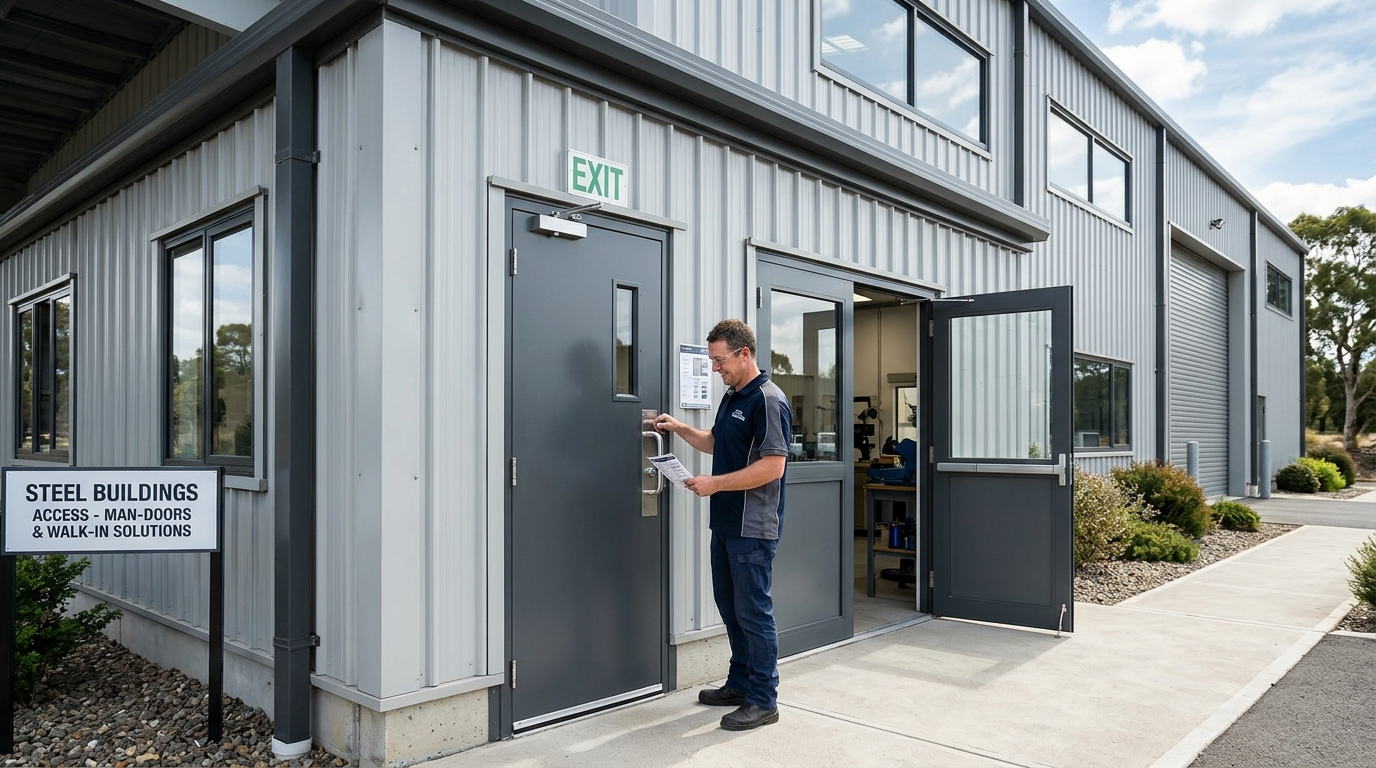
Bay spacing determines where your overhead doors, windows, and walk doors can physically be positioned. Openings have to fall within or between your frame locations. That’s not flexible once the design is set.
Too-tight bay spacing restricts the maximum width of your openings. For agricultural and industrial users, that’s not a minor inconvenience. A door that’s two feet too narrow for your equipment is a door that doesn’t work.
The time to think about door placement is during the design phase not after the building is framed and you’re standing there with a measuring tape wondering what went wrong.
Future Expansion Flexibility
Here’s a question most buyers never get asked: Do you think you’ll ever need more space?
If your bay spacing is consistent, adding onto your building later is straightforward. The new section ties in cleanly to the existing structure. Engineering is simpler. Costs are lower.
If your bay spacing is inconsistent or optimized so tightly for today’s budget that it doesn’t account for tomorrow expansion becomes a much more expensive and complicated project.
Planning bay spacing with potential growth in mind can save tens of thousands of dollars down the road. It’s one of the first questions Metal Pro asks, because the answer shapes the entire design approach from the start.
Load-Bearing Considerations for Your Use
Not all floors are created equal and neither are all roofs.
If you’re planning a mezzanine, running overhead cranes, or storing heavy equipment, your bay spacing needs to account for those point loads and distributed loads. Spacing that works perfectly for a storage building may be completely wrong for a manufacturing facility.
In Canada, snow loads are a critical factor that can’t be ignored. Roof load distribution across bays is directly tied to purlin sizing and frame capacity. A bay spacing that looks fine in southern Ontario can be dangerously undersized for a building in northern Manitoba or the BC interior.
Wind uplift and seismic considerations also vary significantly by province. What’s code-compliant in the Prairies may not meet requirements in BC. These aren’t details to sort out after the fact they need to be baked into the design from day one.
Your building has to perform in your climate, under your loads, for your operations. Bay spacing is part of how that performance gets engineered in.
Want to go deeper on how loads are distributed through your structure? This guide to load-bearing vs. non-load-bearing steel walls is a great next step.
The 4 Bay Spacing Mistakes That Cost Canadian Steel Building Owners the Most
Most bay spacing mistakes don’t happen because buyers are careless.
They happen because no one flagged the issue before it was too late to fix it cheaply. Here are the four most common and most costly mistakes Canadian steel building owners make.
Mistake #1: Choosing Spacing Based on Price Alone
It’s tempting. You get three quotes, one comes in lower, and you go with it.
But a lower quote built on the wrong bay spacing isn’t a deal, it’s a delayed expense. You might save a few thousand dollars upfront and spend far more working around a building that doesn’t suit your operations.
The right bay spacing is the one that works for your equipment, your workflow, and your long-term plans. Price is one input into that decision. It shouldn’t be the only one.
Metal Pro’s consultation process starts with how you’ll use the building before any numbers go on paper. That order of operations matters more than most buyers realize.
Mistake #2: Ignoring Local Load Requirements
Canada is a big country with wildly different structural demands by region.
Snow loads in northern Ontario are not the same as snow loads in the Fraser Valley. Wind requirements in coastal BC look nothing like those on the open Prairies. Seismic zones add another layer of complexity in certain provinces.
Bay spacing that doesn’t account for your specific regional load requirements isn’t just a budget problem, it’s a structural risk. Non-compliant designs fail inspections. Worse, they can fail under load.
Working with a supplier who designs to Canadian codes specifically to your region’s requirements isn’t optional. It’s the baseline for a safe, permit-ready building.
Mistake #3: Not Planning for Doors and Openings Early
We touched on this in the last section, but it deserves its own spot on this list.
Buyers regularly finalize their bay spacing without mapping out exactly where every overhead door, walk door, and window needs to go. Then the building gets designed, the frames get placed and suddenly the 16-foot door they needed won’t fit in the bay they assumed it would.
Retrofitting openings after fabrication is expensive. In some cases, it means reengineering entire frame sections.
The fix is simple: have the door and opening conversation before bay spacing is locked in. Metal Pro builds that conversation into every project from the first call.
Mistake #4: Overlooking Future Expansion
This is the mistake that stings the most because it feels so avoidable in retrospect.
A buyer optimizes their bay spacing tightly for their current budget and current needs. Five years later, they need more space. And they discover that adding on cleanly to their existing structure is going to cost significantly more than it would have if they’d planned for it upfront.
Consistent, well-considered bay spacing makes future expansion modular and affordable. Inconsistent spacing or spacing that was never designed with growth in mind turns a straightforward addition into a structural puzzle.
One conversation about your five- or ten-year plans at the design stage can protect you from a very expensive surprise later. That’s a conversation Metal Pro makes a point of having early.
What Bay Spacing Should You Choose? A Practical Guide by Building Type
Every project is different. But knowing the typical starting ranges for your building type gives you a solid foundation for the conversation with your supplier.
Here’s a practical breakdown.
| Building Type | Common Bay Spacing | Key Considerations |
| Agricultural / Farm Buildings | 20–25 ft | Equipment clearance, large door openings, snow load capacity |
| Commercial Warehouses | 20–30 ft | Racking systems, forklift movement, loading dock placement |
| Workshops / Garages | 15–25 ft | Vehicle size, hoist placement, workflow flexibility |
| Equestrian Facilities | 12–20 ft | Stall configurations, aisle width, ventilation design |
| Industrial / Manufacturing | 20–40 ft | Crane loads, mezzanine integration, heavy equipment movement |
What These Numbers Actually Mean for You
These ranges are starting points not prescriptions.
A 20-foot bay spacing might be perfect for one agricultural building and completely wrong for another, depending on the equipment involved, the local snow load, and whether the owner plans to expand in three years.
The table above gives you a frame of reference. Your specific site, use case, and budget determine where you land within or outside those ranges.
Here’s what’s worth keeping in mind as you review these numbers.
- Agricultural and farm buildings tend to prioritize wide, unobstructed bays. Large equipment like combines, grain augers, and tillage tools need room to move. Door width is often the deciding constraint work backwards from your largest piece of equipment.
- Commercial warehouses are often driven by racking layout. If you know your racking configuration upfront, you can align bay spacing to it from the start saving on both structure and interior fit-out.
- Workshops and garages vary widely based on use. A hobbyist garage has very different needs than a commercial fleet maintenance facility. Hoist placement and vehicle turning radius are often the key functional drivers.
- Equestrian facilities have some of the most specific interior layout requirements of any building type. Stall sizes, aisle widths, and tack room placement all interact with bay spacing in ways that need careful upfront planning.
- Industrial and manufacturing buildings often involve the most complex bay spacing decisions. Overhead crane systems, mezzanine loads, and heavy point loads all push toward wider, heavier-framed bays and require detailed engineering input from the start.
The Bottom Line on “Right” Bay Spacing
There’s no universal answer. But there is a right answer for your project.
It comes from understanding your operations, your site conditions, your regional load requirements, and your plans for the future then engineering a design that balances all of those factors against your budget.
Not sure what bay spacing makes sense for your project? Metal Pro’s team designs hundreds of Canadian steel buildings every year. We’ll help you work through the variables and get it right from the start before anything goes to fabrication.
Why Bay Spacing Decisions in Canada Come with Extra Considerations
Buying a steel building in Canada isn’t the same as buying one anywhere else.
The climate is more demanding. The codes are more specific. And the consequences of getting your design wrong structurally or from a permit standpoint are more significant.
Here’s what makes bay spacing decisions distinctly Canadian.
Snow Loads: The Factor That Changes Everything
Canada’s National Building Code (NBC) sets minimum structural requirements for snow loads and those requirements vary dramatically by location.
Bay spacing directly affects how roof loads are distributed across your purlin and frame system. Wider bays mean each frame and purlin is carrying more snow load over a greater span. That drives up the required steel section sizes and the cost.
A bay spacing that’s perfectly adequate for a building in southern Ontario can be dangerously undersized for the same building in northern Saskatchewan or the BC interior, where ground snow loads can be three to four times higher.
This isn’t a detail to sort out after your building is designed. It needs to be the starting point.
Frost Depth and Foundation Costs
Every frame needs a foundation penetration. In Canada, that means every footing has to reach below the frost line which varies significantly by province and region.
In southern Canada, frost depth requirements might sit around 4 feet. In northern regions, that number can push well past 6 or 7 feet.
More frames mean more of those deep foundation penetrations. That’s more concrete, more excavation, and more labour costs that multiply quickly when you’re building in areas where ground conditions are challenging or contractor availability is limited.
Fewer, well-spaced frames can meaningfully reduce your foundation costs in cold-climate builds. It’s a variable that rarely gets discussed early enough.
Provincial Building Permits and Code Compliance
Steel building permits in Canada aren’t one-size-fits-all.
Provincial and municipal requirements layer on top of the NBC and some jurisdictions have specific expectations around frame spacing, engineering documentation, and structural calculations that must be submitted with your permit application.
Bay spacing is part of your structural engineering package. It has to comply with the applicable codes for your specific location. A building designed to meet Ontario requirements may need significant adjustments to pass permitting in Alberta or BC.
Working with a supplier who understands Canadian code requirements provincially, not just federally protects you from costly redesigns and permit delays.
Shipping and Erection in Remote Locations
Canada is vast. And a meaningful number of steel building projects happen well outside major urban centres.
Fewer, larger frames can actually simplify logistics in remote or rural locations. Fewer pieces to transport, fewer crane picks, and less erection time on site all of which matter when you’re coordinating a build hours from the nearest city.
Tighter bay spacing with more frames adds transport and erection complexity. In remote areas, that complexity has a real price tag attached.
It’s another reason why bay spacing decisions can’t be made in isolation from where your building is actually going.
Why a Canadian-Specific Supplier Matters
A generic steel building supplier particularly one based outside Canada won’t design around these realities by default.
They’ll give you a building that looks right on paper. But it may not be engineered for your snow load, your frost depth, your provincial code, or your site access conditions.
Metal Pro designs specifically for Canadian conditions not as an afterthought, but as the foundation of every project. Every building is engineered to the applicable Canadian codes for the client’s specific region, from the ground up.
That distinction matters more than most buyers realize until something goes wrong.
How Metal Pro Designs Bay Spacing Around Your Life, Not Just a Spec Sheet
Most steel building suppliers start with dimensions.
Metal Pro starts with questions.
The Consultation-First Difference
Before any design work begins, Metal Pro’s team wants to understand how you’ll actually use your building.
What equipment are you moving through it? Where do you need doors and how wide? Do you plan to add on in five years? Are you running a crane? Storing livestock? Running a manufacturing line?
These aren’t afterthoughts. They’re the inputs that drive every design decision including bay spacing.
A building that’s engineered around a spec sheet might tick every structural box and still fight you every day you work in it. A building designed around your actual operations works the way you need it to, from day one.
That’s the difference between a supplier who sells steel and a partner who designs solutions.
Engineering Backed by Canadian Code Expertise
Every Metal Pro building is fully engineered to Canadian codes specifically to the requirements of the client’s province and region.
That means your snow loads, wind uplift requirements, seismic zone considerations, and local permit expectations are all built into the design from the start. Not retrofitted in later. Not flagged as a problem during permit review.
Bay spacing is one of the variables that gets optimized through that engineering process balanced against your budget, your use case, your site conditions, and your long-term plans.
You’re not getting a generic building with your name on it. You’re getting a building engineered for where you are and how you work.
Real Conversations About Real Plans
Metal Pro’s design process is built around genuine dialogue, not a form to fill out and submit.
That means conversations about your five-year plans. About the equipment you have now and the equipment you might add later. About the workflow inside the building and the site conditions outside it.
Those conversations shape bay spacing decisions in ways that no online configurator or cookie-cutter quote process can replicate.
Metal Pro has delivered steel buildings across Canada agricultural facilities, commercial warehouses, equestrian centres, industrial buildings, and more. That breadth of experience means the team has seen what works, what doesn’t, and what questions need to be asked before a design gets locked in.
You Shouldn’t Have to Become a Structural Engineer
Here’s the honest truth.
Bay spacing involves real engineering tradeoffs. Snow load calculations, frame weight optimization, foundation cost variables, purlin sizing these are technical decisions that take expertise and experience to get right.
You shouldn’t have to figure that out on your own.
That’s exactly what Metal Pro is here for. To take the complexity off your plate, ask the right questions, and deliver a building that performs the way you need it to structurally sound, code compliant, and built around your life.
“Your building should work as hard as you do. Getting the design right from the start is how we make sure it does.”
The Bottom Line: Bay Spacing Is a Business Decision, Not Just a Technical One
Bay spacing affects your budget, your daily workflow, your ability to expand, and your building’s ability to handle Canadian winters. It deserves more than a default answer from a price sheet.
The right spacing comes from a real conversation one that starts with how you actually use your building, not just its dimensions.
Your Building Should Work as Hard as You Do
The best steel buildings have doors in the right places, clearance for the equipment that needs to move through them, and a structure engineered for Canadian conditions.
That’s not luck. That’s what happens when every design decision is made deliberately with your operations at the centre.
Ready to Get It Right?
Metal Pro designs hundreds of Canadian steel buildings every year. We’ll walk through your project, your site, and your budget and make sure everything is exactly right for how you work.
Get My Free Steel Building Consultation
Not ready to talk yet? Download Our Steel Building Planning Guide