
Have you ever looked at a massive skyscraper and wondered why the metal doesn’t snap under all that weight? Or maybe you’ve tried to weld a DIY project only to have the metal crack right at the seam?
Choosing the wrong type of steel is a mistake that costs more than just money; it can cost you the safety of your project. Most people use the terms “mild steel” and “structural steel” as if they are the same thing. They aren’t.
If you are confused by technical datasheets or just want to know which metal to buy for your next build, you are in the right place. This guide will break down the “why” and “how” of these two metals so you can build with total confidence.
The Overlap Paradox: Are They Actually Different?
It’s the question that keeps many hobbyists and even some pros up at night: “Is this piece of metal actually what I think it is?” In the world of metallurgy, the terms mild steel and structural steel are often used as if they are the same thing.
The reality? They are related, but they are definitely not identical.
The Quick Answer
Think of it like this: Mild steel is a category based on what is in the metal. Structural steel is a category based on what the metal can do.
While most structural steel used in buildings is technically a type of mild steel, not all mild steel is qualified to hold up a roof. Using a generic “mild steel” rod from a scrap yard for a load-bearing beam is like hiring a fast runner to win an Olympic sprint without checking if they’ve ever run a race before.
Material vs. Mandate
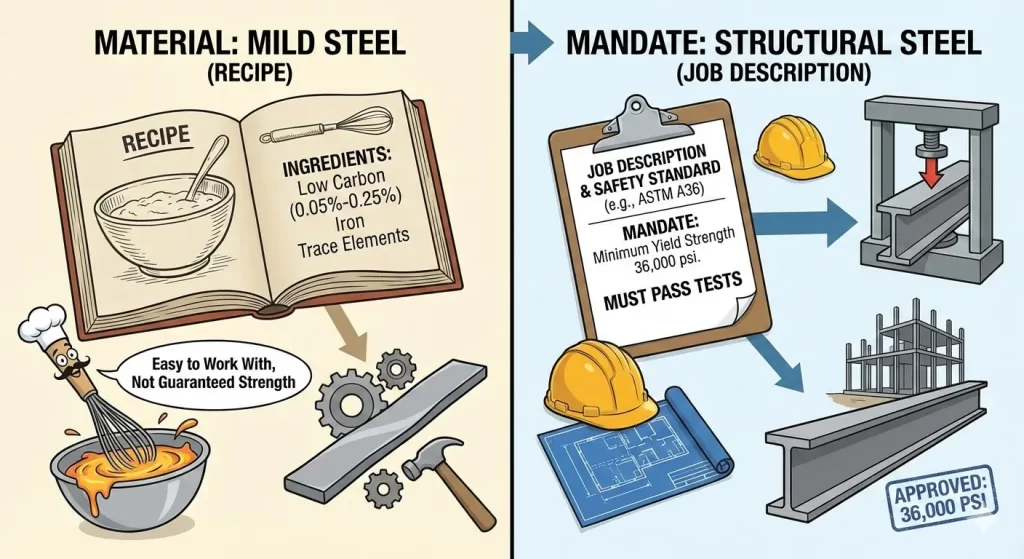
- Mild Steel is a “Recipe”: It tells you the ingredients. It’s defined by having a low carbon content (usually between 0.05% and 0.25%). This makes it easy to work with but doesn’t guarantee a specific strength level.
- Structural Steel is a “Job Description”: It is a legal and safety standard. For example, the common ASTM A36 standard mandates that the steel must have a minimum yield strength of 36,000 psi. It has a specific job to perform, and it must pass tests to prove it can do it.
The Core Distinction: Standards and Alloys
The real “magic” happens in the testing. Structural steel is often treated with specific amounts of manganese or silicon to ensure it doesn’t crack under stress. While a generic piece of mild steel might be great for a garden gate, structural steel is the “certified” version that keeps skyscrapers standing during an earthquake.
The Carbon Threshold: Why the “Mild” Matters
If you’ve ever wondered why we call it “mild” steel, it isn’t because the metal is polite. It’s because of the carbon.
In the world of metal, carbon is like the seasoning in a dish. A little bit goes a long way, and too much can ruin the whole thing.
The 0.05% to 0.25% Carbon Range
Steel is mostly iron. However, adding just a tiny amount of carbon turns it from soft iron into a strong alloy. Most mild steel falls into the 0.05% to 0.25% range.
To put that in perspective, if you had 100 pounds of steel, only a few ounces would be carbon. This low amount is what gives the metal its “mild” personality.
The Goldilocks of Fabrication
Why is this small number such a big deal? It creates a perfect balance that we call the “Goldilocks” zone:
- Soft enough to shape: You can bend it, roll it, or stamp it into shapes without it snapping like a dry twig.
- Strong enough to hold: It still has the “backbone” needed for car frames, pipes, and small buildings.
- The Welding Secret: This is the most important part. Because the carbon is low, you can weld mild steel without it becoming brittle. High-carbon steels often crack near the weld because they cool too quickly and get “glassy.”
Mild steel stays “tough” and flexible even after it’s been heated and cooled. This makes it the ultimate choice for general fabrication.
Structural Steel: The Performance Standard (ASTM A36 & Beyond)
When a building is designed, the architect doesn’t just ask for “some metal.” They ask for a performance guarantee. This is where structural steel leaves regular mild steel in the dust.
Beyond the Recipe
Structural steel isn’t just defined by what is in it, but by how much pressure it can handle before it fails. To earn a “Structural” label like ASTM A36, the steel must pass rigorous tests for:
- Yield Strength: This is the point where the metal stays bent. For A36, this is 36,000 psi.
- Tensile Strength: This is the maximum “pulling” force the steel can take before it actually snaps.
- Chemistry Limits: Scientists check the levels of phosphorus and sulfur. If these are too high, the steel becomes brittle and can crack like glass during a cold winter.
The “So What”: Safety and Law
Why do we care about these numbers? Because of predictability.
If you build a bridge, you need to know exactly how much it will sag when a truck drives over it. Certified structural steel provides that data. In many places, it is a legal requirement. Using non-certified steel in a house frame could not only lead to structural failure but also prevent you from getting insurance or passing a building inspection.
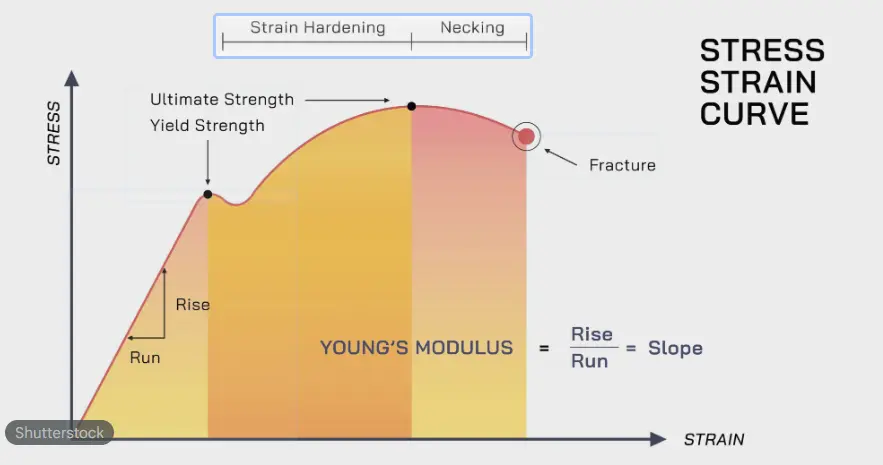
- A Stress-Strain Curve visually represents the behavior of a material when a force is applied. It plots the stress, the amount of force applied to the material’s cross-sectional area, against the strain, the change in the material’s shape relative to its original shape. The shape of the curve provides important insights into a material’s mechanical properties. These include its elasticity, strength, and toughness.
- Strain Hardening and Necking : The strain hardening phase is when the material is permanently deformed and gets stronger, increasing its resistance to further deformation. Necking is the final stage before fracture, where the material’s cross-sectional area starts to decrease, eventually leading to failure.
- Ultimate and Yield Strength : The ultimate strength is the maximum stress a material can withstand, while yield strength is the stress at which the material starts to deform permanently. These points on the stress-strain curve indicate the material’s resistance to deformation. The ultimate strength is the peak of the curve, representing the highest stress the material can handle before it begins to weaken.
- Fracture : Fracture is the point where the material breaks. The stress at which fracture occurs is called the fracture strength. The shape of the fracture region on the stress-strain curve can provide information about whether the material is ductile (able to stretch a lot before breaking) or brittle (breaking with little or no deformation).
- The elastic region is the initial part of the curve where the material can return to its original shape after the stress is removed. Young’s Modulus, or the modulus of elasticity, is a measure of the material’s stiffness and is calculated as the slope of the stress-strain curve in the elastic region, representing the ratio of stress to strain. This is found by taking the rise of the slope over the run of the slope.
Workability vs. Weight-Bearing: A Side-by-Side Comparison
To help you choose the right metal at a glance, here is a breakdown of how they stack up against each other. Remember: while they look the same to the naked eye, their “test scores” are very different.
| Feature | Mild Steel (General Grade) | Structural Steel (Regulated) |
| Primary Goal | Versatility & Shaping: Perfect for projects that need to be bent or molded. | Load-Bearing: Designed specifically to hold weight and resist sagging. |
| Weldability | Excellent: Extremely easy to weld; very forgiving for beginners. | Certified: Weldable, but tested to ensure the joints won’t fail under stress. |
| Ductility | High: Can be stretched and bent into intricate shapes without snapping. | Controlled: Must stretch at least 20% before breaking (safety cushion). |
| Common Forms | Sheets, rods, tubes, and small flat bars for general repairs. | I-beams, C-channels, H-columns, and heavy-duty plates. |
Why the Shape Matters
You will notice that structural steel is almost always sold in specific shapes like the “I” or “H.” This isn’t just for looks. These shapes are engineered to provide the most strength while using the least amount of metal. Mild steel, on the other hand, is often sold in simple sheets or rods because it is meant to be cut and shaped by you.
Workshop Reality: How Each Steel Behaves Under the Torch
When you are in the workshop, the difference between these two metals becomes very real. It’s the difference between a smooth, clean cut and a tool that keeps getting stuck.
The Project Impact: “Gummy” vs. “Crisp”
Most mild steels (like the popular 1018 grade) are a dream to machine. They are often cold-rolled, which means they have a smooth finish and a consistent shape. When you drill or mill them, the metal chips away cleanly.
Structural steel (like A36), however, is usually hot-rolled. This process can make the metal feel a bit “gummy” when you machine it. It might not give you that mirror-smooth finish without extra work. But for welding? It’s fantastic. It’s designed to take the heat of a heavy-duty welder without warping or cracking easily.
The Danger of the Wrong Grade
If you accidentally use a high-carbon steel thinking it’s just “regular metal,” your welds could fail. High carbon makes metal brittle when it cools quickly. This leads to “cold cracking” tiny fractures that you can’t see with the naked eye but can cause a joint to snap under pressure. This is why sticking to certified structural grades is non-negotiable for anything that holds weight.
Cost vs. Capability
Is the price premium worth it? Surprisingly, structural steel (A36) is often cheaper per pound for large projects because it is produced in massive quantities. However, if you need a specific, high-precision part, the extra cost of a specialized mild steel (like 1018) is worth every penny for the time you’ll save on machining and finishing.
How to Choose: The Decision Matrix
Deciding between these two isn’t about which steel is “better” it’s about which one is right for the job. Using structural steel for a garden ornament is overkill (and expensive), while using basic mild steel for a mezzanine floor is dangerous.
Choose Mild Steel (General Grade) if:
- Appearance Matters: You need a smooth, “clean” finish for furniture or art.
- Intricate Shapes: You are bending, rolling, or stamping the metal into complex forms.
- Non-Critical Repairs: You’re fixing a lawnmower deck, a garden gate, or a decorative bracket.
- DIY Projects: You are a beginner welder looking for the most forgiving material to practice on.
Choose Structural Steel (ASTM A36/S275) if:
- Safety is Key: People will be standing under, on, or inside the structure you are building.
- Load-Bearing: The metal needs to support a roof, a floor, or a heavy machine. If you are framing a structure, it is critical to know which sections are doing the “heavy lifting.” For a deeper look at how to apply this to your project, read our guide on Understanding Load-Bearing vs. Non-Load-Bearing Steel Walls.
- Code Compliance: Your project requires a building permit or must meet local engineering standards.
- Predictability: You need to know exactly how much the metal will flex under a specific weight.
The Maintenance Factor: The “Skin” Requirement
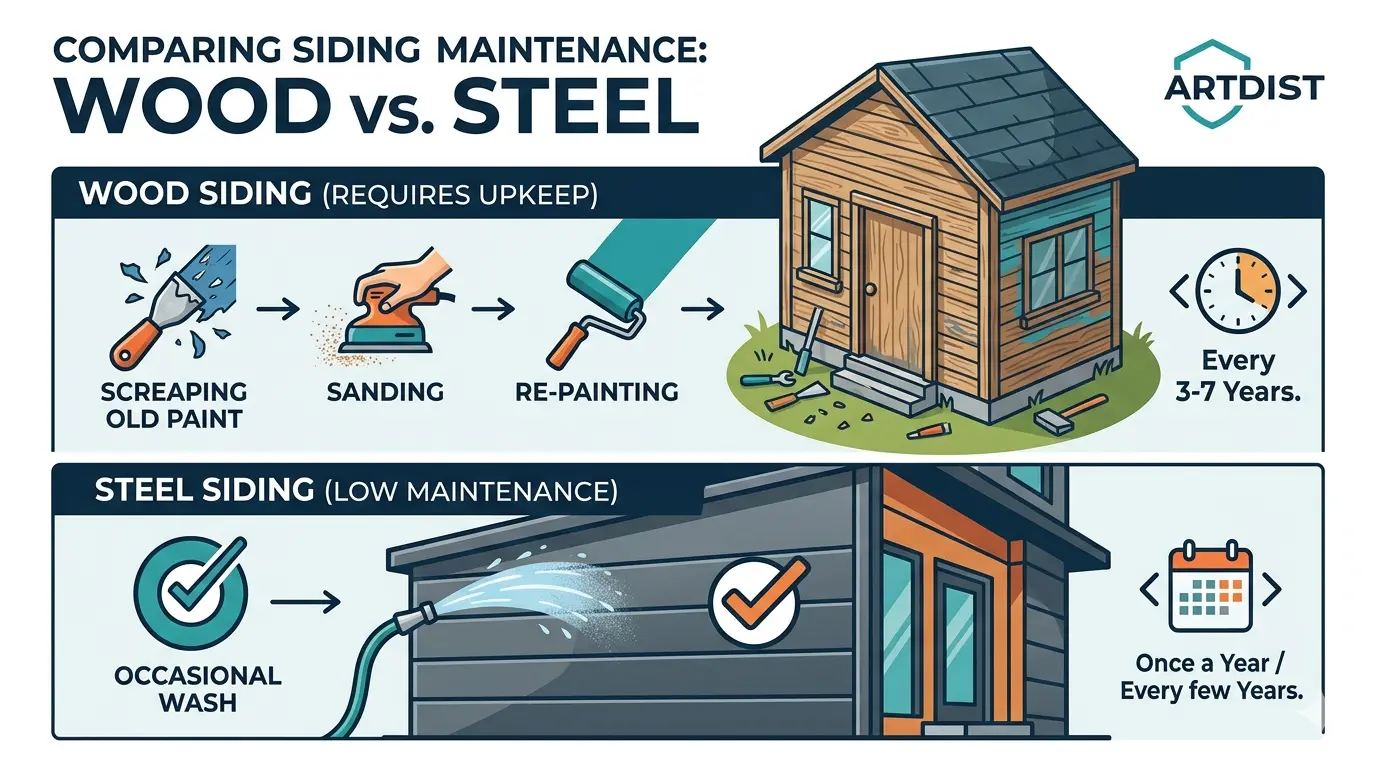
Both mild steel and structural steel have one major weakness: rust. Because they lack the chromium found in stainless steel, they will both corrode if left bare.
- Paint or Powder Coat: Best for indoor use or aesthetic projects.
- Galvanization: A zinc coating that is essential for structural steel used outdoors (like bridge beams or coastal railings).
Conclusion: The Safety Margin
At the end of the day, the difference between structural steel and mild steel isn’t just a matter of chemistry, it’s a matter of integrity.
While all structural steel starts its life with a “mild” chemical profile, it earns its title through rigorous testing and certification. Mild steel is the versatile workhorse of the shop, ready to be bent and shaped into whatever you can imagine. Structural steel is the silent guardian of our infrastructure, providing the predictable strength that keeps our world standing.
The Final Word
Before you spark your torch or place your order, ask yourself: “What happens if this fails?”
- If the answer is “I’ll just weld it again,” go with mild steel.
- If the answer involves safety risks or building codes, always insist on certified structural steel.
Understanding this distinction is what separates a hobbyist from a professional. By choosing the right grade, you aren’t just buying metal, you are buying peace of mind.
Ready to Build? Get the Right Steel for the Job!
Choosing the right material is just the first step. Whether you are planning a massive industrial warehouse or a custom backyard workshop, having the right technical specs at your fingertips can save you thousands in costly mistakes.
Download Our Ultimate Steel Building Brochure Click Here to Download Your Free Brochure Now Take the guesswork out of your next project and build with total confidence.