
You finally did it.
Permits applied for. Contractor booked. Maybe a concrete pad already poured.
Then the building department asks for stamped engineering drawings and you realize they weren’t in the package.
The kit looked complete. The sales process felt smooth. But something critical was never included.
This isn’t as rare as it should be and it’s one of the most costly surprises in the Canadian steel building industry.
If you’re already in this situation, there is a way forward. If you haven’t bought yet, this article could save you months of delays and thousands of dollars.
What Are Engineering Stamps And Why Does Canada Require Them?
An engineering stamp isn’t paperwork. It’s accountability.
When a licensed Professional Engineer (P.Eng.) stamps your drawings, they are personally certifying that the structure meets safety and building standards. Their name, license number, and professional reputation are on the line.
The stamp verifies that the design adheres to applicable engineering standards including load calculations, snow loads, wind uplift, and seismic considerations specific to your site.
This is a legal requirement, not a suggestion. When a design package is submitted to a municipal permitting department, it must have the appropriate sign-off by an engineer licensed to practice in that jurisdiction.No stamp, no permit. It’s that simple.
Why Canadian Requirements Are Especially Strict
Canada isn’t a one-size-fits-all country not climatically, and not legally.
Snow load values, wind pressures, seismic design, and foundation requirements must align with the code enforced by the local authority having jurisdiction. Your building needs to be engineered for your conditions, not a generic template.
The stakes are high. Steel structures are particularly sensitive to code interpretation because they rely on precise engineering assumptions. Small assumptions can have large structural consequences .
On top of that, every province has different requirements, and some municipalities have authority to enforce even more stringent standards based on local safety concerns. The same principle applies in BC, Alberta, and every other province.
A stamp from an engineer licensed elsewhere won’t satisfy your local building department.
What’s stamped for Texas doesn’t protect your building or your family through a Manitoba winter.
The Kit-Only Problem: Why Stamps Go Missing
Many kit suppliers are manufacturers or resellers not engineering firms.
Their job is to sell you steel. Engineering is often treated as a separate service, an add-on, or simply someone else’s problem. Low-cost steel building kits compete primarily on upfront price. To achieve those numbers, engineering is often simplified, deferred, or reduced to basic load tables rather than project-specific structural analysis.
The result? Imported steel building kits often come with U.S. engineering seals, which aren’t valid in Canada. Others arrive with no stamp at all.
Most buyers don’t discover this gap while browsing the supplier’s website. They find out at the permit counter after they’ve already paid.
The “We Can Get That for You Later” Problem
Some suppliers wave off stamp concerns during the sales process. It sounds reassuring. It rarely is.
Some suppliers still suggest that stamped plans are optional, or that generic drawings are “good enough.” This kind of misinformation creates real problems. Getting stamps after the fact means starting the engineering process from scratch except now an engineer is working backwards from a design they didn’t originate.
That’s slower. It’s more expensive. And it sometimes requires design modifications to the kit you’ve already purchased.
A supplier quoting a U.S.-spec building without Canadian engineering stamps will cost you time, money, and permit headaches.
What Happens When You Try to Get Stamps After the Fact
Finding a P.Eng. willing to stamp someone else’s drawings is harder than it sounds. Engineers carry personal liability for what they stamp; many simply won’t take on that risk for a design they didn’t originate.
Most municipalities take 2 to 8 weeks to review complete applications with proper engineering documents. But that clock doesn’t even start until your package is complete. An incomplete submission restarts the review entirely.
Issues identified during permit review can trigger redesigns, resubmissions, and construction delays. Each round adds weeks and costs.
The worst part? You may end up paying for engineering twice. Once implied in the kit price. Once in reality, when you’re forced to hire a Canadian P.Eng. to produce what should have been included from day one.
The Real Cost of the Delay In Canadian Terms
Missing an engineering stamp doesn’t just stall your project, it triggers a chain reaction that costs you time, money, and peace of mind all at once.
The Canadian Construction Season Problem
Canada doesn’t give you much room for error.
In less populous provinces and territories, harsh winters mean construction activities are concentrated in the warmer summer months, creating intense competition for crews, equipment, and inspectors all at once.
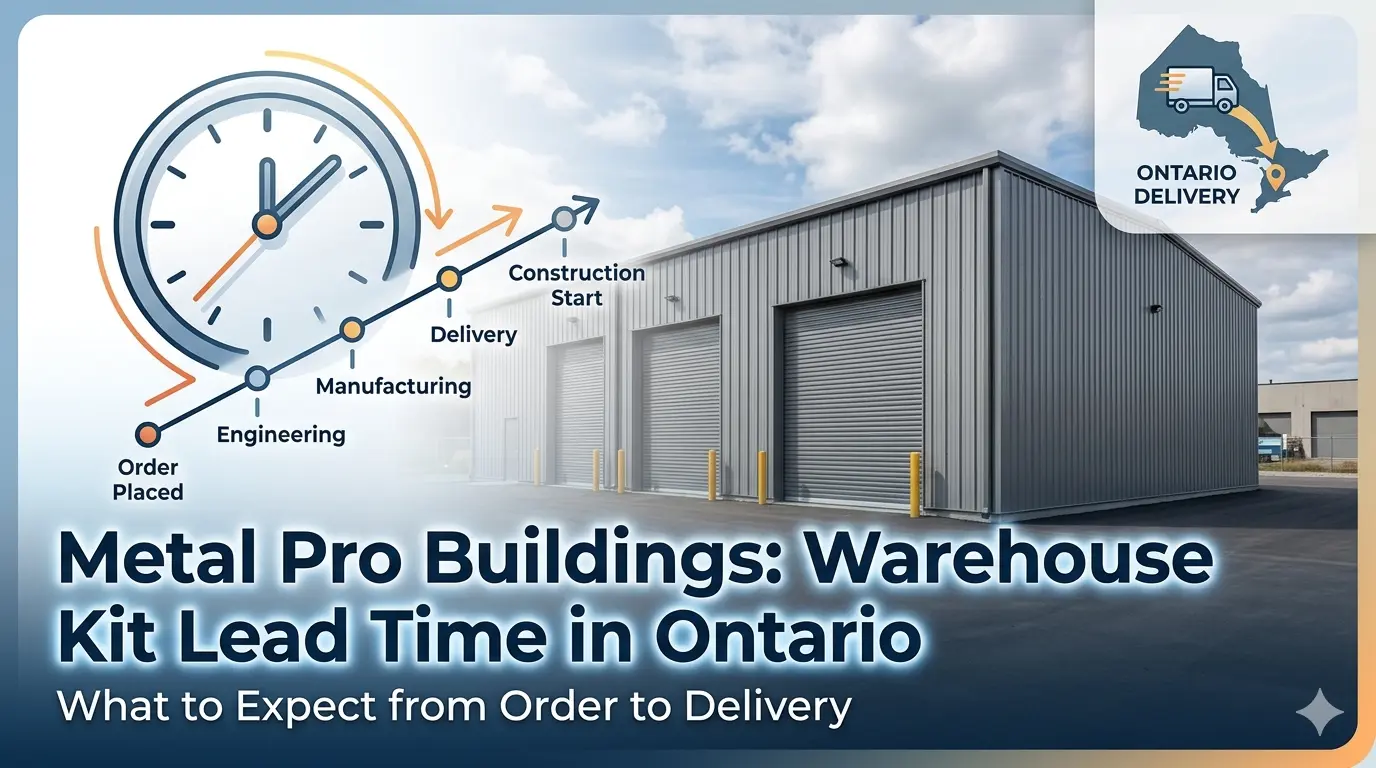
Metal building permits in Canada commonly take 4–8 weeks or more for complete plans and that’s when everything goes smoothly. Larger commercial or industrial projects in busy municipalities can stretch to 12–16 weeks.
Now add a missing engineering stamp to the front of that timeline.
A 6–8 week engineering delay in early spring doesn’t just push your start date back. It can erase your entire build season. If you’re reading this in June without a permit in hand, your summer build is almost certainly a fall foundation at earliest.
The Financial Bleed While You Wait
The delay doesn’t just cost time. It costs money every single week.
In project delay situations, a party must manage potential additional costs for site and office overhead, equipment rentals, idle labour, financing and insurance, and other potential liabilities such as loss of revenue and profit.
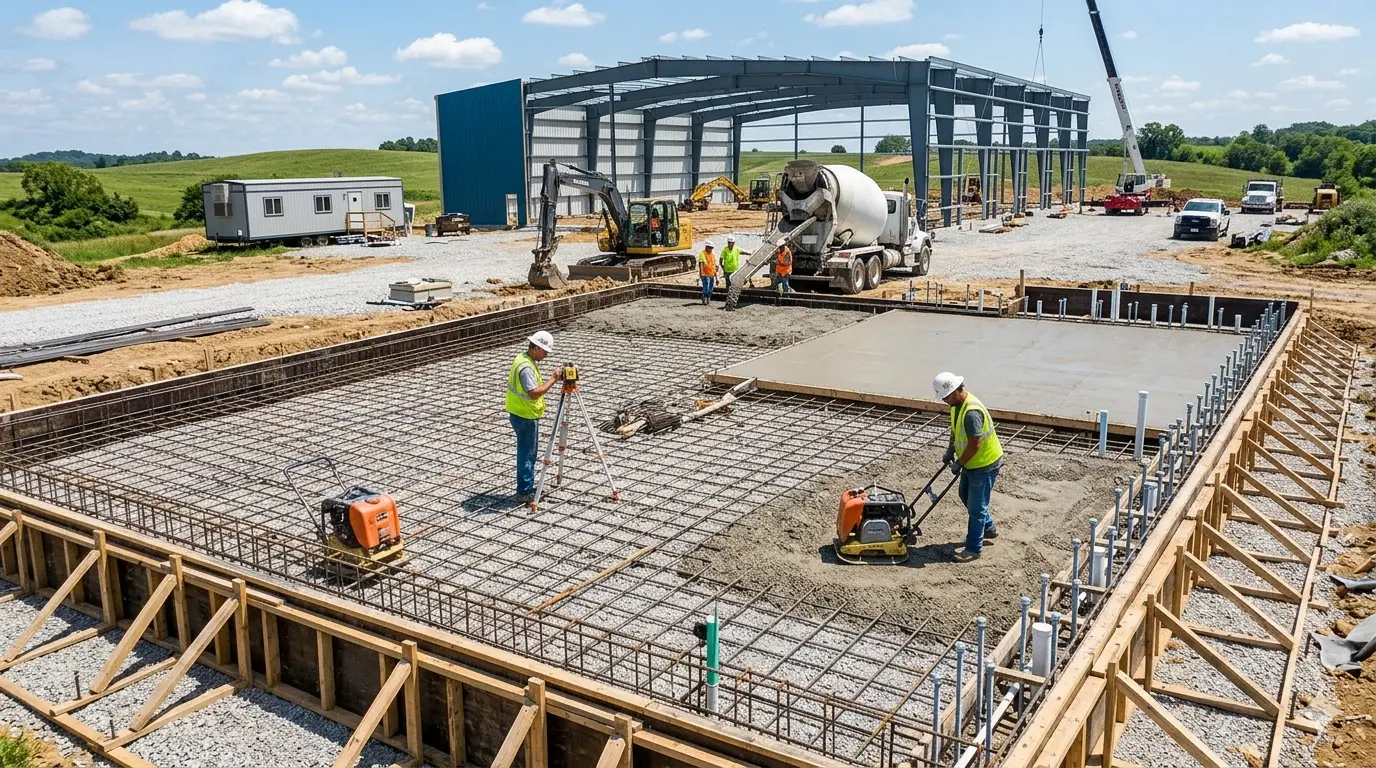
Your materials may be sitting in a yard, exposed to the elements. Your concrete pad is poured and doing nothing. Your contractor has moved on.
Deposits are treated differently from other contract payments in Canada and in many cases, they are non-refundable even when the delay wasn’t your fault.
That rebooking fee, that lost deposit, that storage cost none of it is recoverable from the kit supplier who sold you incomplete drawings.
And the building still isn’t generating revenue, housing your equipment, or serving its purpose.
The Mental Load , Don’t Skip This Part
There’s a cost that doesn’t show up on any invoice.
It’s the stress of chasing answers from a supplier who’s already been paid and has little urgency to resolve your problem. It’s the feeling of being stuck between a kit company, an engineer, and a building department none of whom are talking to each other.
In its 2023 contractor survey, the Ontario Construction Secretariat reported that 36 per cent of contractors had projects cancelled during the past year with the inability to secure permits among the leading reasons.
You didn’t plan for this. You planned to build something.
The helplessness of not knowing how long it will take or what it will ultimately cost ; is its own kind of expensive.
HOW TO SPOT THIS RISK BEFORE YOU BUY
Most buyers only discover missing engineering stamps at the permit stage when it’s already too late. The smarter move is to catch the risk before signing anything.
This comes down to asking the right questions and spotting gaps early. If engineering isn’t clearly defined upfront, delays are almost guaranteed later.
A. Questions Every Canadian Buyer Should Ask Before Signing Anything
Before committing, confirm whether stamped drawings are included or only offered as an extra. If it’s not clearly included, expect added cost and delays.
Make sure the drawings are stamped by a licensed P.Eng. in your province. Anything outside your jurisdiction won’t pass permit approval.
Check that the design matches your exact location. Snow load, wind, and seismic requirements must be site-specific not generic.
Ask if the engineer will support the permit process. Without that, even small questions can stall your approval.
Finally, get a clear timeline for a permit-ready package. If it’s vague, engineering is likely not built into the process.
B. Red Flags in Kit Supplier Contracts
Watch for vague terms like “engineering available upon request.” That usually means it’s not included.
U.S.-based stamps on Canadian projects are another major issue they won’t be accepted.
If there’s no mention of Canadian Building Code compliance, assume it’s missing.
And if no engineer or firm is named, there’s no clear accountability when problems arise.
THE METAL PRO DIFFERENCE , BUILT FOR CANADA, BUILT FOR YOU
Most issues tied to missing engineering don’t come from bad luck. They come from how the project is structured from the beginning. When engineering is treated as optional, delays follow. When it’s built into the process, the project moves forward.
That’s where the difference starts.
A. Engineering-First, Not Engineering-Optional
In many kit-only projects, engineering is something you deal with after purchase. That approach creates gaps, and those gaps show up at the worst possible time during permitting.
At Metal Pro, engineering is not an add-on. It is part of the project from day one.
Each building is designed and stamped by licensed Canadian Professional Engineers (P.Eng.), ensuring that drawings are aligned with local requirements before materials are shipped. Instead of fixing problems later, the project starts with a permit-ready foundation.
B. We Know Canadian Codes Because We Work in Canada
Canadian building codes are not uniform. Requirements change by province and even by municipality, especially when it comes to snow loads, wind exposure, and seismic conditions.
Rather than adapting generic designs, Metal Pro builds each project around these requirements from the start. This eliminates the need for revisions later and reduces the risk of permit rejection.
You shouldn’t need to interpret building codes just to move your project forward. That complexity is handled upfront.
C. One Point of Contact, Start to Finish
One of the biggest sources of delay in kit-only projects is coordination. Buyers often find themselves managing multiple parties: supplier, engineer, and building department without clear accountability.
Metal Pro simplifies this process by handling engineering, documentation, and coordination within a single workflow. This reduces miscommunication and removes the need to chase answers across different providers.
The result is a more streamlined and predictable experience.
D. What a Smooth Project Actually Feels Like
When engineering is handled properly from the start, the entire project feels different.
Permits are secured before construction begins. Contractors arrive on schedule because everything is ready. There are no last-minute surprises or missing documents slowing things down.
The build progresses as planned and is completed within the expected timeline.
That outcome is not accidental. It is the result of having engineering built into the process from the beginning not added later when problems appear