
Canadian buyers of pre-engineered steel building kits are making avoidable errors that delay projects, trigger permit rejections, and shorten building lifespans, industry professionals say, with the release of the National Building Code of Canada 2025 making early compliance planning more critical than ever.
Demand for pre-engineered building packages has climbed sharply across Canada as labour shortages and rising conventional construction costs push buyers toward faster, more predictable solutions. According to Statistics Canada data on non-residential construction inputs, structural metal fabrication has remained among the strongest-performing segments of the country’s building materials sector, particularly in warehouse and agricultural infrastructure. Yet as more first-time buyers enter the prefab market, contractors and code officials report a recurring pattern of preventable mistakes.
“The NBC 2025 changed how snow loads are calculated, added a thermal factor, and expanded provisions for farm buildings,” said Herbert Broderick, CEO of Metal Pro Buildings in Thornhill, Ontario. “Buyers who assume a kit engineered last year still meets current requirements in their province are taking on real risk.”
Foundation poured too early
One of the most expensive errors buyers make is pouring a concrete foundation before engineering drawings are finalized. Foundation dimensions, anchor bolt layouts, and load reactions are all specific to the building design and plans frequently change during development. Pouring based on preliminary measurements can render an entire slab unusable, forcing costly demolition and re-pouring before a single frame member is installed.
Site conditions compound the problem. Soil-bearing capacity, frost depth, drainage patterns, and lot grading all influence the appropriate foundation type. In Alberta and Saskatchewan, frost lines can reach 1.8 metres or deeper, requiring footings engineered well below grade. Buyers who commit to a foundation before a licensed engineer has assessed the site take on significant structural and financial exposure.
Permits and zoning skipped
Ordering a prefab building kit before securing required permits is a mistake that leaves buyers holding materials they cannot legally assemble. Municipal building permits are required for most construction across Canada, and approval depends on zoning, site conditions, and engineered drawings reviewed by local authorities. Rezoning applications can add months to a project timeline.
Buyers should confirm land zoning, setbacks, lot coverage limits, and any environmental overlay restrictions before finalizing an order, Broderick said.
Regional loads routinely underestimated
Canada’s climate places exceptional demands on building envelopes, and pre-engineered kits must be designed for the specific loads at their installation location, not regional averages. The NBC 2025, published by the National Research Council of Canada, revised its snow load formula to incorporate a thermal factor, wind exposure factors, and location-specific winter temperature data. Applying a generic calculation from one region to another can produce an under-engineered result.
Drift zones are among the most common causes of redesign during permit review. Wind redistributes snow unevenly across rooftops and can, in some conditions, increase roof snow load rather than reduce it. A building designed for conditions in southern Ontario will not perform to the same standard if built in northern Quebec without complete re-engineering.
Price chosen over engineering quality
Buyers who evaluate suppliers on purchase price alone frequently encounter problems as lower-grade components degrade ahead of schedule. Maintenance costs, early repairs, and potential failures can eliminate any upfront savings many times over.
“Buildings designed properly cost less over their full service life than buildings corrected after the fact,” Broderick said. The Canadian Institute of Steel Construction notes that pre-engineered systems reduce on-site variability , an advantage that is only realized when the original design and fabrication meet recognized quality standards. Buyers should confirm that supplier drawings are sealed by a licensed Canadian engineer and that fabrication aligns with CSA A660 structural steel design standards.
National vs. provincial code confusion
A pre-engineered building kit compliant with national code assumptions may still face permit rejection in certain provinces. Ontario enforces the Ontario Building Code, which is based on the NBC but incorporates provincial amendments, local reference data, and Ontario-specific administrative standards. Municipal inspectors enforce the provincial code, not the national model. Buyers who assume NBC compliance automatically satisfies provincial requirements risk drawing revisions, permit delays, and additional engineering fees.
Insulation and condensation overlooked
Metal conducts cold efficiently, making condensation management a critical design consideration across most of Canada. Buyers planning year-round use as a workshop, barn, or commercial facility who fail to plan for insulation during the design phase often face retrofit costs that exceed the original budget. Insulation type, thickness, and vapour control must align with the energy performance requirements introduced under the NBC 2025, which expanded provisions for a broader range of building occupancies.
Unvetted suppliers
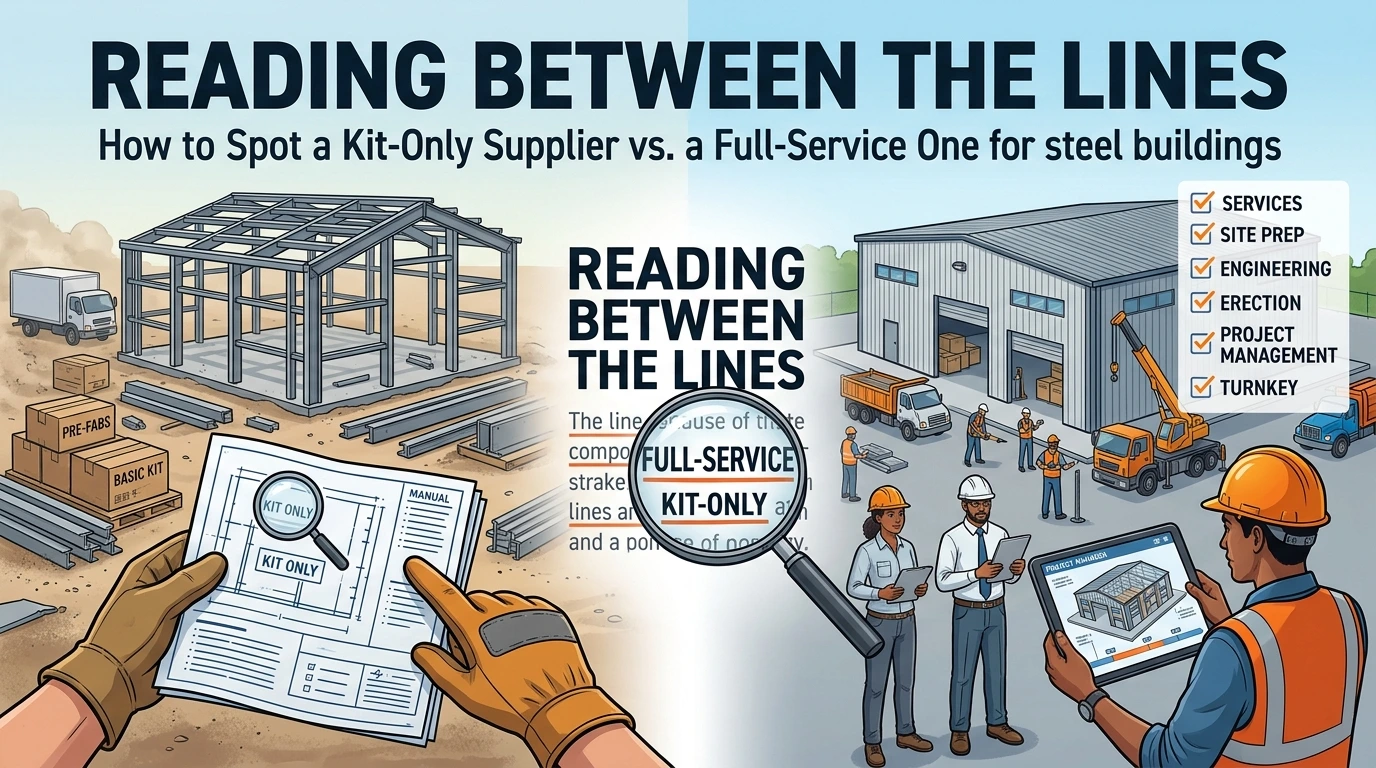
High-pressure sales tactics and an emphasis on discounts over technical specifications are warning signs when evaluating prefab building suppliers. A reliable supplier provides engineer-sealed drawings with every kit, clearly references applicable load data for the buyer’s region, and can document fabrication quality to recognized Canadian standards.
Industry professionals recommend confirming whether framed openings, engineer-sealed anchor bolt plans, and regional load data are included in a package before signing any purchase agreement.
With provincial adoption of the NBC 2025 rolling out over the coming years, buyers planning a project in 2026 and beyond should confirm with their local authority which edition of the building code governs their permit application before the engineering process begins.