
You have three tabs open. Three websites. Each one promises a “complete solution” for your steel building.
But here is the question none of them answers. When a crate of steel arrives at your property, who still answers the phone?
Nobody is necessarily lying. Most suppliers mean what they say. The trouble is what they leave out, because the quiet part rarely gets said out loud.
That gap can cost you weeks, money, and a lot of stress.
This guide shows you how to read between the lines. You’ll learn what a supplier’s words and silences really mean. Then you can tell which kind of company you’re dealing with before you spend hours on quotes.
Once you know who you’re dealing with, our guide on how to compare steel building quotes helps you check the numbers.
Quick Answer: Kit-Only vs. Full-Service Steel Building Suppliers
Quick answer: A kit-only supplier provides engineered building components and leaves site work and assembly to you or a separate contractor. A full-service supplier manages the whole project under one contract. Many Canadian suppliers sit in between. Neither model is wrong, but the wording suppliers use often hides which one you’re dealing with.
Why “Complete” Doesn’t Mean the Same Thing Everywhere
Here is the problem in one sentence. The same phrase on two websites can describe two very different purchases.
One company says “complete building package” and means steel panels in a crate. Another says it and means a finished building on your land. Both sound honest. Neither is wrong. But the price, the workload, and the risk are not even close.
So let’s define the three models in plain words.
Model 1: Kit-Only
The supplier designs and ships the building components. That usually means steel framing, panels, fasteners, and drawings. You handle the rest. You, or a contractor you hire, prepare the site, pour the foundation, and assemble the building.
The supplier’s job ends at delivery. Support after that point varies a lot.
Model 2: Kit With an Installer Referral Network
The supplier ships the kit, just like Model 1. But it also keeps a list of installers who have worked with its products. It points you to them when you ask.
You still hire and pay the installer yourself. The supplier makes an introduction, not a promise.
Model 3: Full-Service
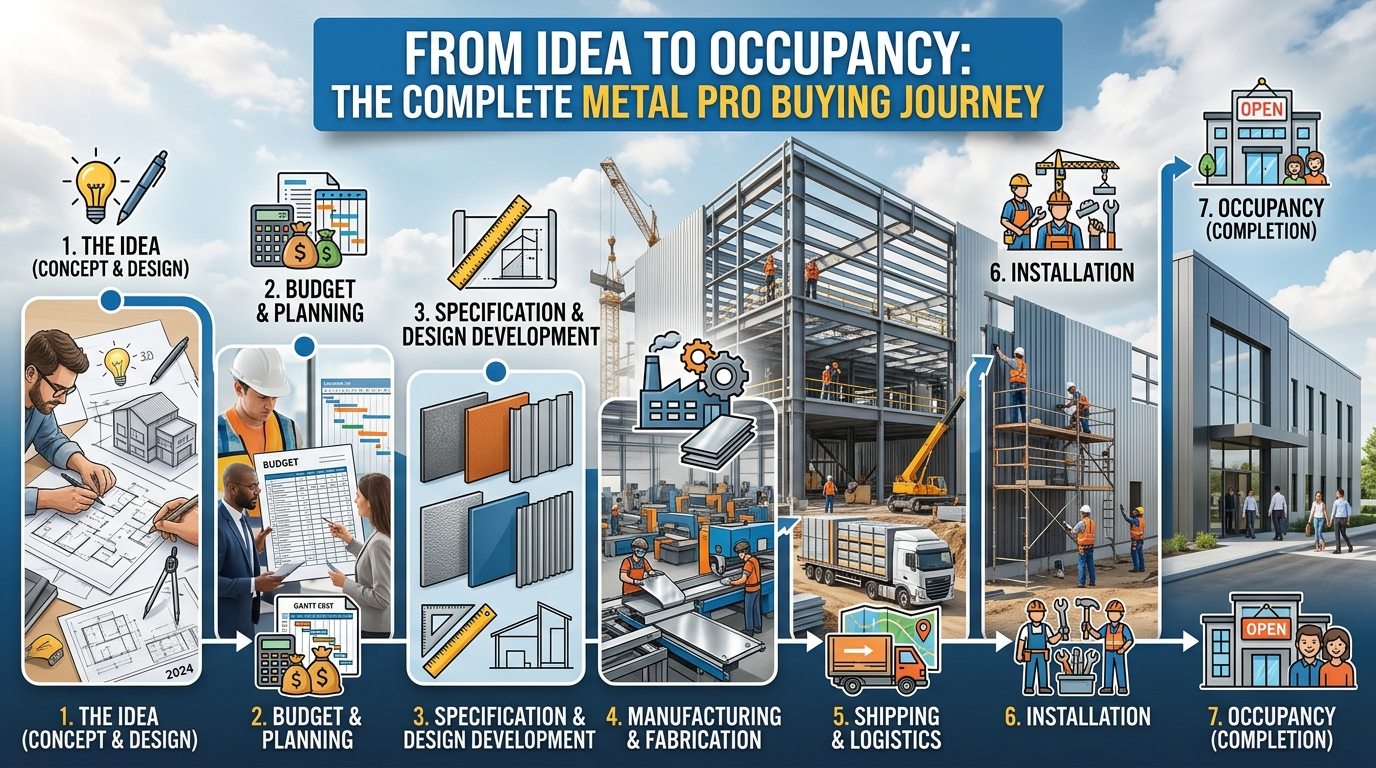
The supplier manages the whole project under one contract. That can include site prep, foundation, delivery, and assembly. One company answers for the result.
You get a more hands-off experience. In return, you usually pay more and have less say over timing and materials.
Where Metal Pro Sits
Metal Pro is a kit supplier with an installer referral network. We are not a general contractor. We supply engineered steel buildings and can connect you with installers who know our products. You contract with them directly.
If you want to weigh the do-it-yourself route against hiring a crew, read our DIY vs. installer comparison for the full details.
Reading Between the Lines, Layer by Layer
Every supplier tells you who they are. Most just don’t say it directly.
The clues are in five places. For each one, you’ll see what you might hear, what it may mean, and what to notice.
On the Website
What you’ll see: Words like “complete,” “turnkey,” and “all-inclusive.” Often, none of them are defined.
What it may mean: The company may be proud of its product and never thought to explain the edges of its service. Or the vagueness may be on purpose.
What to notice:
- Does any page say plainly what the company does not do?
- Do the photos show crews at work, or only finished buildings?
- Is there a page that explains who handles installation?
Crew photos suggest the company works on sites. Finished-building photos alone could mean anything. A customer may have built that building, or a contractor, or the supplier.
On the First Phone Call
What you’ll hear: Questions about your building. Or the lack of them.
What it may mean: A supplier that asks about your province, your site, and your timeline is thinking about the whole project. One that only asks for dimensions and colour is likely thinking about the product.
What to notice:
- Do they ask where the building will go?
- Do they ask when you need it?
- What happens when you ask, “Who installs this?”
Listen closely to that last one. A quick, clear answer is a good sign. A pause, a change of subject, or “we can help with that” deserves a follow-up question. Ask who, exactly, and under whose contract.
In What They Send Besides a Price
What you’ll receive: A quote, of course. But what else comes with it?
What it may mean: The extras show how much the supplier expects you to manage. Drawings, an assembly manual, and a clear scope of supply suggest a company that has thought about what happens after the sale. A bare price sheet suggests the opposite.
What to notice:
- Is there a written scope of supply that lists what’s included and excluded?
- Are drawings or an assembly manual part of the package?
- Is anyone named as your contact?
Engineering paperwork matters too. Our guide on engineering stamps and why they matter explains what to look for.
In the Words They Choose
What you’ll hear: Friendly, confident phrases that can mean very different things.
What it may mean: Marketing language is flexible. The same phrase can be perfectly honest from one company and misleading from another.
What to notice: Use the decoder below. For each phrase, it shows what it often means and what to ask.
The Language Decoder
| What they say | What it often means | Ask this |
| “Complete building package” | Often components only | “What would a crew still need to buy?” |
| “Turnkey” | May be one contract, or may be a referral | “Who signs my installation contract?” |
| “Installation available” | May mean a third party | “Is the installer your employee or independent?” |
| “We work with trusted installers” | A referral, not a guarantee | “Who is responsible if the schedule slips?” |
| “Delivered to your site” | May not include unloading | “Who unloads, and with what equipment?” |
| “Full support” | Undefined | “Who answers, by name, and for how long after delivery?” |
A fair note: The same words can be honest or misleading. The goal is to ask, not to assume the worst. A good supplier will answer these questions without fuss.
In What Happens After Delivery
What you’ll experience: The truck leaves. Then something goes wrong. A panel is dented. A box of fasteners is missing. A wall doesn’t line up.
What it may mean: This is where the model finally shows itself. A full-service company owns the problem. A kit-only supplier may help, but the fix is often yours to manage.
What to notice:
- Is there a named person to call?
- Is there a written process for missing or damaged parts?
- How long does support last?
Ask these questions before you buy. Afterward, the answers matter much more and are much harder to change.
How to Spot a Kit-Only Supplier
A kit-only supplier sells the building and steps back. That is a real business model, and it works well for many buyers.
Here are the signals to watch for.
Seven Signs You’re Dealing With a Kit-Only Supplier
- Installation is described as your job. You’ll see phrases like “easy to assemble” or “hire a local contractor.”
- Site work isn’t mentioned. Foundations, grading, and utilities are left out of the conversation.
- The quote talks only about product. Panels, framing, trims, and colours fill the page. Services don’t.
- No crews or project managers appear. Nobody on the team is described as being on site.
- Support ends at delivery. After the truck leaves, you’re on your own or on a general help line.
- No named post-sale contact exists. You get a main phone number, not a person.
- The scope of supply is short. It lists materials and little else.
One or two of these signs can appear at any supplier. When most of them show up together, you’re likely looking at a kit-only model.
This Model Is Fair, and It Suits Many Buyers
Kit-only is not a red flag on its own. It often gives you:
- A lower upfront price
- More control over who builds, and when
- The freedom to use a contractor you already trust
It fits confident DIYers well. It also fits buyers who already have a contractor lined up. If that’s you, a kit-only supplier may be the best value on the table.
The Real Risk: Kit-Only Plus Silence
Here is where trouble starts. The problem isn’t that a supplier is kit-only. The problem is when it never says so.
A buyer sees “complete package,” assumes installation is included, and finds out too late. By then, the deposit is paid and the schedule is slipping.
A kit-only supplier that is upfront is a good partner. A kit-only supplier that stays quiet is a risk.
So how do you recognize the other side of the coin? That’s next.
How to Spot a Full-Service Supplier
A full-service supplier does more than ship a building. It takes responsibility for getting that building built.
Here are the signals that point in that direction.
Seven Signs You’re Dealing With a Full-Service Supplier
- One contract covers supply and installation. You sign once, and one company answers for the result.
- A named project manager appears. You know who is running your job, and you can call them.
- Site visits are mentioned. Someone walks your land before the quote is final, or before work begins.
- The schedule has milestones. You see dates for permits, delivery, foundation, and assembly, not just “ready in 8 weeks.”
- Foundation scope is stated. The quote says who builds it, to what spec, and who coordinates the inspection.
- Crews are described as part of the team. You hear about the company’s own people, not just “partners.”
- They say “we” when talking about the build. “We’ll pour the slab” sounds very different from “you’ll need a slab.”
Again, one sign alone proves little. A cluster of them points to a full-service model.
What This Model Offers
Full-service gives you a more hands-off experience. Its main strengths are:
- Single-point accountability. When something goes wrong, you make one call.
- Less coordination. You don’t manage trades, deliveries, or timing between them.
- Fewer finger-pointing moments. Supplier and installer are the same company.
These benefits come with trade-offs:
- A higher total price. You’re paying for management and labour, not just materials.
- Less control. You may have less say over timing, crew choice, and materials.
- Less flexibility. Changes mid-project can be harder to negotiate.
For a busy buyer, those trade-offs may be well worth it. For a buyer with a tight budget and a trusted contractor, they may not be.
Don’t Take “Full-Service” at Face Value
Some companies use the phrase loosely. A website may say “full-service” while the installation is actually handled by an independent crew under a separate agreement.
Two questions cut through the noise:
- Who signs the installation contract? It should be the company you’re buying from, not a third party.
- Who carries liability if something goes wrong? Ask for the answer in writing.
If the supplier answers clearly and quickly, that’s a good sign. If it dodges, you may be looking at a referral model with full-service branding.
Now let’s put all three models side by side and see where accountability lands.
Kit-Only vs. Full-Service: Who’s Accountable When Something Goes Wrong?
It’s 4 p.m. on a Friday. The crew is on site. A wall panel doesn’t fit.
Who do you call? And will anyone pick up?
The answer depends on the model you chose. Here is how accountability usually breaks down across all three.
The Accountability Table
| When this happens | Kit-only | Kit + referral network | Full-service |
| Engineering and permit paperwork | Supplier provides drawings. You or your contractor handle permit applications. | Supplier provides drawings. You or your installer handle permit applications. | Supplier provides drawings and usually manages the permit process. |
| Delivery and unloading | Supplier ships to your address. You arrange unloading and equipment. | Same as kit-only. Your installer may help, but confirm it in writing. | Supplier coordinates delivery and unloading as part of the contract. |
| Foundation | You or your contractor build it to the supplier’s specs. | You or your installer build it. The supplier may advise on specs. | Supplier builds it or manages the crew that does. |
| Assembly | You or a contractor you hire. | An independent installer you hire and pay directly. | Supplier’s crew, or a crew under the supplier’s contract. |
| Missing or damaged parts | You report it to the supplier. Replacement is often straightforward, but any delay is yours to manage. | You report it to the supplier. Your installer may be waiting on site. | Supplier handles it and adjusts the schedule. |
| Warranty claim | You file it with the supplier. Check whether poor assembly voids coverage. | You file it with the supplier. Installer workmanship is covered separately, if at all. | One company handles both product and workmanship. |
| Schedule delays | Your responsibility, unless the delay is a late delivery. | Shared, and often unclear. Get dates in writing. | Supplier’s responsibility, as set out in the contract. |
Details vary by company and contract. Always confirm each row in writing.
What the Table Shows
Look at the middle column. It is where most confusion happens.
With a referral network, the supplier and installer are two separate companies. You hold two relationships and two sets of promises. If a delay happens, each side can point at the other.
That is not a flaw in the model. It just means you need to know where each responsibility lands before you sign.
The Takeaway
Accountability doesn’t disappear. It moves.
In a full-service deal, it moves to the supplier. In a kit-only deal, it moves to you. In a referral deal, it is split, and the split is only as clear as your paperwork.
Know where it lands. Then get it in writing.
What Silence Tells You
Most buyers listen to what a supplier says. Few listen to what it leaves out.
Silence is data. It won’t tell you everything. But it can point to the questions you most need to ask.
Four Silences Worth Noticing
- No mention of installation. The website and the quote both skip it. Either installation isn’t offered, or nobody wants to explain how it works.
- No mention of provincial codes. Building rules differ across Canada. A supplier that never brings up your province’s requirements may not be planning for them.
- No named contact. You get a general inbox or a main line. Nobody says, “Call me directly.”
- No mention of what the company doesn’t do. Every business has limits. A company that never names its own is either unaware of them or hoping you won’t ask.
Each of these is a small gap. Together, they can add up to a big surprise.
The Trust Test
Here is a rule of thumb I keep coming back to:
A supplier that tells you what it won’t do is usually one you can trust with what it will.
Think about it. Saying “we don’t install” or “we don’t handle permits” takes confidence. It costs the company a few sales. But it saves you from a bad assumption.
Plain talk about limits is often a sign of plain dealing everywhere else.
A Fair Note Before You Judge
Some silence is just poor writing. Many suppliers have tiny teams, old websites, and no copywriter. A missing detail may be an oversight, not a warning.
So don’t walk away at the first gap. Ask the question directly. Then watch how the supplier answers.
A clear reply in writing is a good sign. A vague one, or no reply at all, tells you what you needed to know.
Next, we’ll look at one phrase that deserves its own close reading: “We have installers.”
If They Say “We Have Installers”: How to Read That Too
Here is the pain point. “We have installers” sounds like a promise. Usually, it is an introduction.
A referral is not a guarantee. When you hire a recommended installer, you are hiring an independent contractor. That person works for themselves, not for the supplier.
That can work out well. But it means the vetting is your job. So let’s make it easy.
The Canadian Installer Checklist
Ask every installer these six questions before you sign anything.
- Is there a written contract and scope? It should list what’s included, what’s not, the price, and the payment terms.
- Do they carry liability insurance? Ask for a certificate of insurance, not just a promise.
- Is their workers’ compensation coverage in good standing? Each province has its own board. In Ontario, that’s WSIB. In British Columbia, it’s WorkSafeBC. In Alberta, it’s the WCB. Other provinces have their own.
- Can they give references from similar projects? Ask for buildings close to your size and type. Then call at least two.
- Have they built this specific kit before? Experience with steel buildings is good. Experience with your supplier’s system is better.
- Is there a written schedule? It should include a start date, a finish date, and what happens if weather or delays interfere.
Why does the workers’ compensation question matter so much? If an uninsured worker is hurt on your property, you could face serious costs. Many boards offer online clearance checks, so verifying takes only minutes.
A Quick Word on Liens and Holdbacks
Most provinces have lien and holdback rules. They affect how and when you pay contractors, and they protect both sides.
These rules vary by province and change over time. Always verify the current requirements with your province or municipality before you sign a contract or make a payment.
How This Applies to Metal Pro
We believe in applying the same standard to ourselves. Metal Pro’s referral installers have prior experience with Metal Pro buildings. But they are independent contractors.
You contract with them directly. You pay them directly. That means every item on this checklist applies to them too.
We encourage you to run it. A good installer will not mind.
Which Model Fits Your Life?
The right model depends less on the building and more on your life. Here are four common buyers and what tends to fit each one.
The Weekend Builder Racing the First Snowfall
You have a free Saturday, a few friends, and a deadline set by the weather. You’re handy and happy to learn.
What tends to fit: Kit-only, or a kit with an installer on call for the hard parts. Your time is the main cost, so protect it.
Confirm in writing:
- The exact delivery date, with a plan if it slips
- A complete parts list and a process for missing items
- Who you can call, by name, if you get stuck mid-build
For a deeper look at this route, see our guide to DIY vs. Full-Service Garage Kits.
The Farmer With a Harvest Deadline and No Spare Crew
Your hands are full from sunrise to sunset. You need the building up before harvest, and you can’t babysit a build.
What tends to fit: Full-service, or a referral installer with a firm written schedule. Reliable timing matters more than saving a few dollars.
Confirm in writing:
- Start and finish dates, plus what happens if weather interferes
- Who handles the foundation and who coordinates inspections
- Who unloads the delivery, and with what equipment
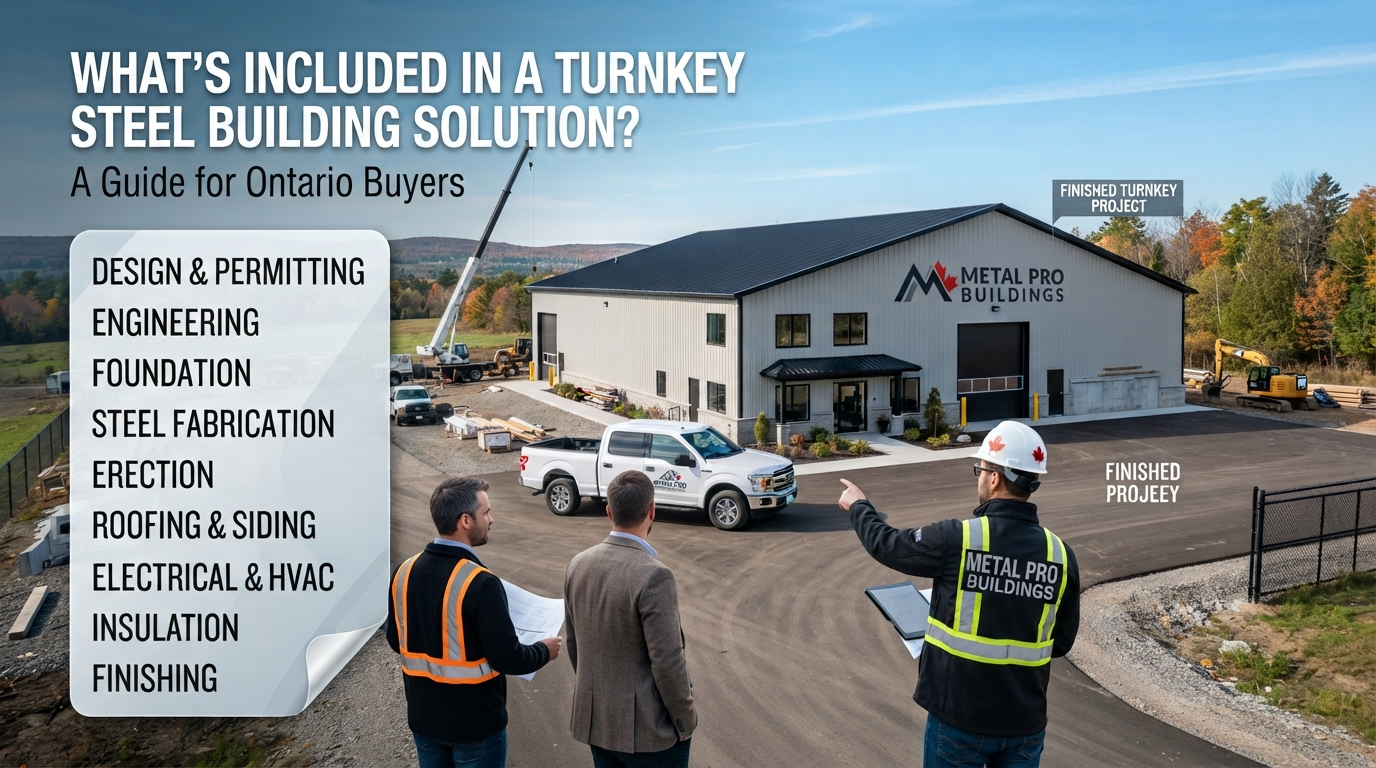
If you’re in Ontario, our Turnkey Steel Building Solution (Ontario) page explains what that service includes.
The Small-Business Owner Who Needs Revenue-Generating Space by a Date
Every week of delay costs you money. A shop, a storage unit, or a workspace has to be open on time.
What tends to fit: Full-service, because one company answers for the schedule. A kit with a referral network can work if the installer commits to dates in writing.
Confirm in writing:
- Milestone dates for permits, delivery, foundation, and assembly
- Who carries liability if the schedule slips
- Who manages permit applications
Not sure whether to build or buy? Our Build or Buy guide can help you weigh it.
The First-Time Buyer Who Wants a Garage and Doesn’t Know Where to Start
Everything feels new. You’re not sure what questions to ask, or which answers should worry you.
What tends to fit: Either a referral model or full-service. Both give you someone to guide you. Pure kit-only works if you already have a contractor you trust.
Confirm in writing:
- A clear scope of supply, listing what’s included and excluded
- Stamped drawings that meet your province’s requirements
- A named contact for questions before and after delivery
Start with the Language Decoder earlier in this guide. It will help you read every quote with confidence.
What a Trustworthy Kit Supplier Looks Like
Let’s reframe the whole question. The problem was never kit-only. The problem is kit-only with silence.
A kit supplier can be an excellent partner. What matters is how it behaves before you buy.
Five Traits of a Trustworthy Kit Supplier
- It says plainly what it doesn’t do. No installation, no permits, no site work? It tells you up front.
- It provides stamped drawings for your province. Engineering that meets local rules comes with the order, not as an afterthought.
- It gives you a named contact. You know who to call, and that person knows your project.
- It has a path to experienced installers. Even if you hire your own crew, a referral list can save you time.
- It answers your questions in writing. Clear emails and written scopes protect both sides.
If a supplier hits all five, you can buy with confidence, whatever the model.
Where Metal Pro Stands
Metal Pro is a kit supplier, not a general contractor. Our buildings use Canadian steel that meets CSA A660, and every order includes engineered drawings. We also keep a referral network of installers who know our products. Our steel carries a 50-year rust perforation warranty.
We say this plainly because it’s what we’d want to read ourselves. To see how we compare on the points in this guide, check our quote comparison guide.
Ask Us the Same Questions
Don’t take our word for it. Use the Language Decoder and the installer checklist on us, too.
Ask us the same questions. We’ll answer them in writing.
Frequently Asked Questions
The Bottom Line: Listen for What Isn’t Being Said
You are not only buying a building. You are buying the answer to one question: who stands behind it?
The best time to learn that answer is day one, before any money moves. Not on a Friday afternoon, with a crew waiting and a panel that won’t fit.
Here is the short version. The models differ. The wording hides the difference. Now you can hear it.
So use what you’ve learned. Read the website closely. Notice what the phone call skips. Run the Language Decoder on every quote. Ask for the answers in writing.
A good supplier will welcome every one of those questions.
Not Sure Which Model Fits Your Project?
Tell us your province, building size, and timeline. We’ll tell you plainly what we can do, what we can’t, and what a good installer referral looks like.
Request a quote or call us at (888) 296-6688