
You know you want a 30×30 steel garage. Now come the decisions that will quietly determine whether it serves you for decades or costs you thousands in regret.
Insulation R-value. Floor slab thickness. Two details. Baked in forever.
The internet gives conflicting advice. Contractors assume you’ll just trust them. Nobody explains how climate, soil, and intended use change everything.
This checklist fixes that. It gives you a clear framework to evaluate every insulation and slab decision so you walk into your build with confidence, not crossed fingers.
At Metal Pro Building, we’ve helped hundreds of owners get this right the first time. We’ve also seen what happens when these details get rushed. This article exists so that doesn’t happen to you.
Why a 30×30 Steel Garage Is a Serious Investment That Deserves Serious Planning
A 30×30 garage is 900 square feet. That’s not a shed. It’s a workspace, a vehicle shelter, and for many Canadians, a serious financial investment.
A well-built garage can return 60% to 80% of its cost in added home value Storage Sheds Outlet making it one of the smartest upgrades you can make to your property.
But two decisions are baked in forever: insulation R-value and floor slab thickness.
Get insulation wrong and you’re dealing with a garage that sweats in spring and freezes in winter. Get the slab wrong and you’re looking at frost heave, cracking, and water pooling that no epoxy coating can fix.
Both mistakes are expensive to live with and even more expensive to correct.
That’s why this checklist exists. So your garage performs the way you imagined it, not the way you settled for.
Part One: R-Value Insulation for Your 30×30 Steel Garage
Insulation for a steel garage isn’t as simple as picking a number off a chart.
Your local climate plays a significant role in determining the type of insulation needed and in Canada, higher R-values are essential to retain heat and prevent condensation.
Steel also creates a unique challenge called thermal bridging. Rigid foam board provides continuous insulation that helps reduce thermal bridging the transfer of heat through the steel frame.
A general contractor who “adds insulation” is not the same as a specialist who designs the system around your steel structure from the start.
We’ve already covered this topic in depth. If you want the full breakdown insulation types, Canadian R-value targets by province, vapor barrier placement, and cost comparisons our detailed guide has everything you need:
👉 Canada’s R-Value Insulation Chart: What You Must Know
Use that guide to select your specs. Then come back here and check them off:
Your insulation checklist:
- ☐ Climate zone identified for your province
- ☐ Conditioned vs. unconditioned use decided
- ☐ Wall R-value specified to regional requirements
- ☐ Ceiling/roof R-value specified separately
- ☐ Insulation type selected for each component
- ☐ Vapor barrier placement confirmed
- ☐ Garage door R-value evaluated
- ☐ Thermal bridging at steel framing addressed
- ☐ All specs documented in writing before signing
Part Two: The Floor Slab Thickness Checklist for Your 30×30 Steel Garage
Your floor is the one part of your garage you interact with every single day. It’s also the one part you can never easily fix after the fact.
Getting the slab wrong means cracking under vehicle loads, frost heave from Canada’s brutal freeze-thaw cycles, and water pooling that no epoxy coating will solve.
Here’s how to get it right.
Checklist Item #1 : Match Slab Thickness to Your Loads
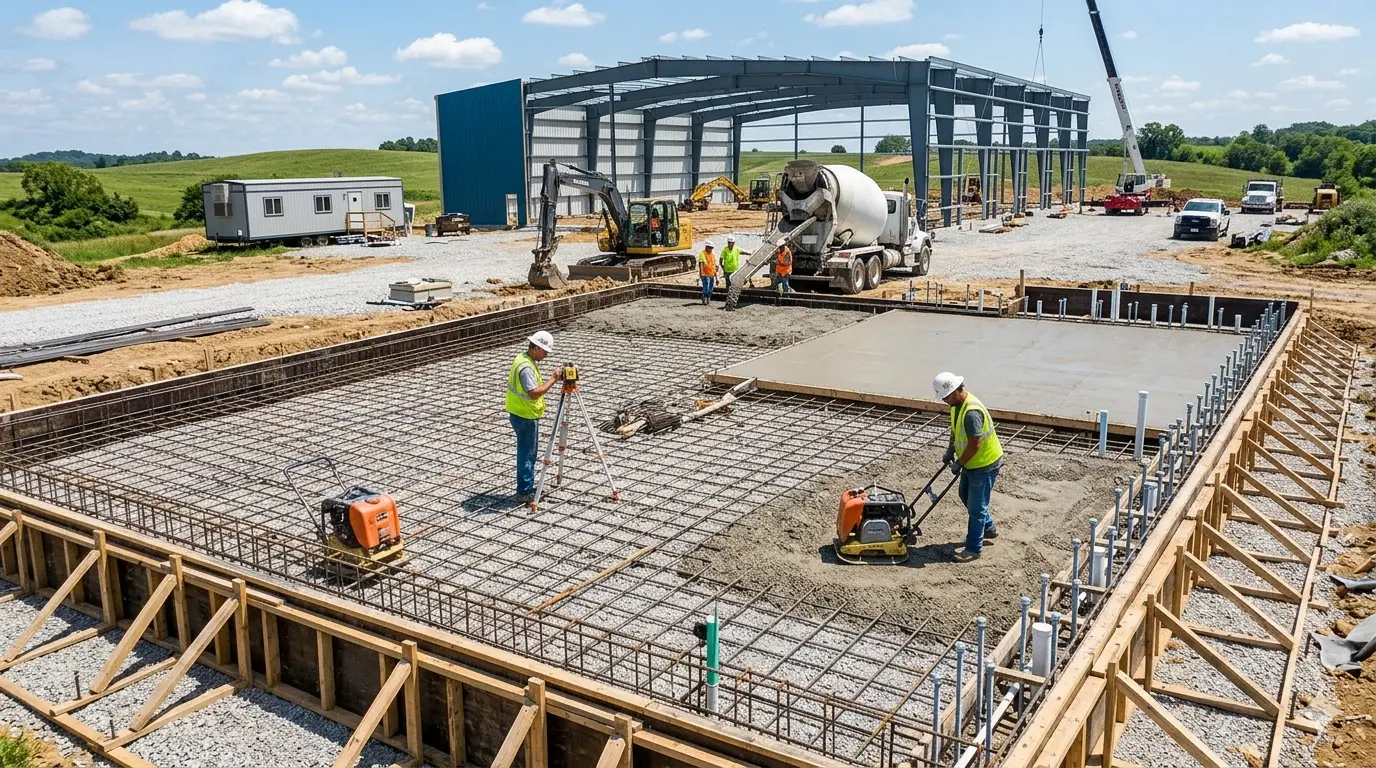
The standard slab thickness is 4 inches for light cars or trucks. For larger vehicles and heavy equipment, you need at least 6 inches. For constant heavy traffic, go 6 to 8 inches commercial spec.
A 30×30 garage built for an RV, a pickup truck with a hoist, or a work vehicle is not a standard build. Don’t let anyone spec it like one.
| Use Type | Minimum Slab Thickness |
| Passenger vehicles / storage | 4 inches |
| Trucks / SUVs / workshops | 5–6 inches |
| RVs / heavy equipment / lifts | 6–8 inches |
Checklist Item #2 : Know Your Soil and Frost Depth
In Canada, frost depth is non-negotiable. In Calgary, minimum footing depth is 4 feet and in Kelowna, at least 2 feet unless an engineer approves a shallower frost-protected design.
Clay soil is a particular risk. It expands and contracts with moisture, making it far more vulnerable to frost heave than sandy or well-draining ground. If your site has clay, a soil test isn’t optional, it’s essential.
A compacted gravel sub-base is the unsung hero of slab longevity. In Montreal, builders remove all organic material, excavate to undisturbed soil, and lay 18 inches of compacted gravel before pouring with thickened edges and doubled rebar at the perimeter. Your sub-base is doing as much work as the concrete itself.
Checklist Item #3 : Specify Your Reinforcement and Concrete Grade
In Canada, garage floors exposed to freeze-thaw cycles and de-icing salts require a minimum concrete strength of 32 MPa (about 4,600 PSI) with air entrainment of 5 to 8 percent.This is classified as C-2 exposure under the Ontario Building Code and CSA standards and it applies across most Canadian provinces.
Rebar is your best reinforcement for heavy loads. Standard rebar spacing is 24 inches on centre but tighter spacing of 12 to 18 inches results in fewer cracks under heavy or dynamic loads.
Don’t forget control joints. Control joints are cut 24 to 48 hours after pouring and spaced at 2 to 3 times the slab thickness in feet; they direct cracking to predetermined lines instead of letting it run randomly across your floor.
Checklist Item #4 : Don’t Accept “Standard Slab” as an Answer
Any builder who quotes a slab without asking about your use case, soil conditions, or frost depth isn’t protecting you, they’re protecting their margin.
At Metal Pro Building, every slab spec is scoped to your actual build. We ask the questions your concrete contractor probably won’t.
Your slab checklist:
- ☐ Load type assessed and slab thickness specified
- ☐ Soil conditions evaluated (test if clay suspected)
- ☐ Frost depth for your region confirmed
- ☐ Compacted gravel sub-base specified
- ☐ Vapor barrier under slab included
- ☐ Reinforcement type and spacing confirmed in writing
- ☐ Concrete strength minimum 32 MPa (C-2 exposure)
- ☐ Control joint spacing planned
- ☐ All specs documented before signing
How Insulation and Your Slab Work Together
Most people treat insulation and the slab as two separate decisions. They’re not.
Concrete has high thermal mass. It absorbs and releases heat slowly, helping maintain stable temperatures inside your garage.But that only works when your slab is properly insulated below and kept inside the building’s thermal envelope.
Without it, your concrete drains heat straight into the frozen ground and no amount of wall insulation makes up for that.
Moisture connects the two systems as well. Your under-slab vapor barrier and wall vapor barrier need to work together as one continuous system, not two unrelated details decided by two different contractors.
At Metal Pro Building, we spec insulation and slab together from day one so nothing falls through the cracks.
Your Complete 30×30 Garage Design Checklist
Use this as your final reference before signing anything. If a builder can’t confirm every item below that’s a red flag worth acting on.
Insulation Checklist:
- ☐ Climate zone identified for your province
- ☐ Conditioned vs. unconditioned use decided
- ☐ Wall R-value specified to regional requirements
- ☐ Ceiling/roof R-value specified separately from walls
- ☐ Insulation type selected for each component
- ☐ Vapor barrier placement confirmed
- ☐ Garage door R-value evaluated
- ☐ Thermal bridging at steel framing addressed
- ☐ All specs documented in writing before signing
Slab Checklist:
- ☐ Primary and future use loads assessed
- ☐ Slab thickness specified (4″ min; 5–6″ for heavy loads)
- ☐ Soil conditions evaluated test if clay suspected
- ☐ Frost depth confirmed for your region
- ☐ Compacted gravel sub-base specified
- ☐ Vapor barrier under slab included
- ☐ Reinforcement type and spacing confirmed in writing
- ☐ Concrete strength minimum 30 MPa for Canadian conditions
- ☐ Control joints planned before pour
What Separates a Good 30×30 Garage From One You’ll Regret
There’s a real difference between a garage that was built and one that was designed.
A built garage checks the boxes. A designed garage performs every Canadian winter, every heavy load, every year after year.
Most homeowners can’t spot the difference at first. But over time, the quality of materials and craftsmanship becomes impossible to ignore cracking concrete, water leaks, condensation, and a workspace that fights you instead of serving you.
The checklist above costs you nothing to use. The mistakes it prevents could cost you tens of thousands.
A garage that’s warm in January, dry in spring, and solid underfoot year-round isn’t luck. It’s the result of two details: insulation and slab being done right before the first bolt is ever set.
How Metal Pro Building Handles This For You
You don’t have to figure all of this out alone.
Metal Pro Buildings has been helping Canadians build smarter since 2016 backed by over 30 years of experience and a leadership team with decades of combined expertise.
Every consultation starts with your vision. A building specialist walks through size, location, accessories, and requirements then delivers a tailored quote with all the details spelled out.No vague language. No surprises.
Every Metal Pro garage is built with 100% AZ180 Galvalume Plus steel, ships free anywhere in Canada, and comes backed by a 50-year rust perforation warranty.
When you request a quote, we ask the questions most contractors won’t about your loads, your soil, your climate, and how you plan to use the space. That’s how every item on this checklist gets addressed before a single bolt is set.
Ready to build it right? 👉 Get your free 30×30 garage design consultation today and let’s walk through this checklist together.