
Canada’s costliest natural disaster year on record has emergency managers, municipalities, and first responders across the country fast-tracking procurement of emergency response metal buildings , pre-engineered steel structures that can be erected in days to serve as evacuation shelters, field hospitals, and command centres when conventional construction cannot keep pace with a crisis.
In 2024, for the first time in Canadian history, insured damage caused by severe weather surpassed $8 billion, according to Catastrophe Indices and Quantification Inc. (CatIQ) , nearly triple the total recorded in 2023, and 12 times the annual average of $701 million in the decade between 2001 and 2010. That figure is reshaping how provincial and municipal emergency planners think about deployable infrastructure.
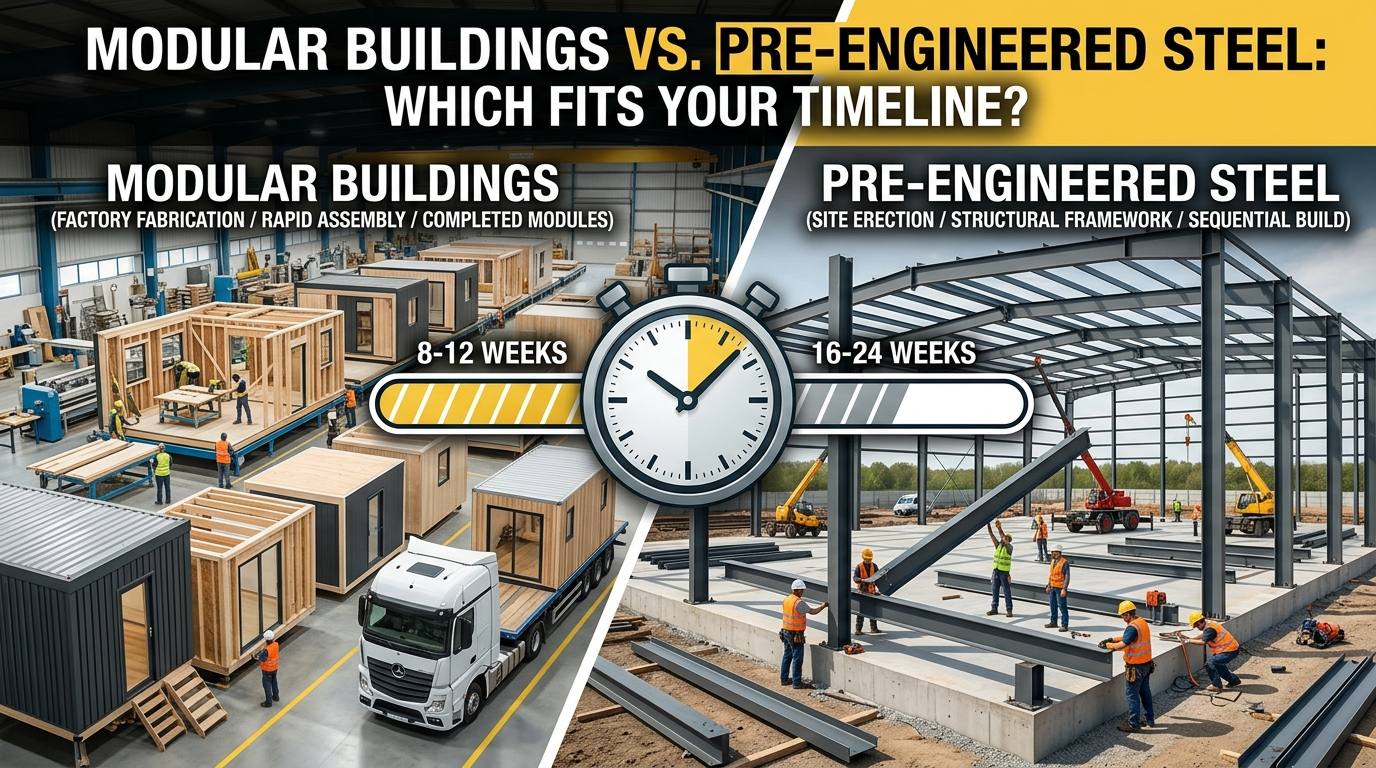
Steel structures have emerged as a leading solution because they can be prefabricated off-site, shipped flat-packed, and erected by small crews in days rather than the months required for poured-concrete or wood-frame alternatives. Across British Columbia, Alberta, and Ontario provinces that absorbed the heaviest disaster losses in 2024 contractors report rising demand for pre-engineered metal buildings configured as evacuation shelters, emergency supply depots, and temporary medical staging areas.
“Pre-engineered steel is the closest thing Canada has to a ready-to-deploy infrastructure solution,” said Herbert Broderick, CEO of Metal Pro Buildings , Ontario. “When a wildfire moves at 60 kilometres an hour, you cannot wait six months for a contractor to frame and pour a conventional building. A pre-engineered kit can be on a flatbed and on site within days.”
Disasters including the Lytton wildfire in 2021, Hurricane Fiona in 2022, the Northwest Territories wildfires in 2023, and the intense wildfire seasons of 2024 and 2025 have underscored how challenging recovery can be and how planning before a disaster strikes can help communities rebuild faster and get businesses back up and running sooner. Those lessons are now reshaping procurement decisions at both the provincial and federal levels.
Emergency response metal buildings deployed in Canadian operations typically span 150 to 1,500 square metres and are configured as single clear-span interiors eliminating interior columns and maximising usable floor space for cots, equipment, or vehicles. Insulated steel panel systems rated for Canada’s cold climates allow year-round habitation, a critical requirement in northern Ontario, the Prairies, and B.C.’s interior, where nighttime temperatures can fall well below –20°C even in spring and autumn.
Structural compliance is equally non-negotiable. The National Building Code of Canada 2020 sets benchmarks for snow loads, wind uplift, and seismic resistance; reputable pre-engineered steel systems are engineered to meet or exceed those provincial variants. Under the NBC 2020, steel framing is also classified as non-combustible construction, a distinct advantage when local fire codes require structures near active wildfire zones to resist ignition.
“NBC 2020 compliance is the baseline, but the non-combustible classification is what gives municipal procurement officers confidence,” Broderick said. “It also affects insurance underwriting and Federal Disaster Financial Assistance eligibility, which matters when a community is processing a disaster declaration and needs to get a structure approved fast.”
Ottawa has signalled its own commitment to the sector: the federal Government Operations Centre recently opened a new facility designed to manage multiple full-scale emergency situations simultaneously, and Budget 2025 included further investments to strengthen the Canadian emergency management system.
Between 2016 and 2025, annual insured losses from catastrophic weather and wildfires totalled $37 billion nearly tripling the previous decade with the average number of claims almost doubling over the same period, according to the Insurance Bureau of Canada. Industry analysts say that financial pressure, combined with a widening infrastructure gap in rural and remote communities, is driving demand for relocatable steel structures that can serve emergency functions first and then be repurposed for storage, community use, or municipal operations once a crisis subsides.
Buyers and emergency planners should monitor updates to provincial adoptions of the NBC 2020, particularly amendments addressing temporary and relocatable structures. Several provinces are expected to issue revised guidance that would clarify permitting pathways and occupancy classifications for emergency-use metal buildings changes that could significantly reduce deployment timelines in future responses.