
Have you ever looked at your industrial roof and seen a massive, missed opportunity? In 2026, a “perfect storm” of high taxes and high tech is changing everything. For years, a roof was just a cost. Today, it is a power plant.
Most Canadian business owners struggle with rising energy costs. You might feel the sting of the federal carbon tax every single month. It feels like money is just flying off your property. You need a way to stop the bleeding and start building equity.
This article shows you why Single Slope Steel buildings are the secret weapon for 2026. You will learn how to stack government tax credits. We will show you how to turn a 30-year expense into a 5-year payback. You are about to see how Canadian winters can actually help your bottom line.
Engineering for the North: Why Single Slope Wins in Canada
In the Great White North, the sun stays low in the sky for months. Most commercial buildings have flat roofs. This is a mistake for solar. Flat roofs let snow pile up and block your panels.
The “Winter Angle” Advantage
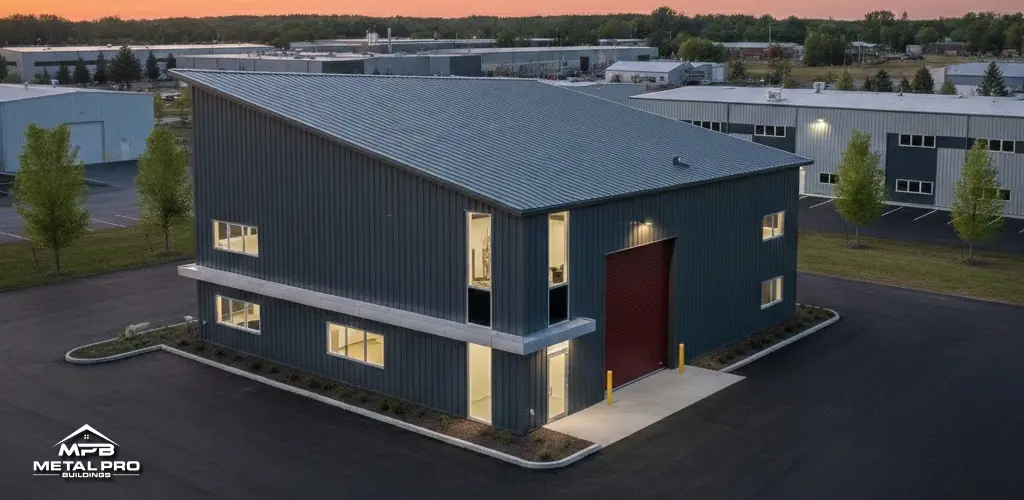
Single-slope buildings are different. You can design the roof with a steep pitch, often between 35° and 45°. This angle is the “sweet spot” for Canadian winters. It points your panels directly at the low winter sun. While your neighbors’ flat panels are dormant under snow, yours are soaking up every ray.
Passive Snow Management
Snow is the enemy of solar ROI. On a single-slope steel roof, gravity is your best friend. The steep, slick surface of the steel allows snow to slide off naturally. You don’t need to pay someone to shovel the roof. This “passive” clearing keeps your modules producing power while others stay dark.
Material Synergy
Steel and solar are a perfect match. Steel doesn’t crack in a -40°C freeze. It also won’t warp in a +30°C summer heatwave. Most importantly, you can use “standing seam” metal roofs. These allow you to clamp solar panels directly to the roof. You won’t have to drill a single hole, which means zero leaks for decades.
The “Financial Triple Threat”: Stacking Canadian Incentives
In 2026, building a solar-ready steel structure isn’t just an engineering choice; it’s a tax strategy. By combining three major federal incentives, you can effectively have the government pay for a massive chunk of your project.
The 30% Clean Technology ITC
The Clean Technology Investment Tax Credit (ITC) is a refundable credit. This means if the credit is worth more than the taxes you owe, the government sends you a cheque for the difference.
- The Bonus: To get the full 30%, you must meet new labor requirements. This includes paying “prevailing wages” and using registered apprentices for at least 10% of the work hours.
- The Safety Net: Even if you choose not to meet these labor rules, you still qualify for a 20% credit.
Accelerated CCA (Class 43.1 & 43.2)
Normally, you write off a building over decades. However, solar equipment falls under Class 43.1. Thanks to recent “Productivity Super-Deduction” rules, equipment that becomes available for use in 2026 qualifies for immediate expensing. You can write off up to 100% of the eligible cost in the very first year. This can wipe out your taxable income and recoup nearly half your project cost in one tax cycle.
Avoiding the Carbon Levy
The federal carbon price is not slowing down. In 2026, the price hits $110 per tonne. It is scheduled to climb to $170 by 2030. Every kilowatt-hour you generate on your own roof is a kilowatt-hour you don’t pay carbon tax on. For a medium-sized industrial site, this “avoided cost” can save tens of thousands of dollars over the system’s life.
Maximizing Yield: The “Albedo Effect” on Steel
In 2026, the best solar panels do not just look at the sun. They also look at your roof. This is possible because of Bifacial TOPCon modules. These panels have glass on both sides. They catch direct sunlight on the front and reflected light on the back.
The Power of Reflection
“Albedo” is a term for how much light a surface reflects. A dark roof absorbs heat and wastes light. But a “Cool White” steel roof acts like a giant mirror. These roofs can reflect up to 80% of the sun’s rays. This extra light bounces off the steel and hits the back of your panels. This turns your entire roof into a massive energy booster.
Winter Gains from Snow
Canadian winters actually help this process. Fresh snow has one of the highest reflectivity rates on Earth. When snow covers the ground around your building, it reflects even more light upward. Research shows that this “snow boost” can increase your energy output by 15% to 19%. While others see snow as a problem, single-slope steel owners see it as a way to generate more power.
Regional ROI Playbook: Alberta vs. Ontario
The location of your single-slope steel building determines your specific strategy. While the federal tax credits are the same across Canada, provincial energy markets work very differently.
Alberta’s Energy Arbitrage
Alberta is the “Wild West” of solar ROI. It has the best sunlight in Canada and a unique deregulated market.
- The Solar Club: You can switch between two electricity rates. In the summer (March–October), you sell your excess power for about 33¢/kWh. In the winter, you switch to a low rate of about 7¢/kWh to buy cheap grid power.
- Energy Arbitrage: This “buy low, sell high” model can cut your payback time by years.
Ontario’s Efficiency Incentives
Ontario focuses on “behind-the-meter” savings and direct grants.
- Save on Energy Retrofit Program: In 2026, mid-sized businesses can receive a prescriptive rebate of $860 per kW of installed capacity. For a 200kW system, that is a direct injection of $172,000 back into your pocket.
- Ultra-Low Overnight (ULO) Rates: Ontario business owners can use solar to avoid peak daytime rates that can reach 39¢/kWh, significantly lowering operational costs.
Municipal Financing (CEIP)
Don’t want to use your own cash? The Clean Energy Improvement Program (CEIP) is available in cities like Edmonton, Calgary, and Ottawa. You can finance up to 100% of the project costs through your property taxes. The loan is tied to the building, not the owner. If you sell the property, the loan (and the energy savings) stay with the new owner.
Estimated Payback Period by Province (200kW System)
| Feature | Alberta (AB) | Ontario (ON) | British Columbia (BC) |
| Annual Sun Hours | 2,300 – 2,600 | 2,000 – 2,200 | 1,900 – 2,100 |
| Primary Incentive | Solar Club (33¢/kWh) | $860/kW Grant | BC Hydro Rebates |
| Est. Payback Period | 5 – 7 Years | 8 – 10 Years | 12 – 15 Years |
| ROI over 25 Years | Very High | High | Moderate |
2026 Procurement: Beating the “Grid Congestion”
In 2026, the biggest challenge isn’t just buying the hardware—it’s getting permission to plug it in. As Canada electrifies everything from delivery fleets to heating, provincial grids are reaching capacity. To maximize your ROI, your timing must be precise.
The Interconnection Hurdle
Utilities like the IESO (Ontario) and BC Hydro are seeing a surge in applications. Getting a “System Impact Study” is your most critical 2026 milestone. These studies can take 6 to 12 months. If you wait until your building is standing to apply, your solar panels might sit idle for a year. Start the paperwork the moment you finalize your building design.
Why Metal Pro™ Buildings Simplify the Timeline
Choosing a Canadian partner is the best way to avoid supply chain bottlenecks. Metal Pro™ Buildings provides 100% Canadian-manufactured steel. Because our structures are pre-engineered, they integrate seamlessly with solar layouts from day one.
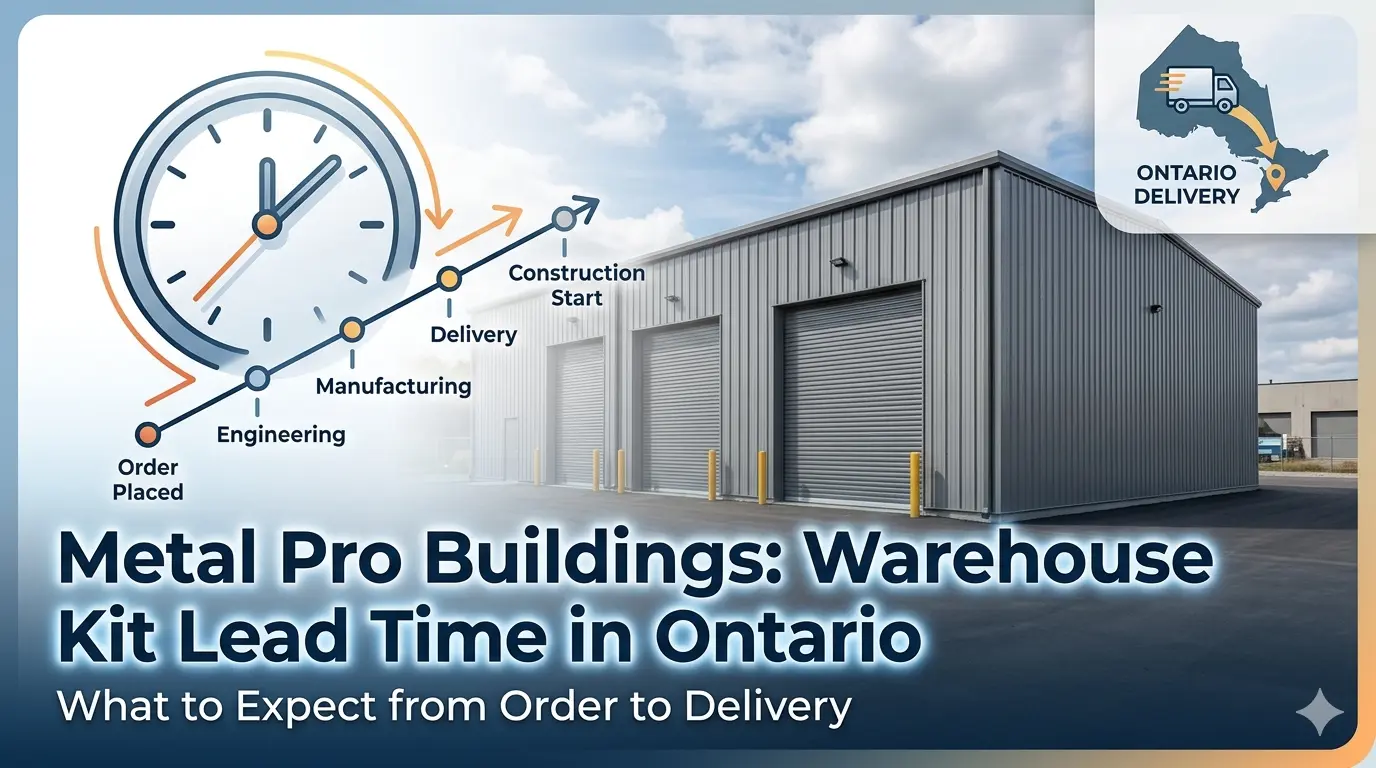
- Reliable Lead Times: While overseas steel can face months of port delays, Metal Pro™ kits typically move from design to delivery in 8 to 16 weeks.
- Engineered for Solar: We design specifically for the extra “dead load” of solar panels and the “live load” of Canadian snow. This means you won’t need expensive structural reinforcements later.
The “Safe Harbor” Strategy
To secure the full 30% ITC, your system needs to be operational or “available for use” by year-end. By coordinating your Metal Pro™ Building delivery with your solar module arrival, you can hit your 2026 tax milestones with confidence. Don’t let a missing component drop your tax credit from 30% to 20% in the following years.
Conclusion: Building for 2030 and Beyond
The year 2026 is a turning point. A roof is no longer just a cost. With single-slope steel, it becomes a high-yield revenue generator. You are shifting from an energy consumer to an energy producer.
By 2030, the carbon tax will hit $170 per tonne. Building now locks in your energy costs and protects your bottom line. 2026 is the “sweet spot” to secure the full 30% ITC and the best grid spots.
Don’t wait for your competitors to act first. The incentives are peak, and the technology is ready. Turn your building into a power plant today.
Ready to Turn Your Roof Into a Revenue Stream?
Don’t let your property remain a passive expense while energy costs and carbon taxes rise. 2026 is the year to leverage the “perfect storm” of high incentives and advanced steel engineering.
At Metal Pro™ Buildings, we specialize in solar-ready, 100% Canadian-manufactured steel structures designed to maximize your ROI from day one. Whether you are in the sun-drenched fields of Alberta or the industrial hubs of Ontario, our team is ready to help you build for the future.
Take the first step toward energy independence:
- Get a Free Quote: Tell us about your project, and we’ll design a single-slope solution tailored for solar.