
Picture this: It’s late May. The ground finally thawed two weeks ago. You’re ready to break ground on your steel building but your permit still hasn’t come through. Your concrete crew is booked until August. And your steel kit? It has a 14-week lead time you didn’t account for.
Now you’re staring down another lost summer.
This scenario plays out across Canada every single year. And it’s not because builders are careless, it’s because Canadian construction has a rhythm that most online guides completely ignore. Those guides were written for Phoenix and Atlanta, not Winnipeg and Red Deer.
You’re not overthinking this. Timing genuinely makes or breaks a steel building project in Canada.
At Metal Pro Buildings, we’ve guided hundreds of Canadian clients through exactly this process. This article gives you an honest, season-by-season breakdown so you can plan with confidence and build without regret.
Why Construction Timing Hits Differently in Canada
Most construction guides you’ll find online were written with American projects in mind. Canada is a different animal entirely and if you’re planning a steel building here, that difference matters enormously.
Start with the ground beneath your feet. Frost depth varies widely across Canada and can vary within the same province depending on climate, elevation, exposure, snow cover, and soil moisture.
In Calgary, the frost line sits roughly 5–6 feet deep. In coastal BC, it may be a fraction of that. Northern Ontario and Prairie regions face deeper frost penetration due to sustained cold and reduced snow insulation, while coastal regions may see variable frost effects depending on moisture levels and freeze-thaw cycles.
This isn’t just trivia. Steel buildings rely on exact geometry to distribute loads correctly; their advantages of precision and efficiency also make them less tolerant of differential settlement.Getting the foundation depth wrong doesn’t just delay your project. It can compromise the entire structure.
Then there’s the permit reality. Metal building permits in Canada commonly take 4–8 weeks or more for complex plans and that’s when everything goes smoothly. Larger commercial or industrial projects in busy municipalities can stretch to 12–16 weeks. In less populous provinces and territories, harsh winters mean construction activities are concentrated in the warmer summer months , creating intense competition for crews, equipment, and inspectors all at once.
The Full Steel Building Construction Timeline at a Glance
Before diving into the season-by-season detail, it helps to see the whole picture at once. Here’s how a typical Canadian steel building project breaks down from idea to move-in:
| Phase | Typical Duration | Best Started |
| Planning & Design | 4–8 weeks | Any season |
| Permits & Approvals | 6–16 weeks | Fall/Winter |
| Site Prep & Grading | 1–3 weeks | Spring/Summer |
| Foundation Work | 2–4 weeks | Late Spring–Early Fall |
| Steel Erection | 1–4 weeks | Spring–Fall |
| Interior Finishing | Varies | Year-round (enclosed) |
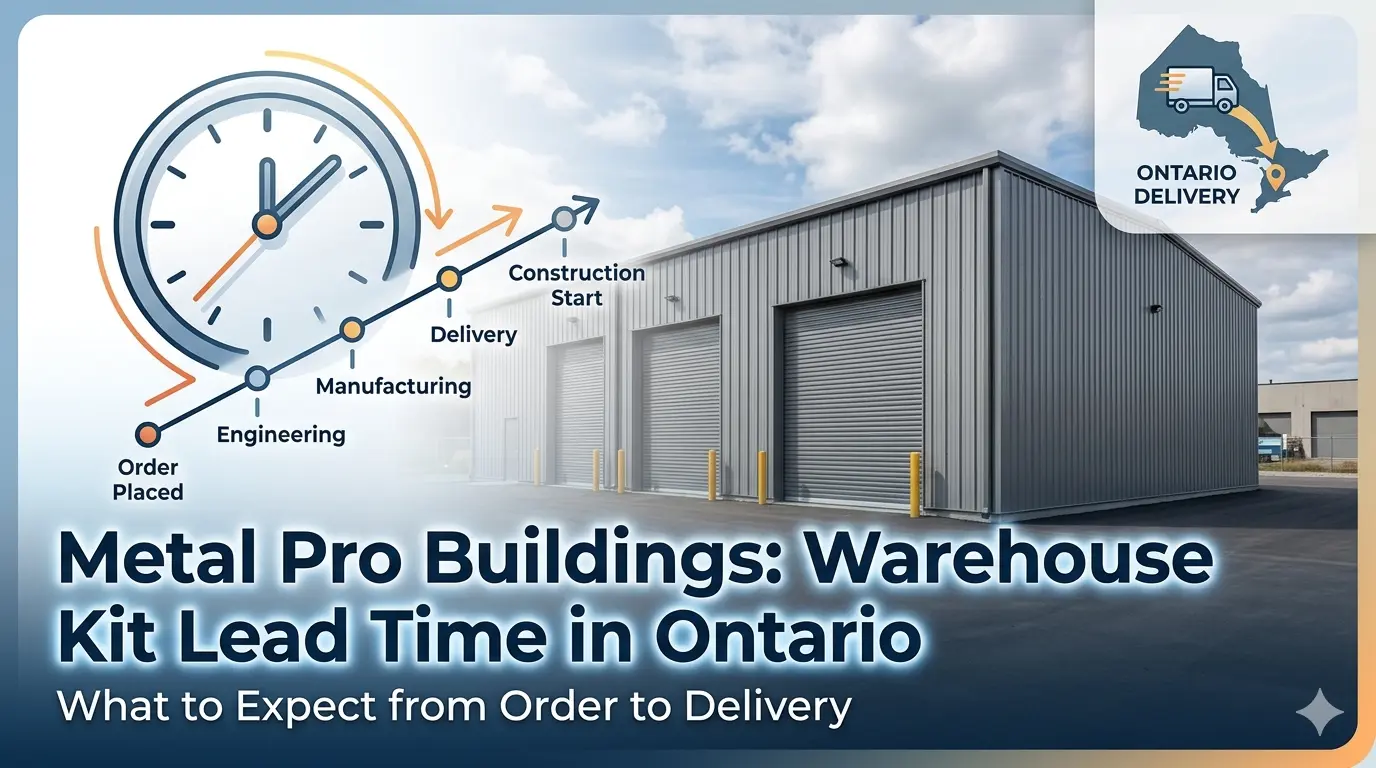
A few things stand out in that table. First, lead time officially begins after steel building engineering approval is completed and drawings are finalized not at contract signing.Many first-time buyers lose weeks assuming fabrication starts the moment a deposit lands. It doesn’t.
Second, most Canadian steel building projects fall within 6 to 14 weeks for delivery after drawings are approved and that’s before a single piece of steel touches your site.
Add it all up and you’re looking at a minimum of 4–6 months from first conversation to enclosed building. More realistically, 6–9 months for a well-planned project.
Every project is different. These windows reflect Canadian climate realities, not just logistics.
Season-by-Season Breakdown — What to Do (and When)
This is the section that actually earns your build season. Most Canadian builders skip these steps entirely then wonder why they’re stalling in July.
Fall (September–November): The Season Most Canadians Underestimate
“I missed summer — is it too late to do anything this year?”
Fall feels like the end. It isn’t.
In reality, fall is the single most important season for a successful Canadian steel building project and it’s almost entirely invisible work. Nothing gets built in the ground. Everything gets built in the plan.
What to do in Fall:
- Finalize your building design and engineering drawings. This is the moment to get specific about size, use, door placement, insulation needs, and site orientation. Design changes after fabrication begins reset your entire lead time.
- Submit your permit applications. Winter typically provides the fastest processing windows; municipal reviewers face lower submission volumes and fewer backlogs compared to spring and summer peaks. If you’re hoping to break ground in mid-April, you’ll want to submit your plans by the end of the previous year. Fall submissions put you ahead of the rush.
- Order your steel building kit. Most Canadian steel buildings fall within 6 to 14 weeks for delivery after drawing approval and that’s after engineering sign-off, not after you place a call. A fall order means a spring delivery. An April order means you’re gambling.
- Complete site surveys and geotechnical assessments. Spring through early fall is the ideal window for site investigation, when the ground is dry and temperatures are moderate.Once frost sets in, meaningful soil testing becomes difficult or impossible. A geotechnical investigation provides critical data on soil composition, strength, moisture behaviour, and frost susceptibility findings that directly support accurate foundation design and help reduce revisions during permit review.
At Metal Pro Buildings, our team helps clients use fall strategically. Most people who build on time in June started planning in October. Fall isn’t the end of your build season. It’s the beginning of your next one
Winter (December–February): Don’t Go Dormant — Go Administrative
“I feel like I’m losing months and falling behind.”
You’re not losing time. You’re building leverage.
Winter is the invisible engine of a successful spring build. Every hour spent sorting financing, finalizing plans, and locking in contractors in January is a week you won’t lose scrambling in April.
What to do in Winter:
- Finalize financing and contracts. Lenders need time. Paperwork takes longer than expected. Get this done before the snow melts.
- Review and revise building plans with your supplier. This is the right time for back-and-forth not after fabrication starts.
- Confirm permit status and follow up with your municipality. Don’t assume. Applications get stalled for minor documentation reasons. A proactive email or call can move things forward fast.
- Research foundation types suited to your soil and frost conditions. Frost depth varies widely across Canada even neighbouring sites can experience different frost behaviour due to grading, drainage, and snow management. Understanding this before spring means your foundation engineer isn’t starting from scratch in March.
- Lock in your contractor and subcontractors now. This is non-negotiable.
⚠️ The Spring Rush Is Real. Come January, many homeowners and builders start booking contractors for spring and if you wait to start your planning, you’ll be behind hundreds of other projects in the municipal and contractor queue.Concrete crews, equipment rentals, and erection teams are booked solid by March in most provinces. If you haven’t secured your crew by February, you’re already competing for second-choice availability.
At Metal Pro Buildings, we work with clients through winter to make sure everything is signed, stamped, and ready to move the moment the ground thaws.
Spring (March–May): Your Execution Window Opens — Don’t Miss It
“I’m worried about frost heave ruining my foundation.”
The ground thaws. The clock starts. And suddenly everyone wants the same crews, the same concrete, and the same equipment at the same time.
Spring is when preparation pays off, or doesn’t.
What to do in Spring:
- Follow up aggressively on permit approvals. Spring and summer are typically the busiest seasons for permit applications, which can extend wait times significantly even for applications submitted months earlier. Staying on top of your file actively moves it forward.
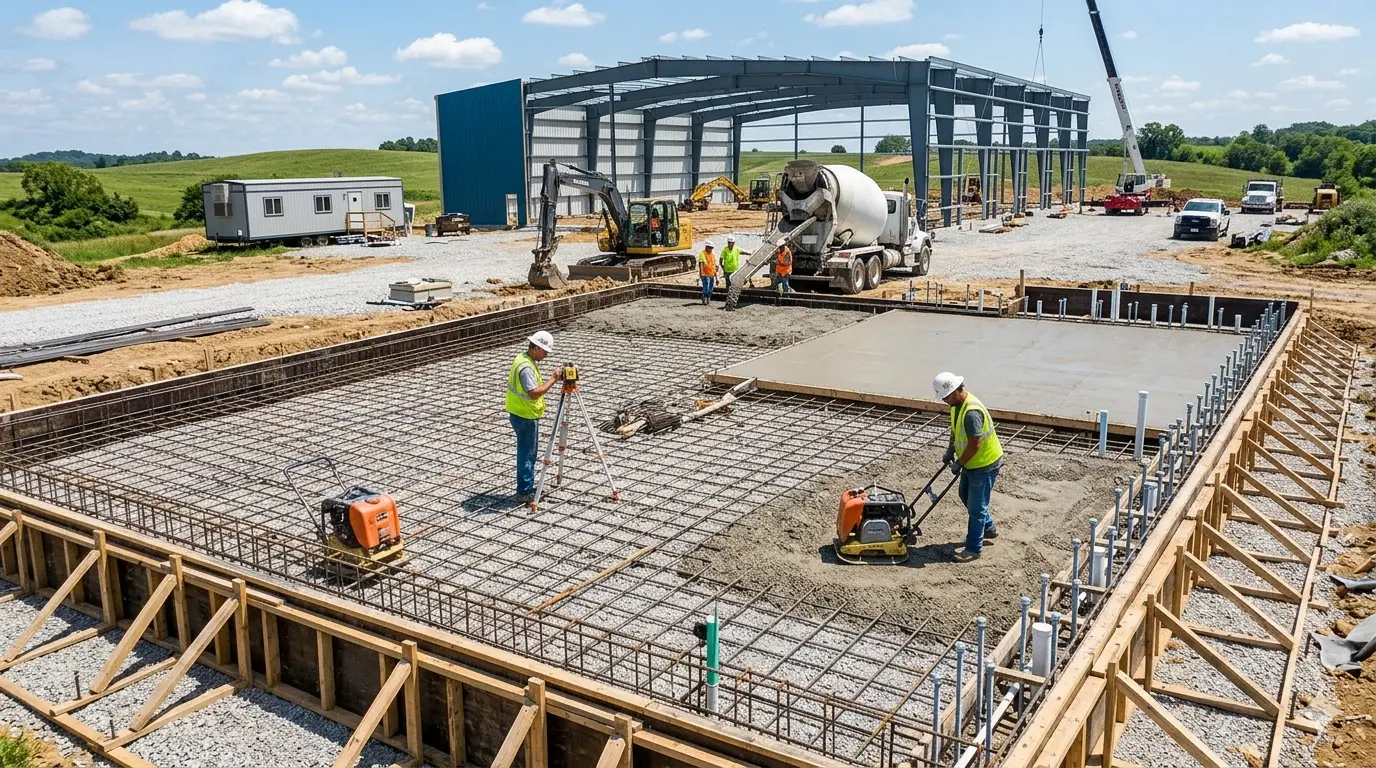
- Begin site grading and preparation as soon as ground conditions allow. Remove trees, brush, topsoil, and any organic material. Excavate unsuitable soil and replace with compactable fill, and grade the area to ensure proper drainage away from the building footprint.
- Schedule your foundation pour once soil temperatures are consistently above 5°C. Under Canadian Standards (CSA A23.1/A23.2), when air temperatures are forecast to fall below 5°C within 24 hours of placing concrete, special protection measures are required including heated enclosures, insulating covers, and preheated granular base. Skipping these steps risks a compromised foundation before your steel kit even arrives.
- Confirm your steel kit delivery window. Align delivery timing with your foundation cure schedule so your erection crew isn’t waiting or worse, arrives before the concrete is ready.
On frost heave: Steel buildings are especially sensitive to small foundation movements because frames, cladding, and doors rely on precise alignment and stable load transfer.Getting the foundation depth right matters far more than the exact build date. In Ontario, foundations must extend at least 1.2 metres below grade to reach frost depth and ensure stability through freeze-thaw cycles.Requirements are even deeper in colder provinces.
Regional note: Spring thaw timing varies significantly across Canada. In southern Manitoba, spring arrival defined as consistent daytime temperatures above 5°C can range from mid-March to late April depending on the year. Alberta’s Prairie regions follow similar patterns. Southern Ontario typically sees workable ground conditions 3–5 weeks earlier than these areas. Build your schedule around your province, not the calendar date.
At Metal Pro Buildings, we pre-coordinate delivery to align with your foundation cure time so your kit arrives exactly when your crew is ready.
Summer (June–August): Prime Building Season — But Only If You’re Already Prepared
“Everyone says build in summer, but I keep hearing about delays.”
They’re right about the season. They’re wrong about the timing.
Summer isn’t where you plan your build. Summer is where you execute it provided the work was done in the eight months before.
What to do in Summer:
- Steel erection. Most pre-engineered steel building kits can be set up in as little as two weeks, depending on size and complexity.With a prepared site, cured foundation, and coordinated crew, summer erection moves fast.
- Rough-in mechanical, electrical, and insulation. Once the building is enclosed, interior work becomes season-independent. Summer is your best window to get ahead of this.
- Complete exterior cladding and roofing. Finish the envelope while conditions are optimal.
- Begin interior finishing if your timeline allows trim, doors, flooring, and utilities.
Why do summer builds go wrong? Almost always, the same reason: people who started planning in May instead of September. Spring and early summer typically bring the longest fabrication queues as buyers aim to start construction meaning ordering in April for a June start is a high-risk move.
📌 Honest callout: If you’re reading this in June without a permit in hand, your summer build is almost certainly a fall foundation at earliest. And that’s okay if you plan it right. A fall foundation pour, followed by spring erection, is a well-established and entirely reasonable Canadian construction sequence. The mistake is not adjusting the plan. The mistake is pretending the original plan still works.
Clients who work with Metal Pro Buildings from the planning stage rarely face summer delays. The work was done months earlier.
The Hidden Timeline Killers — What Nobody Warns You About
“I’ve heard horror stories. I don’t want to be that person.”
You won’t be , if you know what to watch for. Here are the four most common causes of stalled Canadian steel building projects, and why they catch people off guard every single time.
- Permit delays and the gap between what’s published and what’s real
Every municipality posts a processing time. Almost none of them hit it. Published permit timelines promising 6–8 week approvals frequently transform into 4–6 month ordeals with over 80% of permits exceeding published timelines by an average factor of 2.5x. In major centres, the picture can be even bleaker. In Toronto, permit backlogs have grown significantly reaching a weighted average approval time of 32 months for some project types in 2022.Even smaller cities aren’t immune. In Charlottetown, developers are currently reporting waits of months or more, with city officials acknowledging a shortage of building planners and inspectors as a key factor. Never assume 4–6 weeks. Plan for 12–16, and follow up proactively throughout.
- Utility conflicts the delays buried in your own soil
Before a single shovel breaks ground, your site needs to be cleared for buried infrastructure gas lines, water mains, electrical conduits, fibre optic cables. In Ontario, contractors waiting for utility locate responses have reported delays of one to three months, with the Timmins Construction Association noting that the small Canadian build window makes these waits especially damaging to project schedules.When utility conflicts are discovered mid-construction rather than during pre-planning, they can add 6–8 weeks to the project schedule with construction teams sitting idle until conflicts are resolved.The fix is simple: complete your utility locates before breaking ground, not after.
- Engineer revision cycles the quiet schedule killer
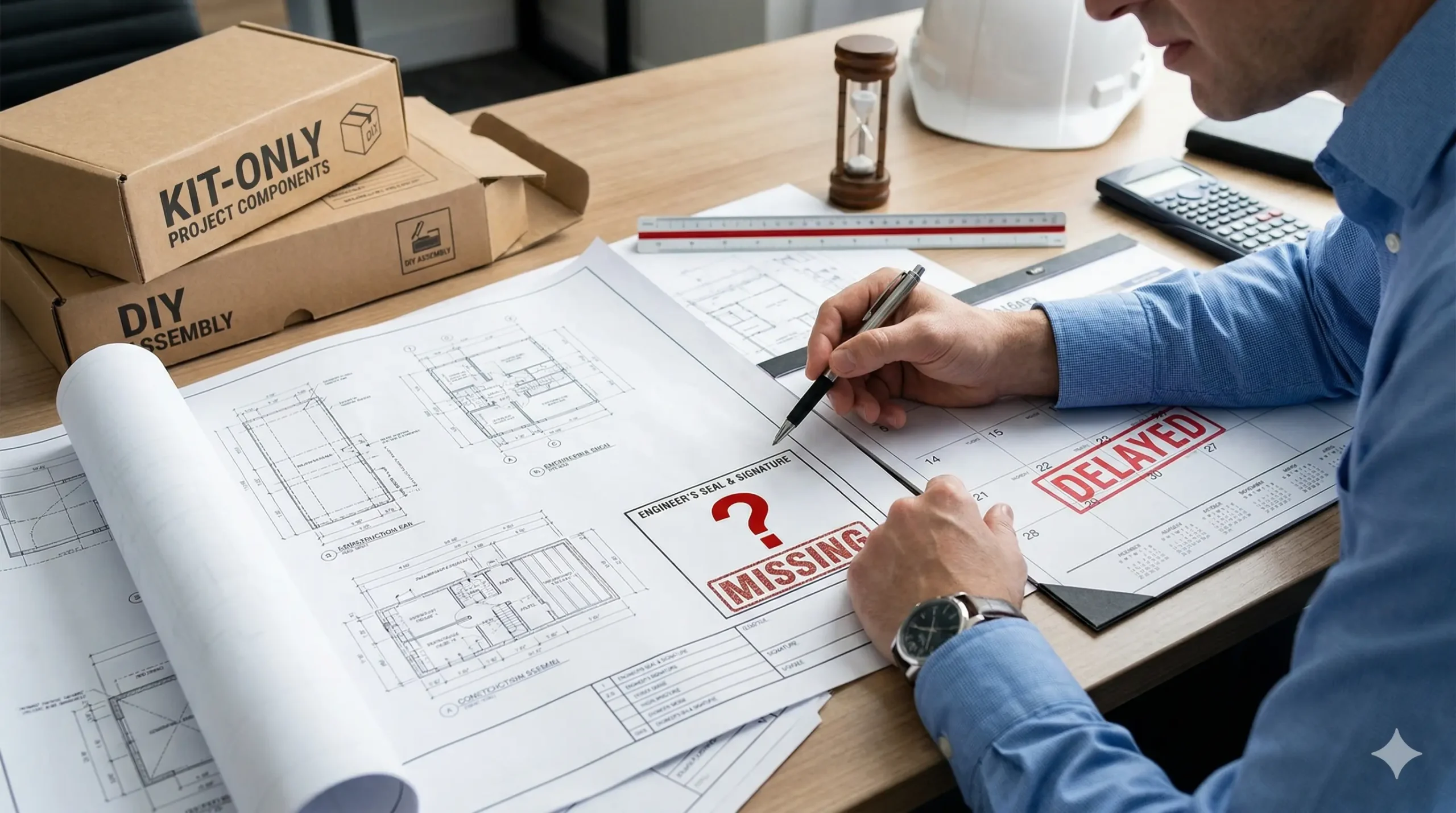
Steel building projects in Canada often move forward with drawings that are technically complete but not fully coordinated and that gap is where redesigns, change orders, and inspection delays originate. Every revision cycle means revised calculations, new drawings, and re-approval sometimes resetting your position in the fabrication queue entirely. The most common delay in permit submission comes from missing drawings or unclear site plans. Imported steel building kits add another layer of risk: kits that arrive with U.S. engineering seals aren’t valid in Canada your design must be stamped by a Canadian licensed engineer referencing the correct NBCC or provincial code. Get this right the first time and you’ll never know how much time you saved.
- Steel lead times, ordering late is gambling with your build season
Spring and early summer typically bring the longest fabrication queues as buyers aim to start construction meaning late design changes remain the single biggest cause of extended lead times, as even small revisions can trigger revised calculations, new drawings, and re-approval, often resetting the fabrication queue entirely. Ordering in April for a June start isn’t a plan it’s a wager. One real-world comparison tells the story clearly: a client who ordered two identical buildings, one in April, one in October waited 14 weeks for the April building. The fall order moved through production in a fraction of that time.
How to Build Your Personal Construction Timeline
Most people start by asking “when can I break ground?” That’s the wrong question. The right question is: “when do I need to be done and what does that mean I have to do today?”
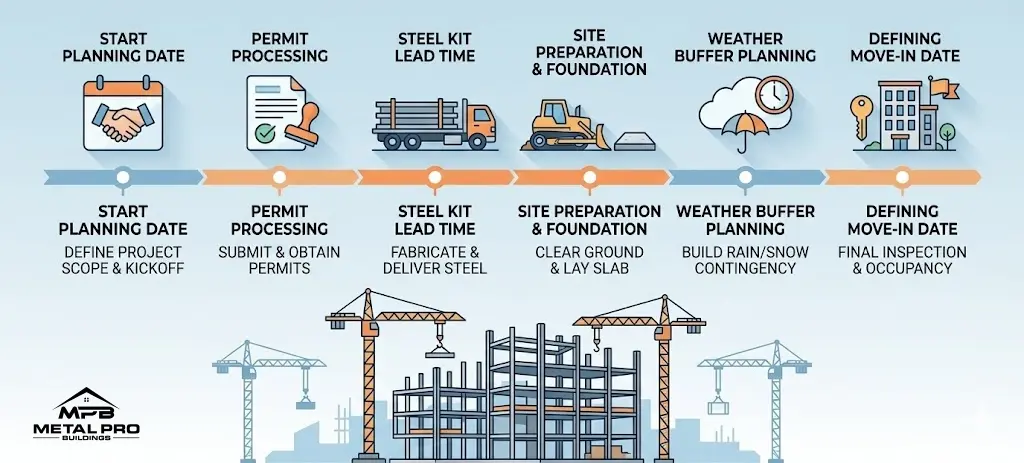
Work backwards from your desired completion date to establish a realistic timeline. Here’s a simple six-step framework to make that work in a Canadian context.
Step 1: Define your target move-in or use date. Be specific. “Sometime next summer” isn’t a plan. “Operational by September 15” is. A proper timeline lays out the path a project will take from initial conception to completion, with specific milestones that provide accountability and help keep everyone on track.Start with the end date and build everything backwards from there.
Step 2: Add 8–16 weeks for permit processing. Don’t use your municipality’s published timeline as your planning assumption. Use their worst case. Permits and regulations significantly influence construction timelines securing approvals often involves navigating complex requirements including local building codes, zoning laws, and environmental standards.If your permit comes through early, you’ll have a buffer. If it doesn’t, you won’t be scrambling.
Step 3: Add 8–14 weeks for steel kit lead time. This clock starts after your engineering drawings are approved, not when you make the call. Order early, or accept that your build date shifts accordingly.
Step 4: Add 4–6 weeks for site prep and foundation. Site preparation involves clearing land, grading, and excavating for foundations and in Ontario and other provinces, this phase can take longer if your project requires site plan approval, rezoning, or conservation authority clearance.Factor in concrete curing time before your steel kit arrives.
Step 5: Add a weather buffer based on your province. If steel erection in normal weather would be completed in a 10-workday duration, that duration should be increased to account for potential weather impacts particularly with consideration for when the work is expected to be performed.Most experienced builders incorporate contingency days directly into their project schedule so mild setbacks don’t derail overall completion dates.In Alberta, Manitoba, or Quebec, budget generously. In coastal BC, somewhat less so.
Quebec builders: one more thing to flag. In Quebec, all construction sites are required to shut down for two full weeks in late July and early August each year, a mandatory industry-wide holiday governed by the Commission de la construction du Québec.In 2026, this shutdown runs from July 20 to August 2. If your erection window overlaps with this period, your schedule absorbs a two-week pause whether you planned for it or not.
Step 6: Identify your “start planning” date. Add up all the steps above and count backwards from your target date. That number often six to nine months before you want to move in is when planning needs to begin. For most Canadian builders, it’s sooner than they expect.
Why Canadian Builders Trust Metal Pro Buildings to Keep Projects on Track
Choosing the right supplier doesn’t just affect your building. It affects your entire timeline.
Here’s what makes Metal Pro Buildings different for Canadian projects and why it matters when your build season is already short.
A Canadian company, built for Canadian conditions. Metal Pro Buildings was established by industry veteran Herbert Broderick, backed by over 30 years of personal experience and a leadership team with decades of combined expertise.This isn’t a US company retrofitting American products for Canadian buyers. Every Metal Pro building is 100% Canadian CSA A660 certified, manufactured by Pioneer Steel using exclusively Canadian steel from ArcelorMittal Dofasco at their Mississauga facility.
That matters when your permit reviewer is checking for Canadian compliance not American equivalents.
Engineering drawings stamped for Canadian building codes. Every steel building order includes three sets of certified engineered and foundational drawings stamped by a Canadian engineer with a digital copy sent for review and approval before delivery.
At Metal Pro Buildings, CSA A660 documentation and engineer-stamped drawings are provided as a standard not treated as an extra. This is the documentation your municipality needs to process your permit without costly back-and-forth.
Transparent lead times no bait-and-switch delivery windows. Metal Pro’s team works closely with clients from the very beginning, making sure each step reflects their needs, their timeline, and their vision.When wildfires impacted one client’s delivery window, Metal Pro acted quickly by arranging temporary storage to protect the materials handling an unpredictable situation professionally and without leaving the client stranded.
Real people, real support, throughout the process. Clients consistently highlight the quality of personal attention they receive. At the Toronto Cricket Club, Metal Pro’s team answered all calls, gave sound advice, and demonstrated knowledge of local bylaws and engineering aspects helping the client make an informed decision. Other clients report representatives returning calls on weekends during their own time off, and products arriving on time exactly as sold going together without a problem.
Conclusion
Here’s what most Canadian builders never realize:
The build happens in the summer. But the project succeeded in the fall before.
Every client who breaks ground smoothly in June made a series of quiet decisions the previous October. They submitted permits early. They ordered steel before the spring queue filled. They locked in crews before everyone else started calling.
That’s not luck. That’s sequencing.
The best time to start planning was last fall. The second best time is today.
Ready to map out your timeline?
Get a free project timeline consultation with Metal Pro Buildings. We’ll build a season-by-season plan around your location, building size, and target date. Contact Metal Pro Buildings today