
It’s February. Your steel building has been up five months.
The walls are sweating. Ice is forming inside. The heater hasn’t shut off in three days and it’s still 48°F.
Nobody warned you this could happen.
Steel buildings in extreme latitudes perform brilliantly or fail spectacularly. It almost always comes down to one thing: whether HVAC was planned from the start or added as an afterthought.
If temperatures swing 80°F between seasons, generic HVAC advice isn’t just unhelpful. It’s dangerous for your investment.
This is the guide you needed before breaking ground.
Why Extreme Latitudes Change Everything About Steel Building Climate Control
Steel is one of the strongest building materials on earth. It’s also one of the fastest conductors of heat and cold.
That’s not a flaw, it’s physics. And in extreme latitudes, it means your steel frame actively works against you if it isn’t properly managed.
Thermal bridging occurs when steel elements create a direct conductive pathway between the outside and inside of a building bypassing insulation entirely.Think of it like a cold shortcut through your walls.
Every column, purlin, and fastener is a potential bridge. Without continuous insulation, a steel wall’s cavity insulation can be only 45–85% effective meaning you could be paying for R-30 performance and getting far less.
In a climate where it hits -40°F, that gap matters enormously.
The Condensation Threat , The Silent Destroyer
Here’s what most people don’t see coming: condensation doesn’t announce itself.
It starts invisibly, deep inside your wall assembly. By the time you notice a problem, the damage is already done.
Rust weakens structural integrity. Condensation fosters mold growth. When insulation absorbs moisture, its thermal performance drops significantly. Your R-value shrinks. Your heating bill climbs. And the building you built to last 40 years starts deteriorating in year two.
In a cold climate, positive pressure to the outside can result in air leakage through any path of least resistance carrying significant water vapor to cold exterior steel where it condenses.
You invested six figures in this structure. Condensation can begin compromising it before the second winter if ventilation wasn’t planned correctly.
Extreme Temperature Differentials and HVAC System Stress
Standard HVAC equipment has limits. Most units are rated for cold but not extreme cold.
A system designed for -4°F outdoor conditions doesn’t just struggle at -30°F. It fails. Seals crack. Ductwork contracts. Equipment housings become brittle.
Cold climate design requires enhanced insulation, sealed envelopes preventing moisture infiltration, and foundation frost protection adding 10–15% to initial cost but delivering 20–30% energy savings.
Systems sized for “average cold” are sized for average winters not the ones that test your building.
Permafrost, Snow Load, and Site-Specific Complications
Canada adds variables most HVAC guides never mention.
Permafrost across the Yukon, Northwest Territories, and Nunavut limits where utilities can be routed. Heavy snow loads can block passive ventilation entirely. And short construction seasons mean HVAC can’t be an afterthought.
The site shapes the system. Local climate knowledge isn’t a bonus, it’s a requirement.
The Integrated Planning Approach: What This Actually Means
Getting climate control right in a steel building isn’t about picking the best equipment. It’s about designing every system envelope, ventilation, and heating as one unified plan from day one.
Why HVAC Must Be Designed Alongside the Building , Not After
Here’s the mistake that costs building owners the most money: treating HVAC as a finish trade.
It gets designed last. Installed last. Thought about last.
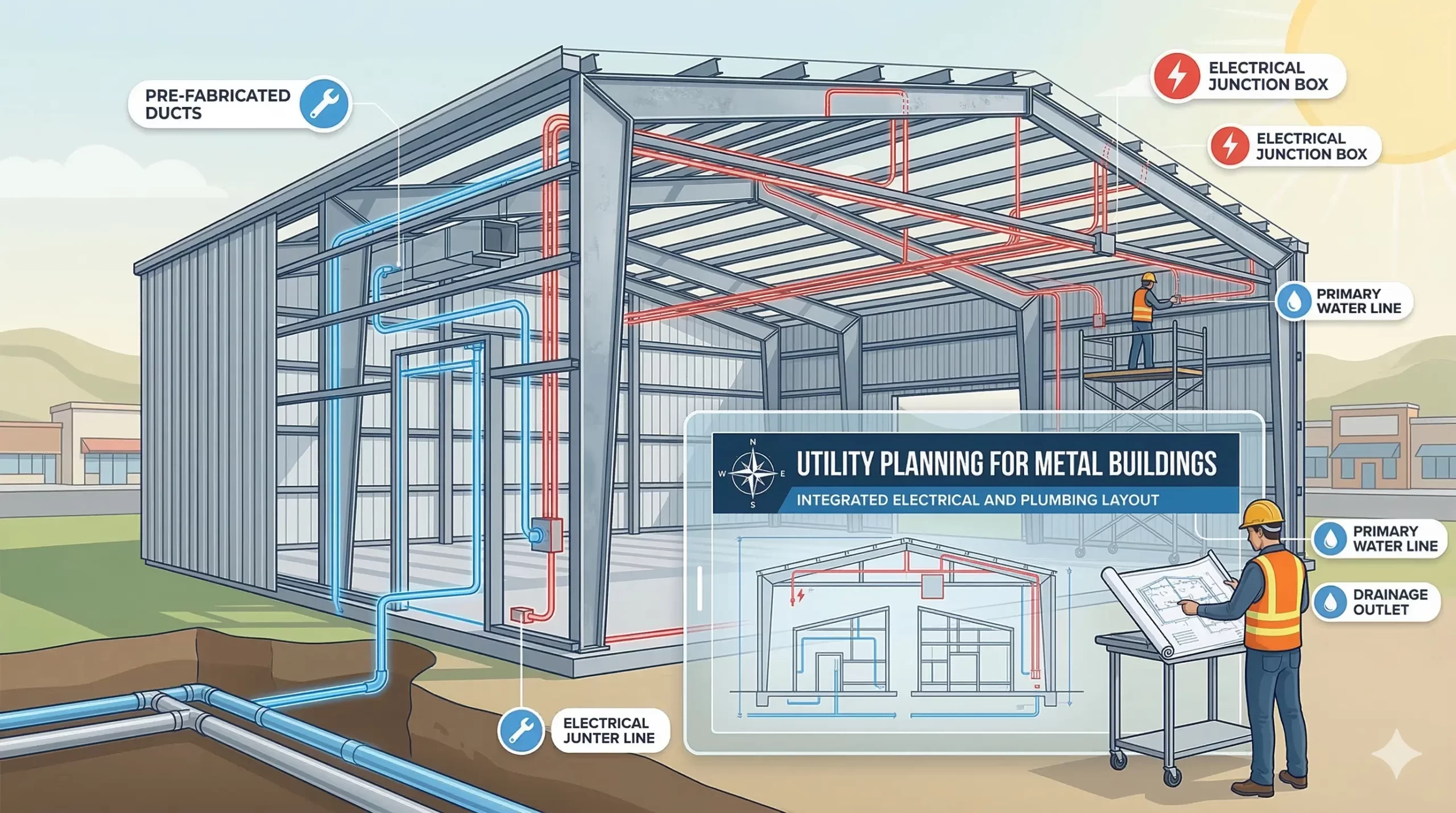
When HVAC is integrated from the start, engineers can optimize ductwork placement, select equipment locations for maximum efficiency, and ensure proper sizing based on the building’s specific requirements. When it’s added after the fact, you’re working around constraints that didn’t have to exist.
Integrated teams can factor in energy efficiency, HVAC strategies, and lighting systems during early design which directly impacts utility savings for years to come.
In extreme latitudes, retrofit HVAC doesn’t just cost more. It performs worse permanently.
Building Envelope First: Insulation and Vapor Barrier Strategy
Before any mechanical system is chosen, the thermal envelope has to be right.
In extreme cold, that means continuous insulation with no gaps, proper thermal break design at every steel connection point, and a vapor barrier placed on the correct side of the assembly.
That last part trips up a lot of builders. In cold climates, the vapor barrier belongs on the warm interior side, not the exterior. Placing it wrong drives moisture directly into your wall assembly.
For retrofits in cold and very cold climates to maximize energy savings, they must capture efficiencies in energy performance, installation, and ongoing operations while delivering thermal comfort at a competitive cost. Getting the envelope right the first time is always the smarter investment.
Airtightness matters too. A leaky building envelope in a -40°F climate isn’t just uncomfortable, it’s a condensation event waiting to happen.
Ventilation System Design for Extreme Climates
Seal a building tight without proper ventilation and you’ve traded one problem for another.
Air quality collapses. Moisture builds up. Occupants get sick. The building deteriorates from the inside.
That’s why Heat Recovery Ventilators (HRVs) and Energy Recovery Ventilators (ERVs) aren’t optional upgrades in extreme latitudes. They’re essential.
HRVs use stale exhaust air to condition fresh incoming air. In winter, incoming fresh air is warmed by outgoing exhaust air creating less drafts than systems that bring in cold outdoor air without preheating it.
ERVs go a step further. An ERV is a type of air-to-air heat exchanger that transfers both latent and sensible heat meaning it manages both temperature and moisture simultaneously. In climates with dry winters and humid summers, that dual capability is a significant advantage.
ERV units are generally ideal for more extreme climates such as very cold, dry climates where managing both heat and humidity is critical year-round.
Heat recovery systems typically recover about 60–95% of the heat in exhaust air, significantly improving the energy efficiency of buildings. In a region where you’re heating for seven months of the year, that recovery pays for itself quickly.
Heating System Selection for Extreme Latitudes
No single heating system is right for every steel building. The best choice depends on the building’s use, size, and available fuel sources.
Radiant in-floor heat
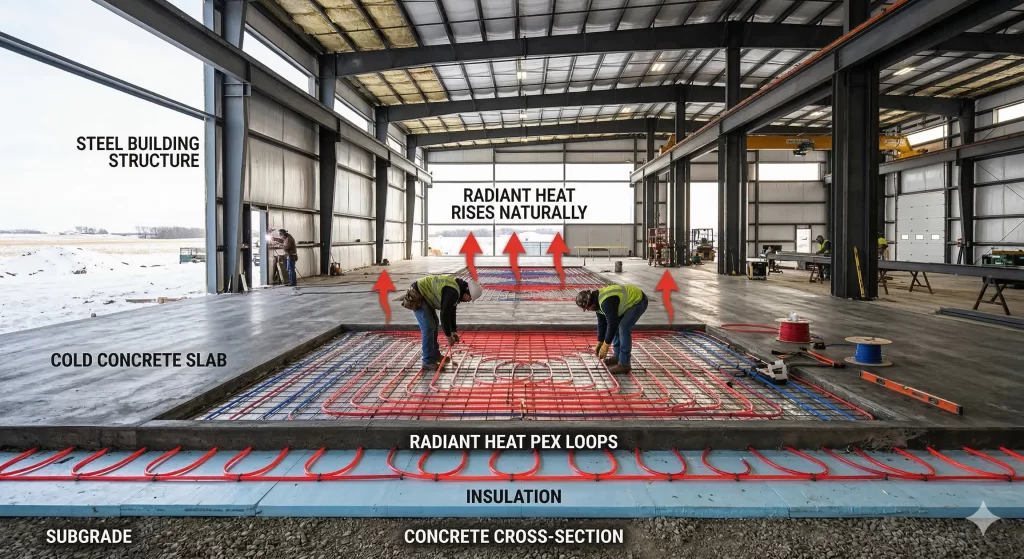
Radiant in-floor heat is one of the best fits for steel buildings on cold concrete slabs. Radiant heating is more efficient than forced-air heating because it eliminates duct losses entirely. Heat rises naturally from the floor exactly where cold concrete slabs would otherwise become a liability.
Radiant heating delivers warmth from the floor up, creating consistent, even temperature throughout the room with no drafts or cold spots.
In a steel building where thermal bridging already works against you, eliminating temperature swings matters.
Forced air systems
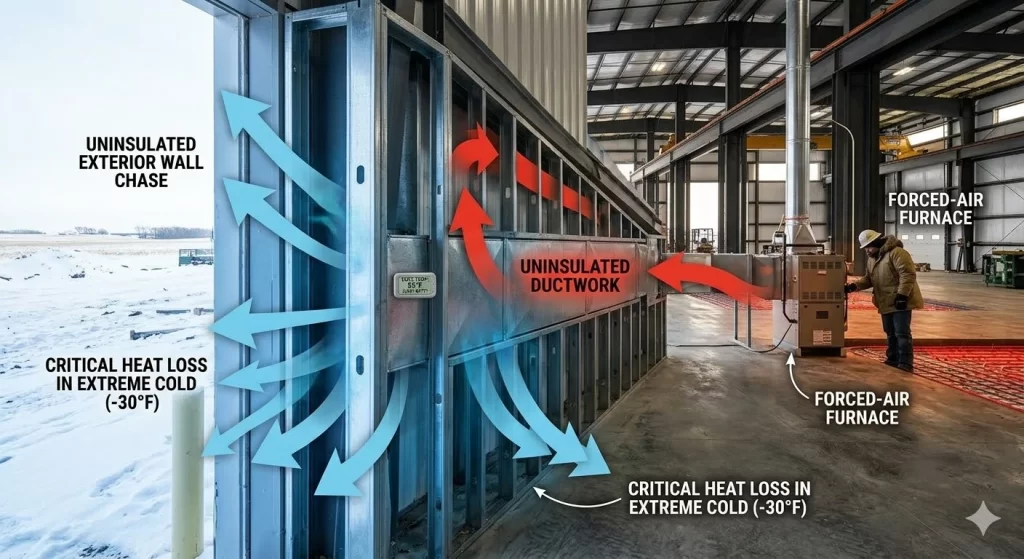
Forced air systems heat a space faster and work well when ductwork can be routed through conditioned spaces. The critical rule in extreme cold: never route ductwork through unconditioned areas. Heat loss in uninsulated chases at -30°F is significant.
Infrared heating
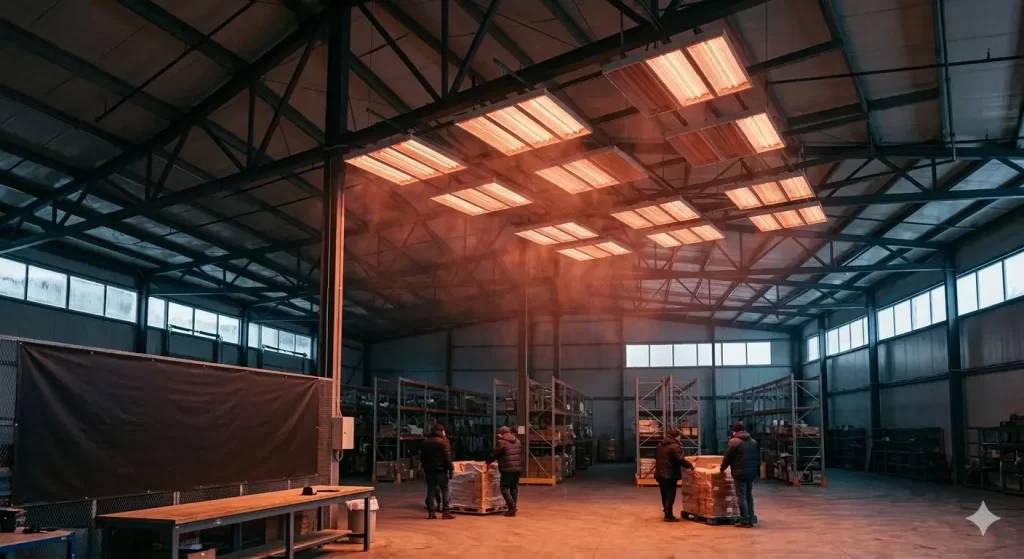
Infrared heating suits large-span structures warehouses, agricultural buildings, hangars where heating the entire air volume is impractical. It warms surfaces and occupants directly without needing to heat the full cubic footage.
Backup systems and redundancy
Backup systems and redundancy matter more in remote extreme-climate locations than almost anywhere else. A single-system dependency in a location two hours from the nearest HVAC contractor isn’t a risk, it’s a liability.
Cooling and Summer Humidity Management
Extreme latitudes have a summer problem that most people don’t plan for.
Short summers can be intensely humid. Relative humidity can swing 60% or more between seasons. And those cold steel surfaces that collected cold all winter? In a humid July, they become condensation magnets now in reverse.
Mini-split systems offer versatility here. They provide both heating and cooling from a single unit, handle humidity independently of temperature, and can zone specific areas of a building without requiring a full duct system.
Managing humidity in summer isn’t a comfort issue. In a steel building, it’s a corrosion and air quality issue. Plan for it from the start.
Ventilation Planning by Building Use Type
Not every steel building has the same climate control needs. The right system depends entirely on what happens inside the building, who uses it, how often, and what’s being produced or stored. Here’s how to think through ventilation by building type.
Commercial and Industrial Steel Buildings
Commercial buildings in extreme latitudes carry occupancy-driven ventilation demands that don’t pause for winter.
ASHRAE 62.1 outlines specific minimum ventilation rates for various commercial settings: office spaces typically require around 20 cubic feet per minute per person, while restaurants, gyms, and healthcare facilities require significantly higher rates due to increased contaminant generation and occupancy turnover.
In extreme cold, meeting these rates gets expensive fast. Every cubic foot of fresh air you bring in at -30°F has to be heated before it’s usable. That’s where make-up air units become critical; they condition incoming fresh air before it enters the occupied space, preventing drafts, ice formation at air intakes, and system overload.
Energy recovery ventilation systems are particularly effective in regions with significant temperature differentials between indoor and outdoor environments, transferring heat and moisture between incoming and outgoing air streams. In commercial applications, these systems don’t just improve comfort they protect the bottom line.
Code compliance in northern and arctic building zones adds another layer of complexity. Local amendments to the International Mechanical Code often exceed base national standards. Always verify requirements with your local authority before finalizing any ventilation design.
Agricultural and Equestrian Steel Buildings
Agricultural steel buildings are among the most demanding environments for any ventilation system.
Livestock don’t just occupy a building. They transform it. Animal respiration, waste decomposition, and moisture from bedding create a continuously aggressive interior atmosphere.
A single livestock building can release hundreds of litres of water vapour per day, depending on animal density and building size.Without a properly engineered ventilation system, that moisture condenses on cold steel and begins destroying the structure from the inside.
Then there’s ammonia. Even well-ventilated buildings contain measurable ammonia concentrations, especially during colder months when airflow is reduced to conserve heat. Ammonia combines with moisture to form corrosive compounds that attack protective coatings, weaken fasteners, and accelerate structural deterioration.
In cold regions, heat recovery ventilators can capture up to 80% of exhaust heat before it leaves the building in naturally ventilated barns, properly positioned ridge vents and sidewall openings can provide free airflow when conditions permit, supplemented by mechanical systems during extreme weather.
The critical mistake in agricultural buildings is treating ventilation and insulation as competing priorities. In Canada’s cold climate, condensation control requires an engineered balance between ventilation and insulation when these systems are coordinated, livestock facilities remain dry, durable, and healthy for animals. When they are not, corrosion, mould, structural damage, and rising maintenance costs follow.
Residential Steel Buildings and Barndominiums
Residential comfort standards are different from commercial or agricultural ones. Occupants aren’t workers tolerating suboptimal conditions; they’re families living there year-round, expecting consistent warmth, good air quality, and low utility bills.
The core challenge of a barndominium in extreme cold is its open floor plan combined with high ceilings. Without walls and low ceilings to guide airflow, hot or cold air tends to stratify warm air rises to the ceiling while cooler air stays near the floor. This makes the living space uncomfortable and forces the HVAC system to work overtime.
Mini-split systems are often the go-to choice for barndominiums due to their versatility; they allow for targeted heating and cooling in specific areas, creating zones so each area is comfortable without wasting energy.
For cold slab foundations nearly universal in steel residential builds radiant floor heating is highly effective. Radiant heat flooring directly heats the floor, which in turn warms the walls, furniture, and occupants, concentrating heat near the floor where it is needed most and minimizing heat loss to the ceiling.
Remember: the steel shell alone isn’t the answer. Interior finishing insulated walls, proper ceiling treatments, and air sealing is what transforms a steel structure into a genuinely comfortable home.
Storage, Workshop, and Utility Structures
Not every steel building needs to keep people comfortable. But even unoccupied structures in extreme climates need a minimum ventilation strategy.
Condensation is the top concern in steel buildings, and inadequate ventilation is often the root cause if not addressed, it leads to rust, mould, and damaged insulation.
For storage and utility structures, the main goal is protecting what’s inside: equipment, materials, and the structural integrity of the building itself. Intermittent heating strategies systems that maintain a minimum temperature rather than full occupancy comfort levels can work well here, provided the thermal envelope is tight enough to hold heat between cycles.
The risk of intermittent heating in a poorly insulated building is repeated freeze-thaw cycling inside the wall assembly. That cycle degrades insulation, loosens fasteners, and accelerates corrosion at every connection point. A minimum ventilation threshold even in unoccupied structures prevents moisture accumulation between heating cycles.
Common Mistakes That Cost You And How to Avoid Them
Most HVAC failures in extreme-latitude steel buildings don’t happen because of bad luck. They happen because of decisions made early in the process, decisions that felt reasonable at the time. Here are the ones we see most often.
Installing equipment without cold-climate ratings.
Standard HVAC equipment has temperature limits. A unit rated for -4°F doesn’t struggle at -30°F it fails. Seals crack. Components become brittle. Efficiency collapses.
Systems sized for average winter conditions will fail during polar vortex events that extreme-climate regions experience regularly. Design calculations must account for the 99% winter design temperature to ensure adequate capacity when it matters most.
Always verify the equipment’s operational rating against your site’s actual extreme low, not the average low.
Skipping the HRV or ERV.
Sealing a building tight without mechanical fresh air exchange is one of the most common and costly mistakes in cold-climate construction.
Trapped air means trapped pollutants, humidity, and odors. Occupants may experience respiratory issues, while the building itself may suffer from mold growth and structural damage due to excess moisture. Many builders assume that small exhaust fans are sufficient, but in tightly sealed buildings, this is simply not the case.
An HRV or ERV isn’t an upgrade. In extreme latitudes, it’s a requirement.
Vapor barrier installed on the wrong side.
This mistake is more common than it should be and the consequences are slow, invisible, and expensive.
The vapor barrier goes on the warm side of the insulation. In cold climates, the warm side is the interior. Installing it on the exterior in a cold climate drives moisture directly into the wall assembly, where it condenses against cold steel.
A vapor barrier installed in the wrong climate or on the wrong side of building materials can cause more harm than good, preventing assemblies from drying and trapping moisture where it can’t escape.
Ductwork routed through unconditioned spaces.
Every foot of ductwork that runs through an uninsulated chase in a -30°F climate loses heat before it reaches its destination. In extreme cold, that loss is significant and it forces the heating system to work harder to compensate.
Keep all ductwork inside the conditioned envelope. If that isn’t possible, insulate duct runs aggressively and seal every joint.
Undersizing the heating system based on “design day” temperatures.
HVAC systems not properly matched to a building’s load requirements will consume more energy through constant cycling or continuous operation which directly translates into higher operational costs that can spiral out of control during peak seasons.
A warehouse with 30-foot ceilings contains three times the air volume of the same floor area with 10-foot ceilings and requires roughly three times the heating capacity. Square footage alone is never enough to size a system for extreme cold.
Always use a full thermal load calculation that accounts for ceiling height, infiltration, equipment ratings, and your actual extreme low temperatures not averages.
Choosing a supplier without cold-climate HVAC integration experience.
A steel building supplier who doesn’t ask about your climate, your heating fuel access, or your ventilation strategy before talking square footage isn’t equipped to serve extreme-latitude builds.
These aren’t hypothetical errors. They’re the conversations that happen after the first hard winter reveals what the planning phase missed.
The Metal Pro Company Difference: Built for Where You Actually Build
Most steel building suppliers will ask about your square footage, your budget, and your timeline. At Metal Pro Company, we ask something different first: Where are you building, and what does February look like there?
That question shapes everything that follows.
Cold-Climate Engineering Is Our Default, Not an Upgrade
Designing for extreme conditions isn’t a premium add-on at Metal Pro. It’s our starting point.
Successful cold-climate steel buildings require R-30 insulated metal panels to eliminate thermal bridging, proper roof pitch for snow shedding, and radiant heating integrated into concrete slabs all of which must be coordinated from the earliest design phase. We don’t wait until the building is designed to think about these elements. They inform the design from the first conversation.
A building envelope consultant integrated into the design process ensures continuous air, water, vapor, and thermal barriers work together providing a dry and comfortable indoor environment while delivering cost-effective solutions that save money on operational, maintenance, and repair costs long term. That’s the standard our clients benefit from on every project.
What Our Integration Process Looks Like
Before we talk square footage, we talk climate.
We ask about your heating fuel access, your site’s extreme low temperatures, your occupancy type, and your ventilation needs. Those answers drive our thermal envelope modeling which is included in our design phase, not billed as an extra service.
Performance modeling and climate data analysis validate that envelope systems are suited to their environment and identify early signs of potential distress before they escalate into costly failures.
We complete this modeling before anything is finalized, so your HVAC contractor receives clear documentation and doesn’t have to guess at what the building was designed to do.
A well-designed building envelope reduces energy use and emissions while minimizing risk by enhancing the building’s ability to withstand environmental stressors.
We coordinate directly with mechanical engineers and HVAC specialists as part of our standard process, not as an exception you have to request.
Nothing gets lost in translation between design and installation.
What Our Clients Actually Experience
The goal isn’t a building that passes inspection. It’s a building you’re proud to use every day, even in February.
Our clients in extreme-latitude zones tell us the same things consistently: their energy costs came in lower than projected, their buildings stayed dry through the first winter, and they didn’t have to call anyone back to fix something that should have been right the first time.
That outcome isn’t luck. It’s the result of asking the right questions before design begins and staying involved until the last detail is resolved.
Our Guarantee Philosophy
We stand behind cold-climate performance. That means if something wasn’t built to perform in your climate, we want to know about it and we’ll work to make it right. Our warranty and support positioning reflects a simple belief: a steel building is a 40-year investment, and our relationship with the client shouldn’t end at delivery.
Your Next Step Start the Conversation Before You Start the Build
The gap between a steel building that performs for 40 years and one that begins deteriorating by year three isn’t the quality of steel. It’s the quality of planning.
Rapid deterioration and costly maintenance are inevitable unless climate stresses are carefully considered during planning, material selection, and throughout construction.
HVAC and ventilation integration in extreme latitudes isn’t a detail, it’s the foundation everything else is built on.
The good news? Getting this right doesn’t require guesswork. It requires the right conversation, with the right people, before a single post is set.
Here’s how to take that next step:
Book a Free Cold-Climate Building Consultation Our team asks the questions most suppliers skip about your climate, your fuel access, your use case before we ever talk square footage. This isn’t a sales call. It’s the planning session your building deserves. 👉 Book your free consultation here