
Have you ever sat in your living room during a heavy wind and felt the walls shiver? Now, imagine that feeling magnified by a thousand. For many of us living in Canada’s “Red Zones” like the rugged BC coast or the St. Lawrence Valley the threat of a major earthquake isn’t just a movie plot. It is a “when,” not an “if.”
The problem is that most traditional homes are built to a “minimum life safety” standard. This means the house is designed to let you get out alive, but the building itself might be a total loss. This realization creates a deep-seated anxiety for homeowners. You aren’t just worried about your safety; you are worried about losing your biggest investment and the place where your memories live.
This article explores why high-performance steel is the next evolution in Canadian home building. You will learn how steel moves from being an “industrial” material to a life-saving shield. We will show you how choosing steel offers a lifestyle that isn’t just lived, but protected. By the end, you’ll see how to turn seismic fear into structural confidence.
Seismic Science: Why Steel Bends Where Others Break
To understand why steel is the champion of earthquake zones, we have to look at a little bit of physics. Don’t worry, it’s simpler than it sounds.
The Physics of Safety
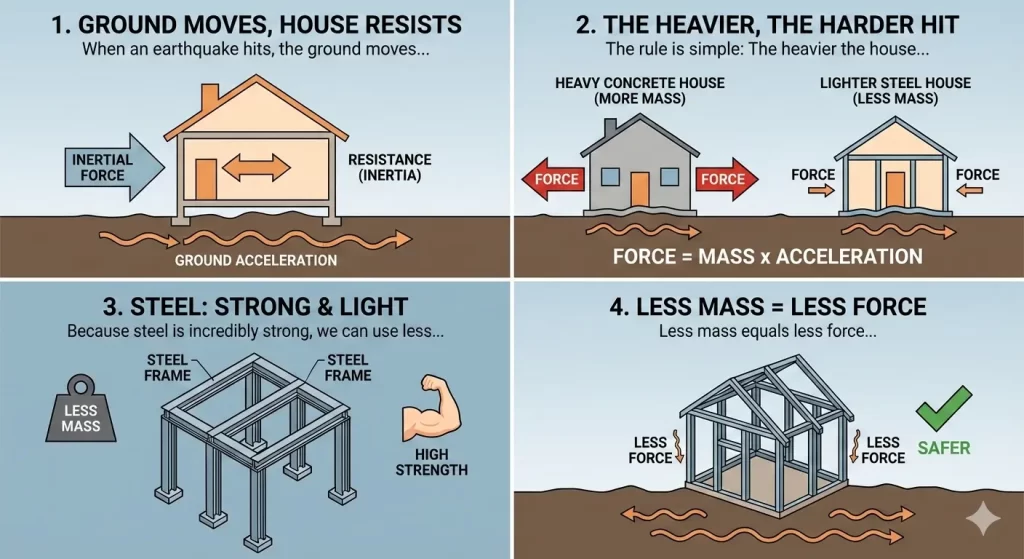
When an earthquake hits, the ground moves rapidly back and forth. Your home has weight (mass), and because it wants to stay still, it resists that movement. This creates what engineers call “inertial force.”
The rule is simple: The heavier the house, the harder it gets hit.
Force = Mass x times Acceleration
Because steel is incredibly strong, we can use less of it to support your home. This means a steel-framed house is often much lighter than a concrete or heavy timber one. Less mass equals less force trying to tear your home apart.
The “Willow vs. Oak” Analogy
Think of a massive, rigid Oak tree in a hurricane. It is strong, but because it refuses to bend, it can snap when the wind gets too high. Now, think of a Willow tree. It sways, it bends, and it “gives” with the wind.
- Brittleness (The Oak): Materials like brick or unreinforced concrete are brittle. They can hold a lot of weight, but once they reach their limit, they shatter.
- Ductility (The Willow): Steel is “ductile.” This means it can stretch and bend without snapping.
Absorbing the Energy
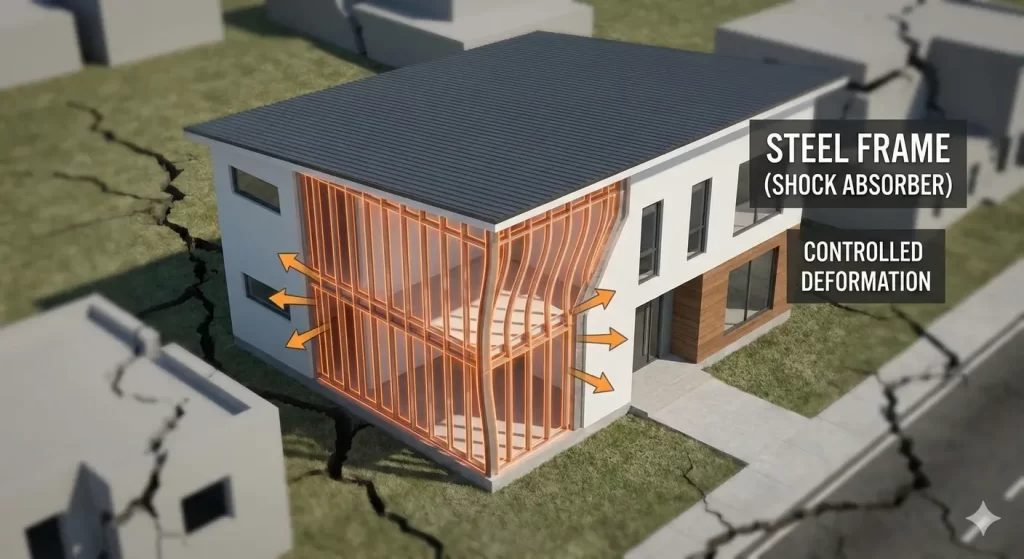
During a tremor, a steel frame acts like a shock absorber. Instead of cracking, the steel absorbs the earthquake’s energy by deforming slightly in a controlled way. Once the shaking stops, a well-engineered steel home is much more likely to be standing and more importantly repairable.
Performance Analysis: Steel vs. The National Building Code of Canada (NBCC)
Building a home in Canada means following the National Building Code (NBCC). However, there is a secret most homeowners don’t know. The code is designed for “minimum life safety.” This means the goal is to make sure you can get out alive, even if the house is destroyed.
Exceeding the Standard
Our steel systems are engineered to go beyond the minimum. We don’t just want you to survive; we want your home to survive. By using advanced steel frames, we aim for property preservation. This means your home can remain habitable even after a significant seismic event.
Precision Engineering with CAD and BIM
In the old days, builders relied on “gut feelings” or simple blueprints. Today, we use Building Information Modeling (BIM) and CAD software.
- We simulate a virtual earthquake on your home before we even pour the foundation.
- This identifies every weak point and ensures every bolt is placed exactly where it’s needed.
- Digital precision eliminates human error on the construction site.
Lateral Load Management
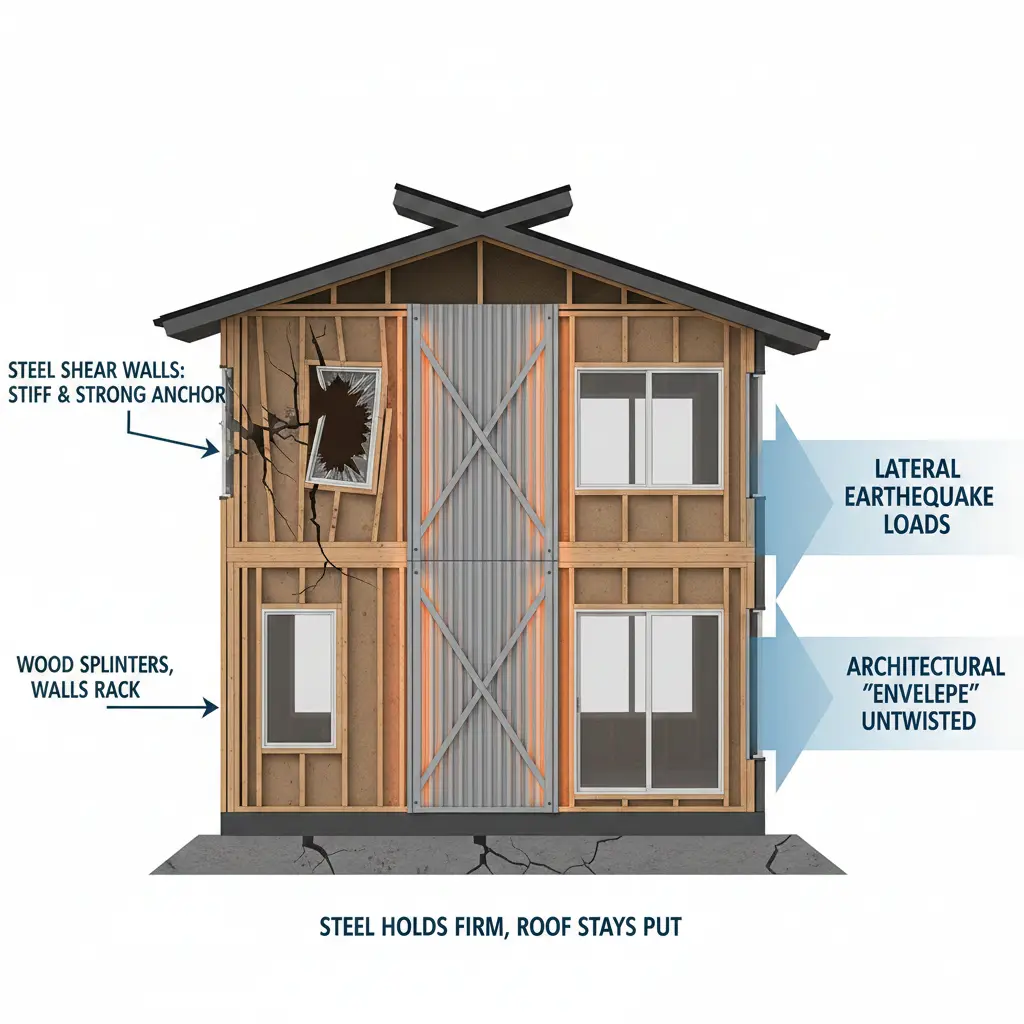
The “shaking” of an earthquake creates lateral loads , forces that push your house sideways. Most homes fail because their walls warp or “rack” under this pressure.
- We use steel shear walls to act as the home’s anchor.
- These walls are incredibly stiff and strong, preventing the architectural “envelope” (your windows and doors) from twisting out of shape.
- While wood can splinter under these loads, steel holds firm, keeping your roof where it belongs.
Beyond the Quake: The Lifestyle Benefits of Steel in Canada
While safety is the priority, a home is where you live every day. There is a common myth that steel homes are “cold” or “noisy,” but the reality of modern engineering is quite the opposite. When built correctly, a steel home offers a level of comfort that traditional wood frames struggle to match.
The “Quiet” and Warm Home
In the Canadian winter, insulation is everything. Steel is a great conductor of heat, which could lead to “thermal bridging” (heat escaping through the studs). To solve this, we use continuous exterior insulation.
- We wrap the entire steel frame in a protective thermal blanket.
- This stops heat from escaping and prevents cold spots on your walls.
- Combined with high-performance acoustic insulation, your home becomes a quiet sanctuary, blocking out street noise and heavy winds.
Design Freedom: Walls Without Limits
Because steel has a superior strength-to-weight ratio, it can support more weight over longer distances. This opens up incredible architectural possibilities:
- Wide-Open Spaces: You can have massive “great rooms” without needing bulky support columns in the middle of your floor.
- Floor-to-Ceiling Windows: You can install large glass walls to enjoy Canada’s stunning views without weakening the home’s ability to withstand an earthquake.
Secondary Protections: Fire and Water
Earthquakes often bring secondary disasters, like fires from broken gas lines.
- Non-combustibility: Steel does not burn. It won’t fuel a fire, giving your family more time to get to safety and reducing the risk of total property loss.
- Mold and Rot Resistance: In the damp climates of British Columbia or Atlantic Canada, wood rot is a constant threat. Steel is inorganic. It doesn’t rot, warp, or provide a home for mold or termites. Your home stays as straight and true as the day it was built.
Addressing the “Anxiety of Investment”
Building or buying a home is likely the biggest financial decision of your life. When you choose a steel-framed home in a seismic zone, you aren’t just buying a house; you are buying an insurance policy you can live in. Many people worry about the “upfront cost,” but the real story is found in the long-term value.
Insurance and the “Safety Dividend”
In Canada, earthquake insurance is usually an optional add-on with a high deductible sometimes as high as 20% of your home’s value.
- Lower Premiums: Because steel is non-combustible and seismically resilient, many insurers view it as a lower risk. This can lead to lower annual premiums.
- The 1:4 Rule: Research shows that for every $1 spent on making a home resilient today, you save roughly $4 to $11 in future recovery costs. If a tremor hits, a wood home might need a total rebuild, while a steel home might only need minor cosmetic repairs.
Resale Value: The Gold Standard
As awareness of climate change and seismic risk grows, buyers are looking for “hardened” homes.
- Longevity: A steel frame has a lifespan of 50 to 100+ years, compared to 40-60 years for traditional wood.
- Precision: Prospective buyers love knowing a home was engineered with CAD precision. It means the walls are perfectly straight, the floors don’t creak, and the structure hasn’t warped or settled over time.
The “Cost” Myth Debunked
While the raw material for steel can sometimes be more expensive than lumber, the “all-in” cost is often surprisingly similar.
- Faster Builds: Steel kits are prefabricated. This means they go up much faster than “stick-built” wood homes, saving you thousands in on-site labor.
- Zero Waste: You don’t pay for a pile of scrap wood at the end of the job. Every piece of steel is cut to the exact millimetre.
- Maintenance Savings: Over 30 years, a steel home can save you tens of thousands of dollars in pest control, rot repair, and structural reinforcement.
Why Metal Pro Buildings is the Architect of Your Peace of Mind
Choosing the right partner for a seismic build is as important as choosing the material itself. At Metal Pro Buildings, we don’t just sell kits; we provide a complete engineering ecosystem designed to protect your family and your investment.
Our Philosophy: Engineering “Forever Homes”
We believe a home should be a sanctuary, not a source of worry. Our engineering team focuses on post-disaster integrity. This means we design your structure to handle the specific seismic forces of your exact location.
- We use Spectral Acceleration (Sa) data from the National Research Council of Canada to calculate exactly how much the ground might move at your specific GPS coordinates.
- Whether you are on the rocky slopes of BC or the soft clays of the St. Lawrence, your home is custom-tuned to its environment.
The Local Edge: Deep Canadian Expertise
Navigating Canadian building codes and municipal permits can be a nightmare.
- We provide fully stamped engineered drawings that meet the latest National Building Code standards (NBC 2020/2025).
- Our team works directly with local authorities to ensure your permit process is smooth and your design is 100% compliant.
- We understand the unique challenges of the Canadian climate, ensuring your home is as energy-efficient in the winter as it is safe during a tremor.
The White-Glove Process
Construction is famous for being stressful. We’ve redesigned the experience to be as seamless as the steel itself.
- Consultation: We start by understanding your vision and the seismic profile of your land.
- Digital Twin: We create a precise 3D model of your home to eliminate errors before fabrication.
- Support: From the first bolt to the final inspection, our experts guide you or your contractor through every step of the assembly.
Conclusion: Building for a Resilient Future
Steel is more than just a modern building material. It represents a commitment to your family’s future and a smarter way to inhabit our beautiful, yet unpredictable, Canadian landscape. When the ground begins to move, the difference between a total loss and a minor inconvenience lies in the materials you chose years before.
By opting for high-performance steel, you aren’t just following a code, you are exceeding it. You are choosing a home that bends so it doesn’t break, stays warm when the wind howls, and stands tall when the earth shakes. You can’t predict when the next tremor will happen, but you can decide exactly where you’ll be standing when it does.
Ready to Build Your Forever Home?
Don’t leave your family’s safety to “minimum standards.” Learn exactly how our precision-engineered steel systems can protect your investment and provide ultimate peace of mind.
Download our Comprehensive Steel Building Brochure today.