
Imagine a home that arrives on a truck and fits together like a giant, high-tech puzzle. It sounds like science fiction, doesn’t it? Yet, across the rugged landscapes of Canada, this is becoming the new reality for savvy homeowners.
For decades, we have relied on wood-frame houses. But today, the “stick-built” dream is hitting some major roadblocks. Have you noticed how the cost of lumber seems to jump every time you check the news? Or maybe you’re worried about the increasing threat of wildfires and mold in our changing climate.
If you are tired of unpredictable building costs and flimsy materials, you aren’t alone. This article will show you why a precision-engineered metal home kit isn’t just a “backup” plan. It is actually a smarter, tougher, and more affordable way to build your forever home in the Great White North.
Beyond the Stick-Built Standard: A New Era for Canadian Homeowners
The traditional Canadian dream of a “wood-frame house” is rapidly becoming a logistical nightmare. For decades, “stick-built” was the gold standard, but as we navigate 2026, the cracks in that foundation are showing.
A System Under Stress
If you’ve looked into building a home recently, you’ve likely hit the “Triple Crisis”:
- Skyrocketing Costs: Lumber prices have remained volatile, and the “floating” cost of materials makes budgeting nearly impossible.
- The Labour Gap: The Conference Board of Canada recently highlighted that job vacancies in the skilled trades are rising by 13% annually. Finding a reliable crew for a 6-month wood build is harder than ever.
- Climate Anxiety: With wildfire seasons becoming more intense and destructive, many homeowners are rightfully worried about building their biggest asset out of a combustible material.
A Smarter Choice for the North
Here is the reality: Residential metal kits are no longer just an alternative , they are the most strategic choice for the Canadian climate. Precision-engineered steel kits aren’t “tin sheds” or temporary shelters. They are sophisticated, permanent structures designed to withstand the unique pressures of our landscape. Whether it’s the heavy snow loads of the Prairies or the salt-heavy winds of the Atlantic coast, steel doesn’t warp, rot, or burn.
Performance That Meets the Code
Unlike traditional builds that rely on human error and site-specific adjustments, these kits are manufactured in controlled environments. This means every bolt and beam is exactly where it needs to be.
More importantly, high-quality Canadian kits are designed to meet or exceed the National Building Code of Canada (NBC 2025). They provide a high-performance envelope that is easier to permit, faster to build, and significantly more resilient than wood.
Engineered for the North: Why Steel Outperforms Wood in Canada
Building a home in Canada means preparing for the “Big Three”: heavy snow, freezing cold, and unpredictable spring thaws. While wood has been the go-to for years, it often struggles under these pressures.
Winter Durability: Beyond the Breaking Point
Heavy snow can weigh thousands of pounds. On a wood roof, this weight can cause rafters to creak or even crack over time. Metal home kits are different.
Steel has a superior strength-to-weight ratio. This allows it to handle massive snow loads , often between 40 and 100 pounds per square foot. Unlike lumber, steel doesn’t warp or “move” when the temperature drops to -40°C. Your doors will still shut straight, and your floors will stay level.
The Fire & Pest Fortress
Wildfire season is a growing reality for many Canadian provinces. Steel is 100% non-combustible, earning it the highest “Class A” fire rating. This doesn’t just provide peace of mind; it can also lower your home insurance premiums by up to 75%.
In damp regions, wood faces another silent enemy: pests. Carpenter ants and termites love the soft, moist fibers of a traditional home. Since steel contains no organic material, these pests have nothing to eat. You can skip the expensive chemical treatments and yearly pest inspections.
Predictable Pricing in a Volatile World
Lumber prices are famous for their “roller coaster” swings. Trade duties and supply chain gaps make it hard to know your final building cost.
Steel offers a much more stable outlook for 2026. Because your kit is precision-engineered in a factory, you get a fixed price for your materials. There are no “surprises” at the lumber yard halfway through your build. Over 30 years, a metal home can cost 15% to 35% less to maintain than a wooden one.
The Insulation Secret: Staying Warm at -40°C
A common myth is that metal homes are “cold” or “tin cans” in the winter. In reality, a well-insulated metal home can be more energy-efficient than a standard wood-frame house. The secret lies in how we manage heat flow.
Moving Past the “Cold Metal” Myth
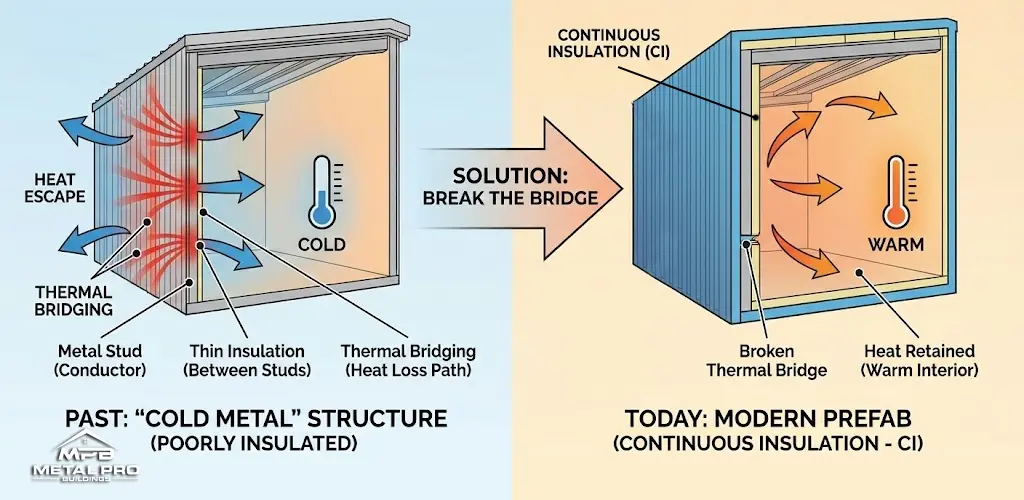
Metal is a conductor, meaning it likes to move heat. In the past, poorly built metal structures felt cold because heat escaped through the metal studs, a problem called thermal bridging.
Today, we use Continuous Insulation (CI). Think of this like wrapping your entire house in a high-tech parka. Instead of just putting insulation between the studs, we place a layer over them. This breaks the “bridge” and keeps the warmth inside where it belongs.
Effective R-Value: The Metric That Matters
You might see insulation labeled as R-20 or R-40. That is the “nominal” value. But in the Canadian cold, you need the Effective R-Value, the actual performance of the whole wall.
- Standard Wood Walls: Often lose 25% of their R-value through the wood studs.
- Metal Pro Systems: By using continuous rigid foam or closed-cell spray foam, we maintain a rock-solid thermal envelope.
In provinces like Alberta or Ontario, where winter nights are long, these systems can reach R-values of R-30 to R-50 for walls and R-60+ for roofs.
Efficiency as a Financial Investment
Heating a home in Canada isn’t cheap. By eliminating drafts and thermal leaks, a metal home kit reduces the load on your furnace. Many homeowners see their monthly energy bills drop by 30% to 50% compared to older wood homes. Over 20 years, those savings can pay for a significant portion of the home’s initial cost.
Navigating the Canadian Permit Maze (CSA A660 & A277)
One of the biggest hurdles for any new build is the paperwork. Many homeowners try to save money by importing cheap metal kits from overseas, only to find they’ve purchased an expensive “lawn ornament.” In Canada, if your structure doesn’t meet specific national safety standards, your local building official will likely deny your permit before you even break ground.
The Metal Pro Solution: 100% Canadian Compliance
At Metal Pro Buildings, we eliminate the stress of the “permit maze.” Every residential kit we provide is 100% Canadian CSA A660 Certified.
This isn’t just a label; it’s a national quality benchmark that audits the entire engineering and fabrication process. Our buildings are manufactured right here in Ontario using premium Canadian steel from ArcelorMittal Dofasco. When you choose Metal Pro, you aren’t just getting a building; you’re getting a structure designed specifically for the loads and codes of your exact Canadian address.
The “Fast Pass” for Building Inspectors
When you hand over your permit application, the inspector is looking for one specific document: the Certificate of Design and Manufacturing Conformance.
- Signed & Sealed: Every Metal Pro kit comes with this certificate, signed and sealed by a licensed Professional Engineer.
- National Building Code (NBC) Aligned: This document proves to the city that your home meets all provincial requirements for snow, wind, and seismic loads.
- Eliminating Human Error: Because our systems are factory-engineered, the inspector knows the structural integrity is verified by a third-party audit, not just a site-built guess.
Engineering Included: We Handle the Stamps
Whether you are building in British Columbia and need a Schedule B (Letters of Assurance) or in Ontario needing a P.Eng seal, we’ve got you covered. We provide the full documentation package including three sets of certified engineered and foundational drawings so you can move from “concept” to “construction” without hiring outside structural experts.
Beating the Snow: The Speed of the “Dried-In” Phase
In Canada, builders live by the calendar. There is a “Short Season” window between the spring thaw and the first November blizzard. If you miss that window, your project could sit frozen for six months. This is known as “Short Season” anxiety.
The Magic of the “Dried-In” Milestone
“Dried-in” means your home is weather-tight. The roof is on, the walls are up, and the windows are sealed. Once you hit this stage, the snow can fall all it wants. Your crews can work comfortably inside on the electrical, plumbing, and drywall.
Traditional wood framing can take 5 to 8 weeks just to reach this point. If a rainy week hits, your lumber gets soaked, leading to potential mold later. Metal kits change the game.
A Workflow Built for Speed
Because every piece of a metal home kit is pre-cut and pre-drilled, the “skeleton” goes up fast.
- Concurrent Progress: While your foundation is curing, your home is being manufactured in a factory.
- Rapid Assembly: A standard metal home can be framed and dried-in 30% to 50% faster than a wood home. We are talking weeks, not months.
- No “Wet Lumber” Issues: Steel doesn’t care about the rain or snow. It won’t swell or rot if it gets wet during the build.
The Lifestyle Connection
Imagine your current situation. Would you rather spend your Christmas staring at a frozen, half-finished wood frame covered in a blue tarp? Or would you rather be inside your “dried-in” metal home, finishing the kitchen while the storm rages outside? Speed isn’t just about saving money on labor. It’s about getting into your sanctuary before the winter sets in.
Aesthetics Without Compromise: It Doesn’t Have to Look Like a Barn
When people hear “metal home,” they often picture a cold, grey warehouse or a farm shed. In 2026, that couldn’t be further from the truth. Modern engineering allows you to build a home that looks exactly like a high-end designer residence. Whether you want a ‘Modern Farmhouse’ look or a ‘Minimalist Cube,’ a metal kit provides the perfect bones to make it happen. Many Canadian homeowners are also exploring barndominiums as a hybrid living space, which combine agricultural aesthetics with modern residential comfort using the same metal-frame technology.“
Architectural Freedom: The “Clear Span” Advantage
One of the best parts of a metal kit is the Clear Span design. Traditional wood homes need “load-bearing walls” every few meters to hold up the roof. This often breaks up your living space with clunky pillars.
Steel is so strong that it can span huge distances without middle support. This is how you get those massive, light-filled “Great Rooms” that are so popular in the Rockies and the Muskokas. You can have an entirely open floor plan with floor-to-ceiling windows and vaulted ceilings.
Curious how a steel home looks in a residential neighborhood? View our recent residential projects.
Exterior Versatility: Matching Any Neighborhood
You aren’t limited to metal siding. Once the steel frame is up, you can finish the exterior with almost any material:
- Natural Cedar Accents: Perfect for a West Coast or cottage look.
- Stone and Brick Veneer: Adds a classic, sturdy feel for suburban lots.
- Modern Stucco or Fiber Cement: For a sleek, contemporary aesthetic.
Most people walking past a finished metal home will have no idea it’s made of steel. They’ll just see a beautiful, modern house. Whether you want a “Modern Farmhouse” look or a “Minimalist Cube,” a metal kit provides the perfect bones to make it happen.
The Lifecycle Math: Why Steel is the Savvy Canadian’s Choice
When you build a home, the sticker price is only half the story. The real cost of a house is measured over 30 to 50 years. In the Canadian market, where inflation and carbon taxes are a daily reality, “Lifecycle Math” is where metal home kits truly shine.
Maintenance-Free Living: Summer is for the Lake
If you own a wood home, your summer weekends often involve a “to-do” list: scraping peeling paint, replacing rotted deck boards, or fixing siding that has buckled in the humidity.
Steel doesn’t rot, split, or warp. Most modern metal home kits come with high-performance coatings that are warrantied for 40 years or more. This means you spend your summers on the trails or the water, not climbing a ladder with a paintbrush.
The Financial Comparison: Wood vs. Steel
To see the true value, you have to look at the long-term expenses. Here is how a metal home kit stacks up against a traditional wood-frame house over time:
| Expense Category | Traditional Wood Frame | Metal Home Kit (Steel) |
| Pest Control | High (Annual spray/inspections) | Zero (Steel isn’t edible) |
| Roof Replacement | Every 15–20 years (Asphalt) | 50+ years (Metal) |
| Exterior Painting | Every 5–7 years | 40+ years (Factory coating) |
| Structural Settling | Common (Cracked drywall) | Rare (Steel stays straight) |
| Insurance Rates | Standard | Preferred (Non-combustible) |
The “Hidden” Discount: Insurance & Resale
Canadian insurance companies are becoming more cautious due to wildfire risks. Because steel is non-combustible and resistant to extreme wind, many providers offer lower premiums for steel structures. In high-risk zones, steel is often the only material insurers are eager to cover.
Furthermore, a metal home built today will be just as straight and square in 2080 as it is on Day One. When it comes time to sell, a home that hasn’t “settled” or developed mold issues commands a much higher resale price.
Conclusion: Your Home, Built to Last as Long as the Land
Building a home in Canada is more than just a financial investment; it is about creating a sanctuary that can withstand the test of time and the elements. We’ve seen that the “old way” of building with wood is increasingly plagued by rising costs, labor shortages, and climate risks.
Metal home kits represent the next evolution of Canadian living. By choosing steel, you are opting for:
- Total Peace of Mind: Knowing your home won’t burn, rot, or be eaten by pests.
- Predictable Budgeting: Avoiding the “price-hike” surprises common in the lumber market.
- Unmatched Efficiency: Staying cozy during a -40°C polar vortex without breaking the bank on heating.
Don’t settle for a house that starts decaying the moment the last nail is driven. Whether you are building a modern retreat in the Muskokas or a resilient family home on the Prairies, a precision-engineered metal kit is the savvy choice for the 2026 landscape.
Ready to take the first step toward your steel-strong future?
At Metal Pro Buildings, we don’t just sell kits; we deliver Canadian-made structures engineered specifically for our unique climate. We provide the CSA A660 certification and the stamped blueprints you need to make your permit process a breeze.
Click here to explore our Project Gallery and find your inspiration.