
Have you ever stood inside a massive warehouse and wondered how the roof stays up without a forest of pillars? It feels like magic, but it is actually the power of steel. Steel isn’t just a building material; it is the skeleton that allows our modern world to function. From the Amazon hubs that ship your packages to the factories that build your car, steel makes it all possible.
Building a modern industrial space is stressful and expensive. Many owners worry about their buildings becoming outdated or failing under the weight of heavy machinery. If you choose the wrong materials, you face constant repairs, limited space, and a building that can’t grow with your business. These “hidden” costs can sink a company before it even gets started.
In this article, we will break down why steel is the only choice for serious industrial work. You will learn how steel saves you money over time and how it protects your expensive equipment. We will also show you why steel buildings are easier to change as your business grows. By the end, you will understand how to build a “backbone” that lasts a century.
The Physics of “Big”: Why Scale Demands Steel
Imagine trying to park a fleet of semi-trucks inside a house. It wouldn’t work because the interior walls and wooden pillars would be in the way. In industrial construction, you need huge, open spaces. You cannot house a massive logic center or a logistics hub in a wood-frame building without a “forest” of columns blocking your path.
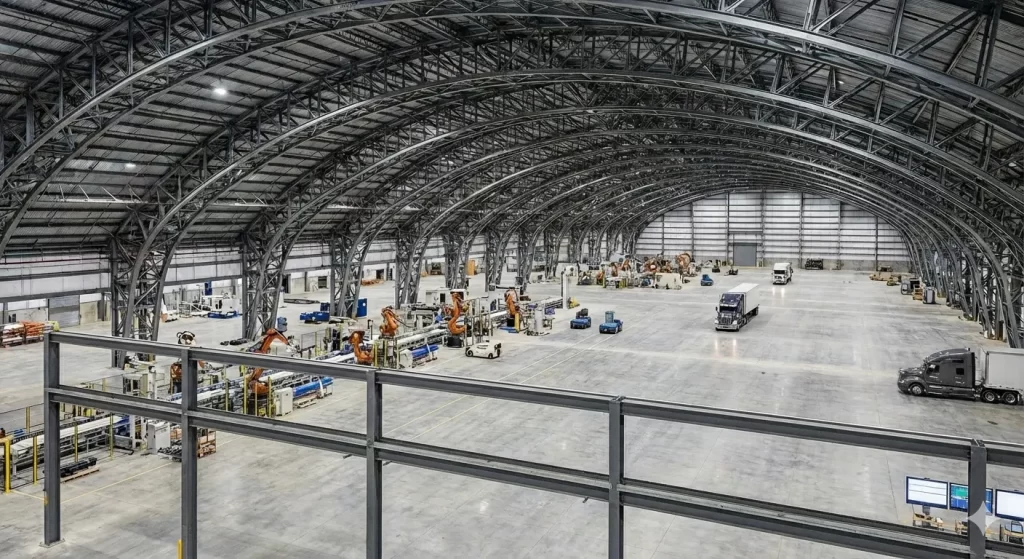
The Backbone Concept: Steel is the hero here because of the “Clear Span.” This is an engineering term for a building’s ability to bridge a vast distance, sometimes over 300 feet without a single support pillar in the middle. Because steel is so strong but relatively light, it can hold up a massive roof all by itself. This leaves the floor wide open for robots, trucks, and assembly lines.
What Most People Get Wrong: Many people think that to make a building bigger, you just need “thicker” walls. But in physics, weight is the enemy. If you build a massive structure out of stone or wood, the building eventually gets so heavy that it would “crush itself” under its own weight. Steel is the only material that stays strong enough to carry the building’s load plus the weight of everything inside, even at a massive scale.
The Vibration Factor: Housing the Machines
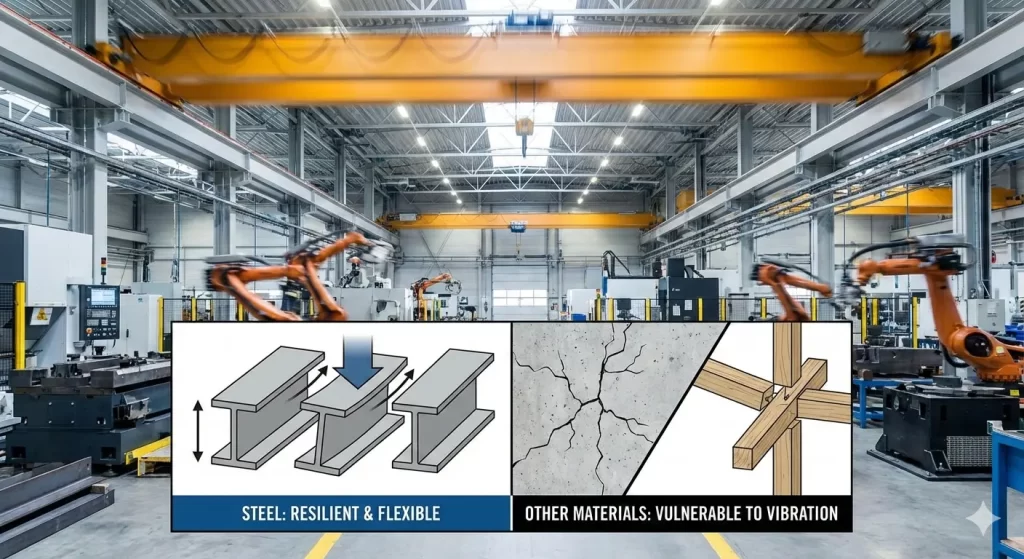
Modern factories are not quiet places. They are filled with massive moving parts, overhead cranes, and high-speed robotics. These machines create constant shaking. If a building cannot handle these “micro-movements,” the structure will eventually fail.
Steel is ductile. This means it can bend and flex without breaking. In a factory, steel acts like a giant shock absorber. It takes the kinetic energy from heavy machines and spreads it through the frame. Steel is resilient; it flexes under a heavy load and then returns perfectly to its original center.
Other materials struggle with motion. Wood can loosen at the joints or rot over time. Concrete is very strong but brittle; repetitive, high-frequency vibration can cause it to develop tiny cracks that grow into major problems. Without a steel backbone, your high-tech machinery would literally shake the building apart.
The Vertical Advantage: Volume vs. Square Footage
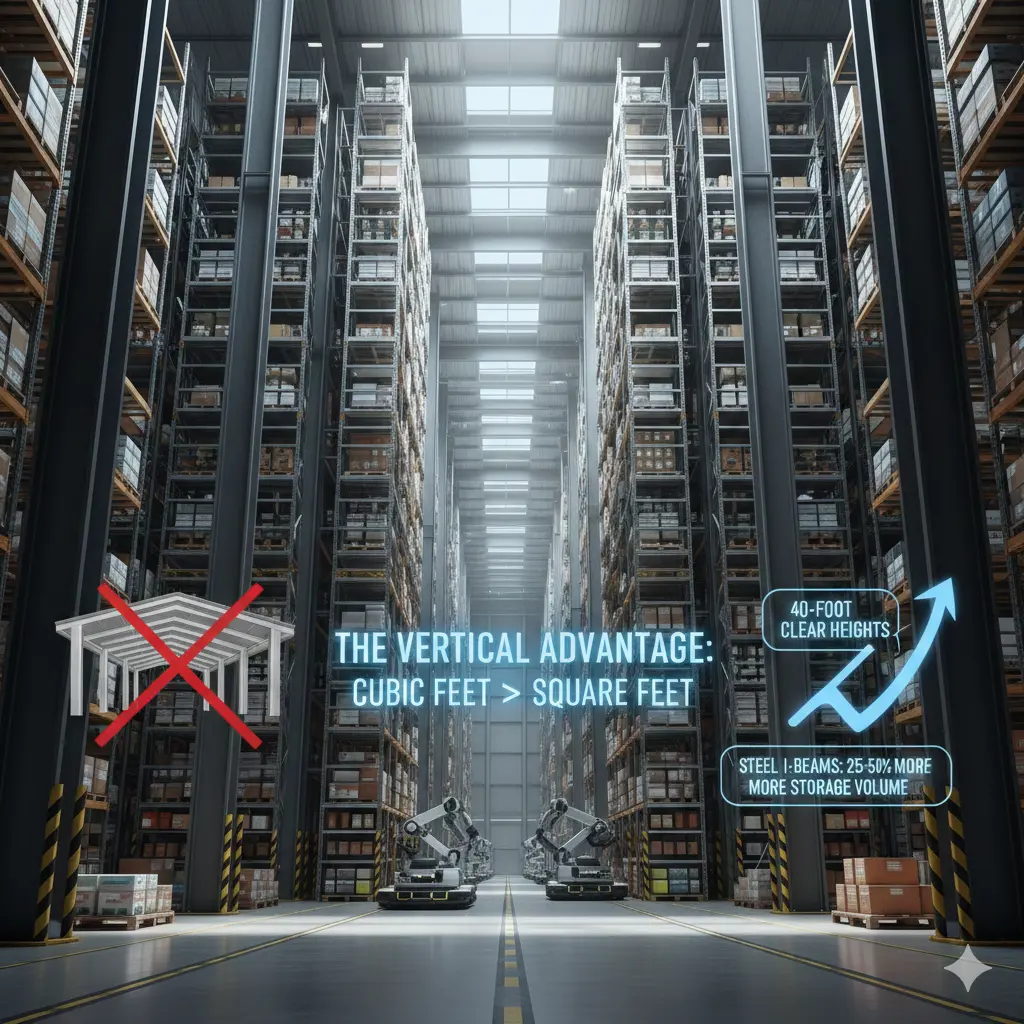
In the past, business owners looked at “square feet” to see if a building was big enough. Today, that has changed. In 2026, the focus is on “cubic feet.” Because land is expensive, modern industrial construction is moving upward rather than outward.
To compete in today’s world of automated shipping and logistics, you need height. Modern “Class A” warehouses now aim for 40-foot “clear heights.” This extra height allows for massive automated racking systems that can hold thousands of more products in the same footprint. If you build with wood or concrete, reaching these heights requires incredibly thick supports that eat up your valuable floor space.
Steel I-beams are the secret to going vertical. Because steel has a high strength-to-weight ratio, you can use slender beams to support a very high roof. This allows the building to stay tall and narrow at the base rather than becoming “bottom-heavy.” With steel, you get 25% to 50% more storage volume without needing a single extra inch of land. But sizing that height correctly requires understanding clear height constraints and design trade-offs before breaking ground.
The “Modulor” Fallacy: Why Industrial Buildings Must Change
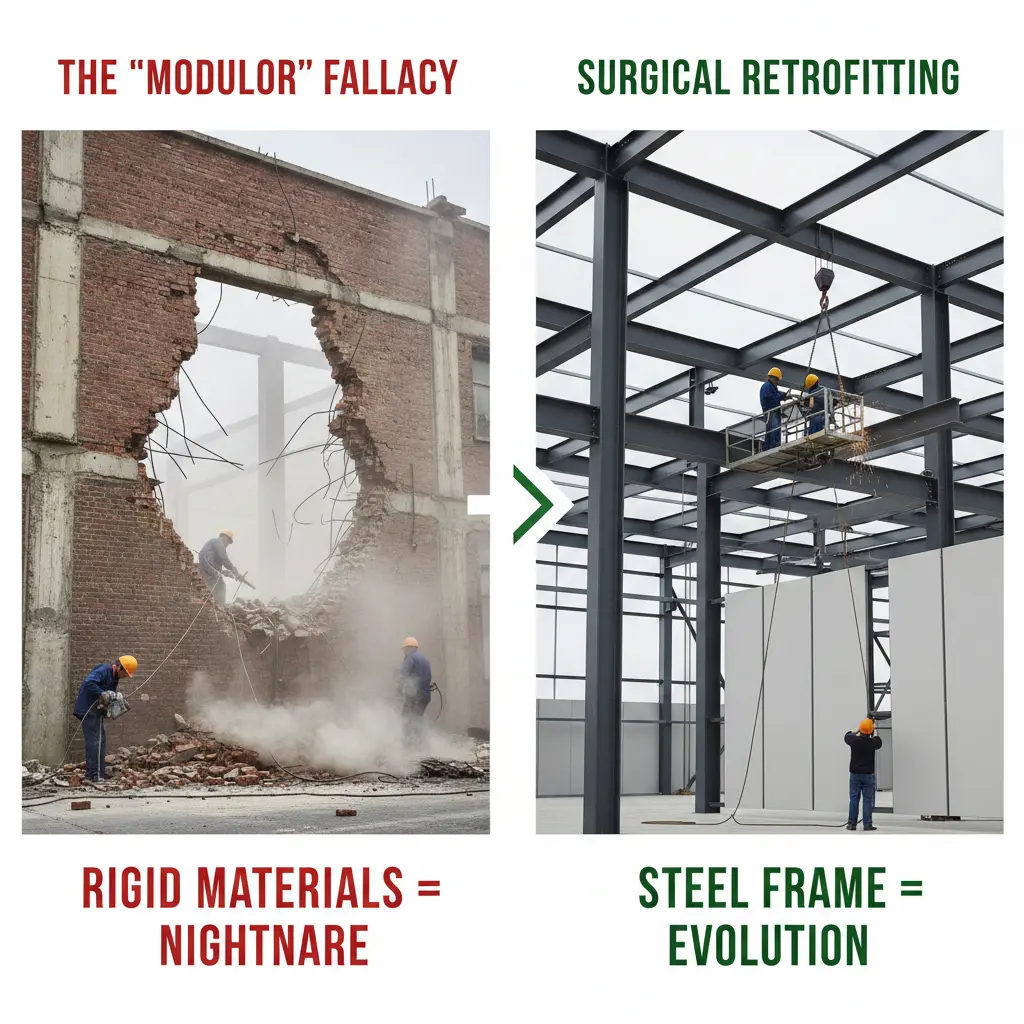
People often think a building is “finished” once the roof is on. They view a warehouse or factory as a permanent box that will stay the same forever. In the fast-paced industrial world, this way of thinking is a trap.
Industrial tenants change, and technology moves fast. A warehouse that stores dry goods today might need to become a cold-storage unit tomorrow. A traditional factory might need to be gutted and turned into a high-density server farm. If your building is made of rigid materials like brick or poured concrete, making these changes is a nightmare that involves jackhammers, dust, and massive costs.
Steel is the only material that allows for “Surgical Retrofitting.” Because the building’s strength is in a frame of beams and bolts, you can modify it with incredible precision. Need to add a new mezzanine level? You can bolt it directly to the existing columns. Need a new opening for a massive machine? You can cut out a section of the wall and weld in a reinforcement beam in hours. You simply cannot “weld” a new wing or a heavy-duty crane onto a brick building. Steel allows your building to evolve as fast as your business does.
Survival Physics: The Seismic and Wind “Backbone”
If you look it up, you will see that steel is “strong in tension.” This means it can be pulled and stretched without snapping. While this sounds like a classroom fact, it is the secret to why a skyscraper doesn’t fall over during a storm.
Ask any contractor in a disaster zone, and they will tell you: a rigid building is a dead building. If a building is too stiff like one made of unreinforced brick or heavy concrete it cannot handle the Earth moving under it. When a hurricane or earthquake hits, the building needs to give a little. Steel’s ability to sway and dissipate energy is why industrial hubs in California and Japan are 99% steel. It’s not about being “hard”; it’s about being “tough.”
Modern steel buildings use “moment-resisting frames” and “dampers” that act like shock absorbers for a car. During a massive windstorm or a 7.0 earthquake, the steel frame actually drinks up the energy of the disaster. Instead of cracking, the building moves with the force and then snaps back into place. This “survival physics” is what keeps your inventory safe and your workers alive when nature strikes.
The 100-Year ROI: Maintenance of the Skeleton
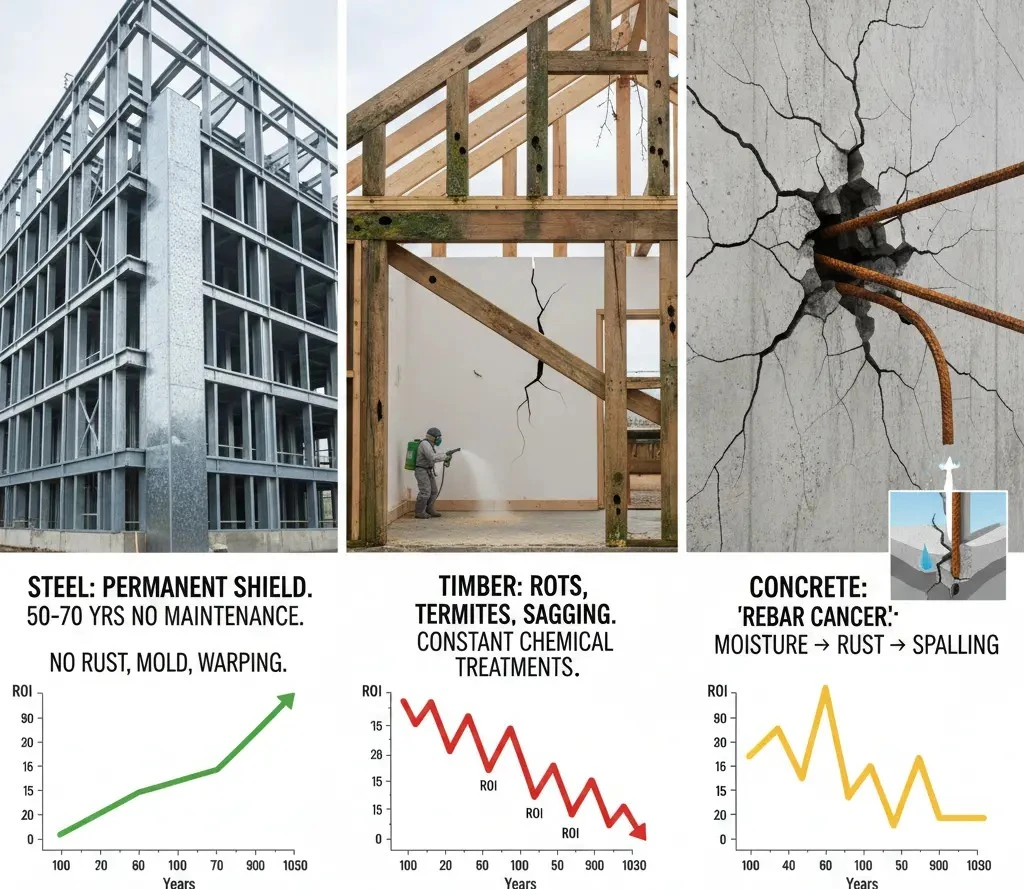
A common worry is that metal eventually rusts, making it a high-maintenance choice. Many people believe that because steel is made of iron, it is a ticking time bomb for corrosion and expensive repairs.
Modern technology has solved the rust problem. Techniques like hot-dip galvanization and advanced industrial coatings create a permanent shield around the steel. In most industrial environments, a galvanized steel frame can last 50 to 70 years without needing any structural maintenance at all. Because steel is inorganic, it doesn’t warp, shrink, or host mold, which keeps the building’s skeleton perfectly straight for a century.
When you look at the long-term Return on Investment (ROI), steel wins by a mile.
- Timber: Wood is a “living” material that can rot, attract termites, or sag over time. It requires constant chemical treatments to stay safe.
- Concrete: While concrete is tough, it suffers from “rebar cancer” (spalling). If tiny cracks allow moisture to reach the steel bars inside the concrete, they rust and expand, causing the concrete to explode from the inside out.
With steel, what you see is what you get. The “backbone” remains as strong on day 10,000 as it was on day 1.
Conclusion: The Material That Built the Modern World
We often call our history the “Industrial Age.” This name exists because of steel. Without this material, the massive leaps in logistics, manufacturing, and technology that we see in 2026 would be impossible. Steel is more than just a metal; it is the infrastructure that allows the global economy to breathe and expand.
If you try to build a modern industrial business on a 19th-century material backbone, you will run into walls both literally and figuratively. Your business will be limited by the architecture you choose. By choosing steel, you aren’t just buying a building. You are buying the freedom to scale, the strength to survive, and the flexibility to change with the times.
Take Your First Step
Don’t let your building be the thing that holds your business back. If you are planning a new facility, start by looking for a structural engineer who specializes in high-clearance steel frames. Ask about “clear span” options and how you can maximize your “cubic footage.” Building the right backbone today means you won’t have to rebuild it tomorrow.
Ready to start your next project with the strength of steel?
Download Our Modern Steel Construction Brochure Get the technical specs, case studies, and cost-benefit analyses you need to build for the future.