
It’s early March. You walk out to your greenhouse and the roof has caved in. Snow did what snow does in Canada. Your seedlings are gone, your season is already behind and it all comes down to one decision you made months ago.
This happens every year to farmers across BC, Ontario, the Prairies, and Quebec. And it almost always traces back to the same thing: the wrong greenhouse structure.
A greenhouse isn’t just a building. It’s your growing season, your income, your food independence. So the real question isn’t “wood or steel?” , it’s what kind of farming future do you want?
This article is an honest, side-by-side comparison of two main contenders:
- Traditional greenhouses : wood or aluminum frames with glass or polycarbonate glazing
- Steel-frame greenhouses : engineered, load-bearing structures built for performance
By the end, you’ll know exactly which one fits your farm, your climate, and your long-term goals.
What We Mean by “Traditional Greenhouse”
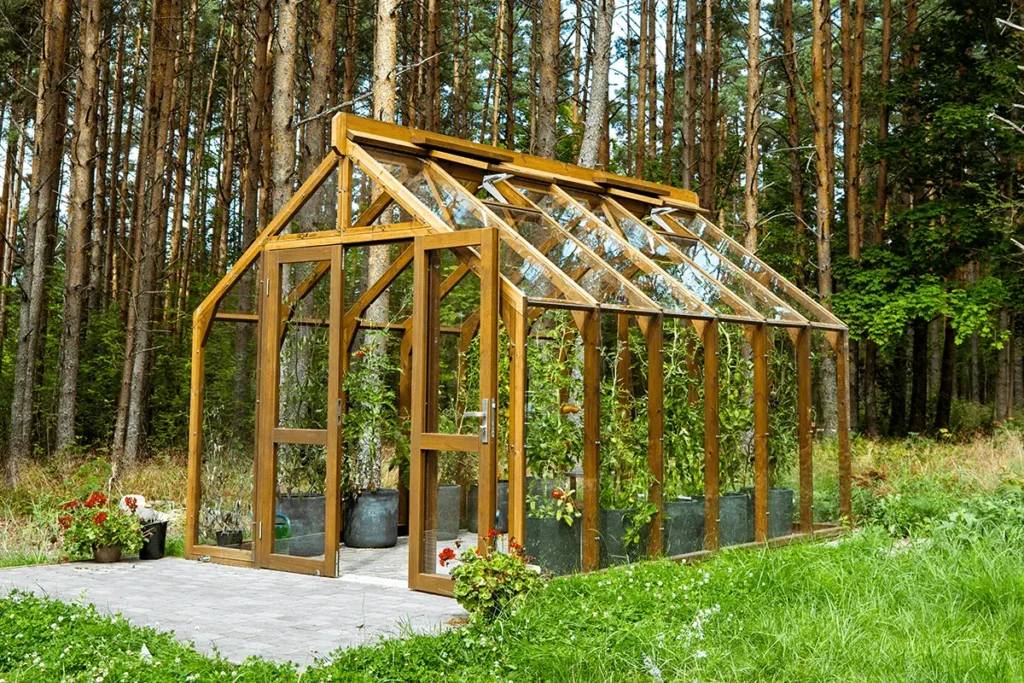
When most people picture a greenhouse, they picture a traditional one. Wood or aluminum frames. Glass or polycarbonate panels. A structure that looks like it belongs on a heritage farm or in a gardening magazine.
These greenhouses have been around for generations and for good reason. They’re familiar, widely available, and often cheaper to build upfront. Many farmers inherit them. Others build them as weekend DIY projects.
Traditional greenhouses are popular with:
- Hobby growers testing the waters before committing to a larger setup
- Small farms with limited starting budgets
- Homesteaders who value the rustic, natural aesthetic of wood construction
There’s real appeal here. Wood feels warm. Glass looks beautiful. And if you’ve grown up around these structures, they feel like home.
But here’s the problem.
That charm has a shelf life and in Canada, it’s shorter than most people expect.
Wood warps. It swells with moisture and shrinks in the cold. Freeze-thaw cycles are relentless, and they attack wood frames every single winter. Aluminum fares better, but it still bends under heavy snow loads and offers little structural confidence when a real storm rolls in.
They look beautiful until the second or third Canadian winter.
What Is a Steel-Frame Greenhouse?
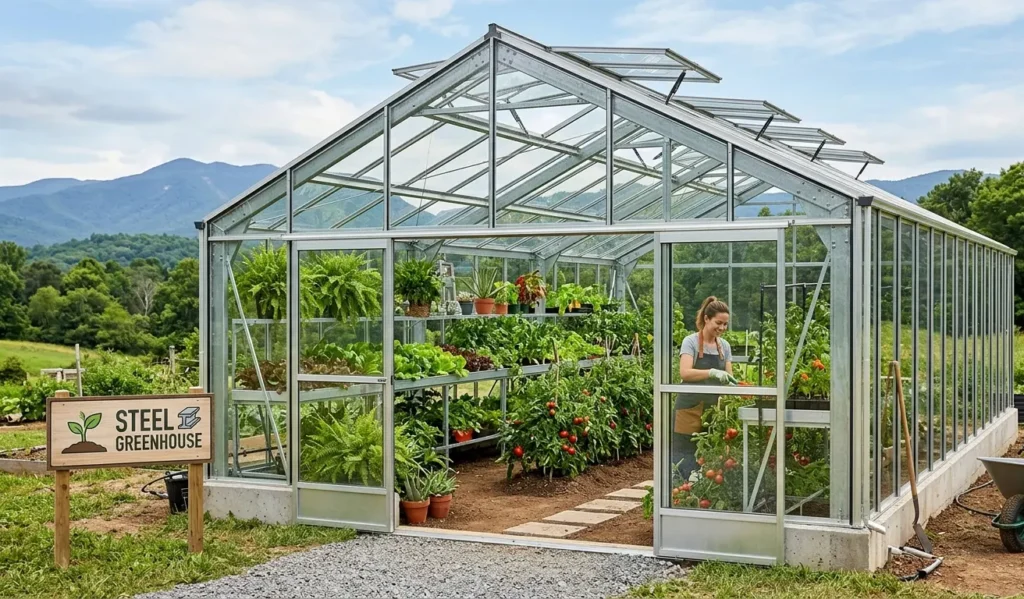
A steel-frame greenhouse is exactly what it sounds like a structure built on an engineered steel skeleton. But the details matter.
The best ones use hot-dip galvanized or powder-coated steel, which means they’re built to resist corrosion from the inside out. These aren’t the flimsy hoop houses you see in big-box stores. They’re engineered structures, designed to handle real loads, heavy snow, high winds, and decades of freeze-thaw cycles.
Modern steel greenhouses offer features traditional structures simply can’t match:
- Clear-span interiors : no internal columns eating into your growing space
- Modular builds : designed to expand as your farm grows
- Custom sizing : built to fit your land, not the other way around
These aren’t one-size-fits-all kits. They’re purpose-built for serious growers.
At Metal Pro, we build steel greenhouses specifically for Canadian conditions engineered from the ground up, not pulled from a generic catalogue. Our clients range from commercial growers who can’t afford seasonal downtime, to forward-thinking hobby farmers who’ve already lost one structure to a bad winter, to agri-businesses scaling into hydroponics and year-round production.
If your farm is your livelihood or you want it to be this is the category worth understanding.
Head-to-Head Comparison: The 7 Factors That Actually Matter
Let’s get into the details. Here’s how traditional and steel-frame greenhouses stack up across the factors that actually affect your farm.
1. Structural Strength & Weather Resistance
Canadian weather doesn’t negotiate. Heavy snow loads, freeze-thaw cycles, and high winds will test any structure every single year.
Traditional wood frames warp, swell, and weaken over time. Moisture gets in, freezes, expands, and slowly destroys the integrity of the frame. Aluminum fares better, but it still bends under serious snow loads and offers little confidence in a real storm.
Steel-frame greenhouses are engineered to meet Canadian snow load and wind codes including National Building Code (NBC) and provincial standards. They’re designed with these conditions in mind, not just adapted to them.
That snowstorm last February didn’t care about your wood frame.
✅ Steel wins
2. Lifespan & Long-Term Durability
This one is straightforward but the numbers might surprise you.
A well-maintained traditional greenhouse lasts 10–20 years. And “well-maintained” means consistent work: sealing gaps, replacing rotted boards, re-glazing broken panels, fighting rust on aluminum joints.
A steel-frame greenhouse, properly galvanized, lasts 40–60+ years with minimal structural upkeep. Galvanized steel resists corrosion even in high-humidity growing environments.
Think about cost per year of use. A $15,000 traditional greenhouse lasting 15 years costs $1,000/year just in structure. A $30,000 steel greenhouse lasting 50 years costs $600/year and that’s before you factor in maintenance savings.
✅ Steel wins
3. Maintenance Requirements
Traditional greenhouses demand attention every season. Annual sealing. Repainting. Replacing warped or rotted boards. Re-glazing broken panes after every harsh winter. It adds up in money, yes, but more painfully, in time.
Steel frames need almost none of that. An occasional inspection is typically all that’s required. The structure does its job quietly, year after year.
Imagine spending your weekends growing , not repairing.
✅ Steel wins
4. Upfront Cost vs. Total Cost of Ownership
Traditional greenhouses win on sticker price. That’s real, and it’s worth acknowledging. But sticker price is only part of the story.
Hidden costs accumulate fast: repairs, energy loss through gaps and poor insulation, earlier-than-expected replacement. Over 20 years, a “cheaper” traditional greenhouse often costs more than a steel one.
Here’s a simple breakdown:
| Factor | Traditional Greenhouse | Steel Greenhouse |
| Avg. Lifespan | 10–20 years | 40–60+ years |
| Annual Maintenance Cost | $500–$1,500+/year | Minimal |
| Snow/Wind Resistance | Moderate | Engineered to code |
| Total 20-Year Cost | High (repairs + early replacement) | Lower (durable, low maintenance) |
| Customization | Limited | Fully custom |
The math favors steel , especially for farmers thinking beyond the next five years.
✅ Steel wins on total cost of ownership
5. Growing Season Extension
This one matters enormously in Canada. Every extra week of growing season is yield. It’s income. It’s independence.
Traditional greenhouses struggle here. Air gaps, poor insulation integration, and heat loss in shoulder seasons mean you’re fighting the cold instead of growing through it.
Steel-frame greenhouses support airtight construction. They’re compatible with modern heating systems and insulated cladding options that keep heat in when temperatures drop.
What would an extra 6–8 weeks of growing mean for your harvest or your income?
✅ Steel wins
6. Customization & Scalability
Your farm today is not your farm in ten years. Plans change. Operations grow. Crops diversify.
Traditional greenhouses are difficult and expensive to expand. Their structural limits mean you often have to tear down and start over when your needs outgrow the building.
Steel greenhouses are modular by design. You can expand the footprint, increase the span, or reconfigure the interior as your operation evolves. They grow with you not against you.
✅ Steel wins
7. Environmental Impact & Sustainability
This factor is becoming harder to ignore. Consumers care. Regulations are tightening. And Canadian farmers are increasingly expected to demonstrate sustainable practices.
Traditional wood-frame greenhouses require frequent replacement meaning more raw materials consumed over time. Wood sourcing, disposal, and rebuilding all carry an environmental cost.
Steel is fully recyclable. Its long lifespan means fewer resources consumed per decade of use. One steel greenhouse built today may still be standing and growing when your grandchildren take over the farm.
✅ Steel wins
Where Traditional Greenhouses Still Make Sense
This comparison wouldn’t be honest without acknowledging where traditional greenhouses have a legitimate place. Not every farm needs a steel structure and pretending otherwise would be doing you a disservice.
Traditional greenhouses still make sense when:
- You’re a hobby grower with no plans to expand beyond a small personal garden
- Your budget is extremely tight and you have no long-term farming intent
- Aesthetics are the priority heritage properties or lifestyle farms where visual style matters more than performance
- You need something temporary while planning a larger permanent structure
These are real scenarios, and a basic kit greenhouse or wood-frame build can serve them just fine.
But here’s the honest truth.
If your farm is your livelihood or you want it to be, the math changes fast. The moment you start depending on your greenhouse for income, food security, or serious year-round production, the calculus shifts completely.
A structure that costs less upfront but fails in year eight isn’t a bargain. It’s a liability.
Growing a few tomatoes for fun? A kit greenhouse might be perfectly fine. Building a farming future? That’s a different conversation entirely.
The Canadian Climate Factor: Why This Decision Hits Different Here
Farming in Canada is not the same as farming anywhere else. The climate doesn’t just challenge your greenhouse it actively tries to defeat it. And it has a long season to try.
Depending on where you farm, you’re dealing with:
- Snow loads that can exceed 100 kg/m² in BC’s interior, the Prairies, and parts of Quebec
- Wind events that arrive fast and hit hard across open agricultural land
- Freeze-thaw cycles that repeat dozens of times each winter, attacking every joint, seal, and frame member
- Shoulder seasons where a single cold snap can wipe out an early or late harvest
These aren’t edge cases. They’re the reality of Canadian agriculture.
Canadian building codes reflect this reality. Agricultural structures are subject to National Building Code (NBC) requirements and provincial standards that account for regional snow and wind loads. A greenhouse that isn’t engineered to these standards isn’t just underbuilt; it may not be insurable.
Traditional greenhouses are rarely designed with these codes in mind. Steel-frame greenhouses, when properly engineered, are built to meet or exceed them.
The cost of a greenhouse failure in Canada goes beyond the structure itself. Think about what’s inside: seedlings started weeks in advance, heating systems, irrigation infrastructure, growing media, and crops at various stages. A collapsed or compromised greenhouse mid-season can set a farm back an entire year.
Canadian farmers don’t get second chances from a March blizzard.
Steel was essentially engineered for climates like ours. The structural calculations that go into a properly designed steel greenhouse load-bearing capacity, deflection limits, connection strength are precisely the factors that matter when a Canadian winter decides to push back.
This isn’t about building bigger for the sake of it. It’s about building smart for the conditions you actually face.
Why Metal Pro? Building Greenhouses for the Way Canada Actually Farms
If you’ve made it this far, the case for steel is probably clear. The next question is the one that actually matters: who do you trust to build it?
Not all steel greenhouses are created equal. An engineered structure is only as good as the company behind the engineering. And in Canada, that means working with someone who understands the climate, the codes, and the real demands of Canadian agriculture, not a manufacturer based somewhere that’s never seen a February snowstorm.
That’s where Metal Pro comes in.
We’re a Canadian company, building steel structures for Canadian conditions. Our greenhouses aren’t pulled from a generic catalogue and shipped to your farm with a “good luck” note. Every structure we build is custom-engineered to your location, your land, and your operation.
Here’s what working with Metal Pro looks like:
- Custom engineering : structures designed around your specific snow load, wind zone, and site conditions
- End-to-end service : from initial design through engineering, supply, and ongoing support
- Scalable builds : whether you’re starting small or building a commercial operation, we design for where you’re going, not just where you are
- Canadian expertise : a track record with farms across the country, in the climates that actually test a structure
We don’t believe in one-size-fits-all greenhouses because no two farms are the same.
Whether you’re extending your growing season by two months or building a year-round commercial operation from the ground up, the right greenhouse starts with the right conversation.
Get a free consultation and custom quote from Metal Pro →
How to Choose: A Simple Decision Framework
Still weighing your options? Run through this quick checklist. It takes less than a minute and it’ll tell you everything you need to know.
Check every statement that applies to your situation:
- I plan to farm seriously for 10 or more years
- My location gets heavy snow, high winds, or both
- I want to extend my growing season into shoulder months
- I’m planning to scale my operation over time
- Long-term ROI matters more to me than the lowest upfront cost
- My greenhouse will support my income — not just my hobby
Here’s how to read your results:
If you checked 1–2 boxes, a traditional greenhouse may meet your current needs. Keep your budget lean and revisit as your plans evolve.
If you checked 3–4 boxes, you’re in the middle ground but the risk of underbuilding is real. A steel greenhouse will likely pay for itself faster than you expect.
If you checked 5–6 boxes, a steel greenhouse isn’t just the better option. It’s the only decision that makes financial and practical sense for your farm.
Most Canadian farmers who farm seriously check at least four. If that’s you, the conversation is worth having.
This Isn’t Just About a Building
Remember that farmer we talked about at the start walking into a collapsed greenhouse in early March, staring at lost crops and a lost season?
That moment isn’t really about a building. It’s about everything that was counting on that building. The seedlings started weeks earlier. The income planned around that harvest. The confidence that comes from knowing your operation can handle a Canadian winter.
That’s what’s actually at stake in this decision.
Steel costs more upfront. That’s true, and it’s worth saying plainly. But what you’re buying isn’t just steel it’s decades of growing seasons you won’t lose. It’s weekends spent farming instead of repairing. It’s the ability to scale when you’re ready, without tearing everything down and starting over.
It’s peace of mind through every Canadian winter between now and retirement.
That kind of confidence doesn’t come from the cheapest structure on the market. It comes from building something that was designed from the first engineering calculation to the last bolt , to last.
You’ve put too much into your land to settle for a structure that won’t.
If you’re ready to build a greenhouse that works as hard as you do, Metal Pro is ready to help. No pressure, no generic quotes, just an honest conversation about what your farm needs and how we can build it.
Book your free consultation with Metal Pro today →