
Ever feel like your kitchen table is a battlefield? Between the hum of the fridge and the clutter of daily life, “working from home” often feels like “working in chaos.”
Many remote professionals struggle to find a quiet, dedicated space. You need a place that handles professional Zoom calls but also accommodates your heavy-duty hobbies or side hustles. A standard home office is too small, and a garage is often too dark and cramped.
This article will show you how a custom metal building shop can be the perfect solution. You’ll learn how to design a layout that boosts productivity, integrates modern tech, and keeps your work life separate from your home life.
Understanding Modern Remote-Work Lifestyles
Remote work isn’t just about a laptop anymore. Today’s professionals often blend digital tasks with hands-on projects. You might be a software engineer by morning and a woodworker by afternoon.
Daily Needs of Remote Professionals
A productive day requires more than just Wi-Fi. You need ergonomic comfort, zero distractions, and a space that feels professional. Metal buildings offer the “blank canvas” necessary to meet these diverse needs.
Blending Digital and Creative Tasks
Your shop should support your whole self. Designing a space that handles a dual-monitor setup and a welding bench requires smart zoning. It’s about creating a flow where one activity doesn’t ruin the other.
The Power of Separation
Physical distance between your “living” space and “earning” space is vital. Walking across the yard to a dedicated shop creates a mental shift. It helps you “arrive” at work and, more importantly, “leave” work when the day is done.
Purpose-Driven Design for a Metal Building Shop Workspace
Before you pour the concrete or bolt a single beam, you must decide: What is the primary job of this building? A metal building designed for a software developer who occasionally restores vintage motorcycles looks very different from a full-time fabrication shop with a small desk in the corner.
Defining the Shop’s Role
Think about your average Tuesday. Are you spending eight hours on video calls, or are you running a CNC machine? If your work is 90% digital, your design should prioritize insulation and acoustics. If your “shop” work is the bread and butter, your layout needs to focus on equipment clearance and heavy-duty power.
Office-First vs. Shop-First Layouts
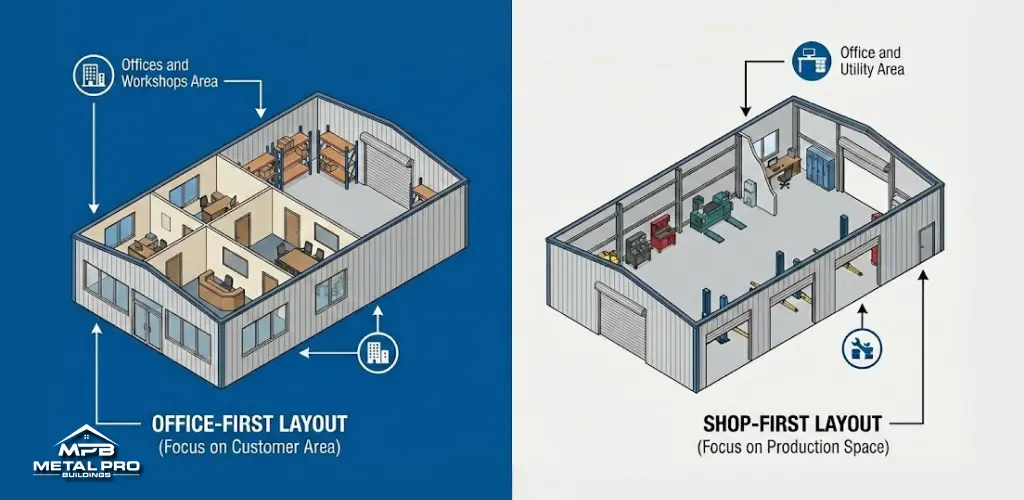
- Office-First: This design treats the shop as an extension of the office. The office is often a fully finished “room-within-a-room” with high-end HVAC and soundproofing. It’s perfect for those who need a pristine environment for professional meetings.
- Shop-First: Here, the office is a functional nook. It might be an elevated mezzanine or a corner partitioned by glass. This is ideal if your remote work is creative or technical like engineering, where you move constantly between a computer and a prototype.
Designing Around Your Routine
Layout isn’t just about where things sit; it’s about how you move.
- The “Morning Path”: Place your coffee station and office entry near the door closest to your house.
- The “Dirty Zone”: Keep the heavy machinery and messy projects at the far end of the building, away from your “clean” office air.
Layout Design for Focus and Flexibility
One of the biggest perks of a metal building is the clear-span design. Because the roof is supported by the exterior frame, you don’t have to deal with annoying interior columns. This gives you total freedom to map out your floor plan.
Zoning Your Space
Don’t just “put things where they fit.” Create zones:
- The Hot Zone: For welding, grinding, or painting (needs high ventilation).
- The Cold Zone: For storage and assembly.
- The Quiet Zone: Your enclosed office.
Open-Plan vs. Divided Interiors
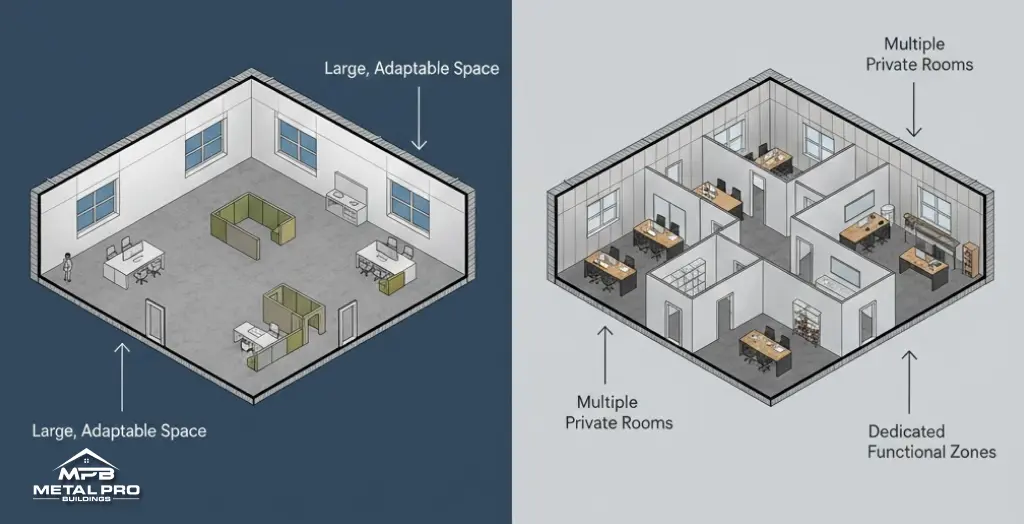
An open-plan shop feels massive and airy, which is great for large projects. However, for a remote worker, a divided interior is usually better. Using metal studs to create a permanent wall for your office provides a physical and acoustic barrier that “open” spaces lack.
The Mezzanine Advantage
If you have high ceilings (14ft or more), consider a mezzanine. Placing your office on a second level keeps your ground floor wide open for tools and vehicles. Plus, looking down at your shop from above provides a great “command center” feel for your workday.
Creating a Comfortable All-Day Work Environment
A metal building can feel like an icebox in the winter or an oven in the summer if it’s not designed correctly. To stay productive for an eight-hour shift, you need more than just four walls; you need climate and sound control.
Step 1: Prioritize Advanced Insulation
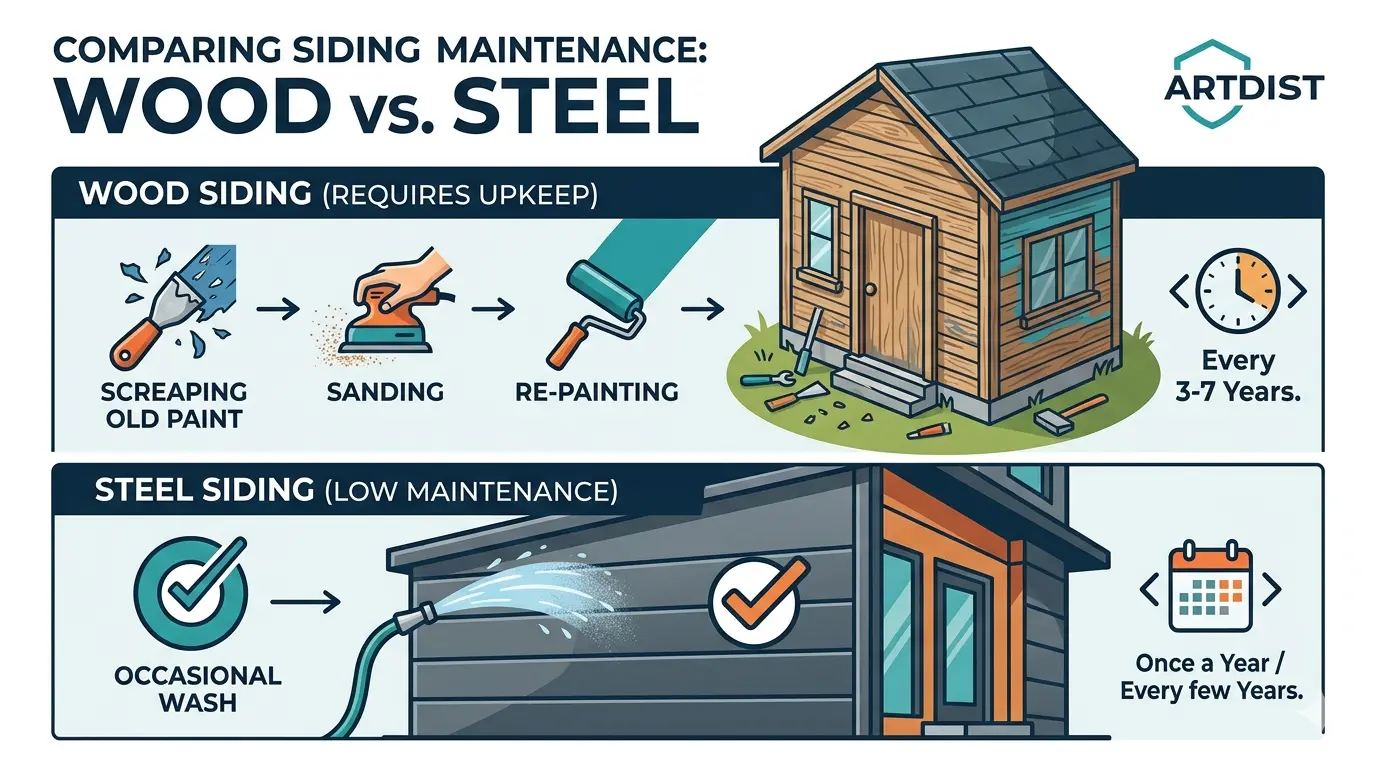
Metal is a high conductor of heat. Without a barrier, your workspace will follow the outside temperature.
- Best Choice: Closed-cell spray foam is the gold standard. It provides a high R-value (thermal resistance) and acts as a vapor barrier to prevent the “sweating” common in metal structures.
- Budget Alternative: Fiberglass blankets with a high-quality vapor retarder. They are cost-effective and provide decent sound absorption for a quieter shop.
Step 2: Plan Your HVAC for Mixed Use
You shouldn’t use the same heating and cooling logic for a dirty workshop and a clean office.
- The Mini-Split Solution: Install a ductless mini-split system. These allow you to heat or cool the office independently of the shop floor. They are quiet, energy-efficient, and don’t require bulky ductwork.
- Ventilation: If you plan on doing any welding or painting, install a dedicated exhaust fan in the shop zone to keep fumes away from your office intake.
Step 3: Master the Acoustics
Nothing ruins a professional Zoom call like the echo of a metal building or the hum of a compressor.
- The “Room within a Room”: Build your office as a separate wooden-framed structure inside the metal shell. Use Mass Loaded Vinyl (MLV) or acoustic mineral wool in the office walls to block outside shop noise.
- Soft Surfaces: Metal reflects sound. Add area rugs, acoustic wall panels, or even bookshelves to your office to kill the echo and make your voice sound crisp on calls.
Designing for Remote-Work Technology Needs
In 2026, a “connected” shop is non-negotiable. You need a space where the Wi-Fi is fast and the power is reliable.
Smart Power Placement
Don’t rely on extension cords. They are a trip hazard and a fire risk.
- The Office Zone: Install quadruple outlets every four feet. Include at least two USB-C charging ports directly in the wall plates.
- The Shop Zone: Run 220V outlets for heavy machinery (lathes, welders) and ceiling-mounted retractable cord reels so you have power wherever your project lands.
Lighting for Screens and Tasks
- The 500 Lux Rule: Aim for 500 lux of brightness at your desk for detailed work. Use LED panels with a “Daylight” color temperature (around 4000K to 5000K) to stay alert.
- Video Call Prep: Avoid placing your desk directly in front of a window, or you’ll be a silhouette on camera. Instead, use indirect LED lighting that bounces off the walls to provide a soft, professional glow on your face.
Modern Interior Design and Aesthetic Choices
Your metal building doesn’t have to look like a warehouse on the inside. In 2026, the trend is “Industrial Refined” mixing the raw strength of steel with the warmth of a modern home.
Step 1: Choose Your Design Language
- Industrial Chic: Lean into the structure. Paint exposed steel beams matte black and keep your concrete floors polished.
- Warm Minimalism: Soften the metal with natural wood accents. Use reclaimed wood for your desk or as a “feature wall” to break up the gray of the steel panels.
- Modern Loft: Use glass partitions for your office. This keeps the space feeling massive while providing a clear physical boundary.
Step 2: Select Materials for Comfort and Style
Don’t let the metal overwhelm the room. Balance the “hard” surfaces with “soft” textures:
- Flooring: Polished concrete is durable for the shop, but add a large, thick area rug in the office zone. It adds color and kills the “echo” effect.
- Walls: You don’t have to drywall the whole building. Consider using metal laminates or shiplap in the office area to create a “finished” look that feels separate from the workshop.
- Greenery: A “living wall” or a few large floor plants can transform a cold corner. Plants also act as natural sound diffusers.
Supporting Work-Life Balance Through Design
The biggest danger of a home-based shop is that you never feel like you’re “off.” Your design should help you protect your personal time.
Step 1: Create a “Transition Zone”
Instead of a door that opens directly into your workspace, design a small entry vestibule.
- The Mudroom Effect: Include a place to kick off dirty work boots and hang up your “shop coat.”
- The Mental Reset: This 4-foot space acts as a “decompression chamber” between your professional life and your home life.
Step 2: Define “Hard Boundaries”
- Physical Separation: If possible, place the building at least 20–30 feet from your main house. This short walk is your “commute,” helping your brain switch gears.
- Visual Privacy: Use landscaping or the orientation of the building so you aren’t looking at your unfinished “home chores” (like the lawn or the trash cans) while you’re trying to focus on a deadline.
Step 3: Build in “Recharge Zones”
Don’t just work and leave.
- The Coffee/Break Nook: Carve out a small corner with a comfortable chair and a coffee station.
- The Creative Wall: Use a section of the shop for “non-work” creative projects. Having a space to tinker without the pressure of a deadline makes the building a place of joy, not just labor.
Adaptability for Evolving Remote-Work Needs
A metal building is a long-term investment, but your career or hobbies might change in three to five years. Designing with adaptability ensures your shop doesn’t become obsolete. In 2026, the trend is “Modular and Future-Ready” creating a space that shifts as you do.
Step 1: Utilize Clear-Span Flexibility
Because metal buildings don’t require interior support columns, you have a 100% open floor plan.
- Action: Avoid building too many permanent interior load-bearing walls. If you need to divide a space, use metal studs and drywall or modular glass partitions that can be moved or removed later without compromising the building’s strength.
Step 2: Plan for “Vertical Expansion” (The Mezzanine)
If you aren’t ready to build a second floor yet, ensure your initial design has the ceiling height to accommodate one later.
- The 14-Foot Rule: A 14-foot eave height allows you to add a mezzanine in the future. This “bonus” space can start as storage and eventually become a secondary office, a guest suite, or a dedicated studio as your remote-work needs grow.
Step 3: Implement “Scalable” Utilities
Don’t bury your tech in places you can’t reach.
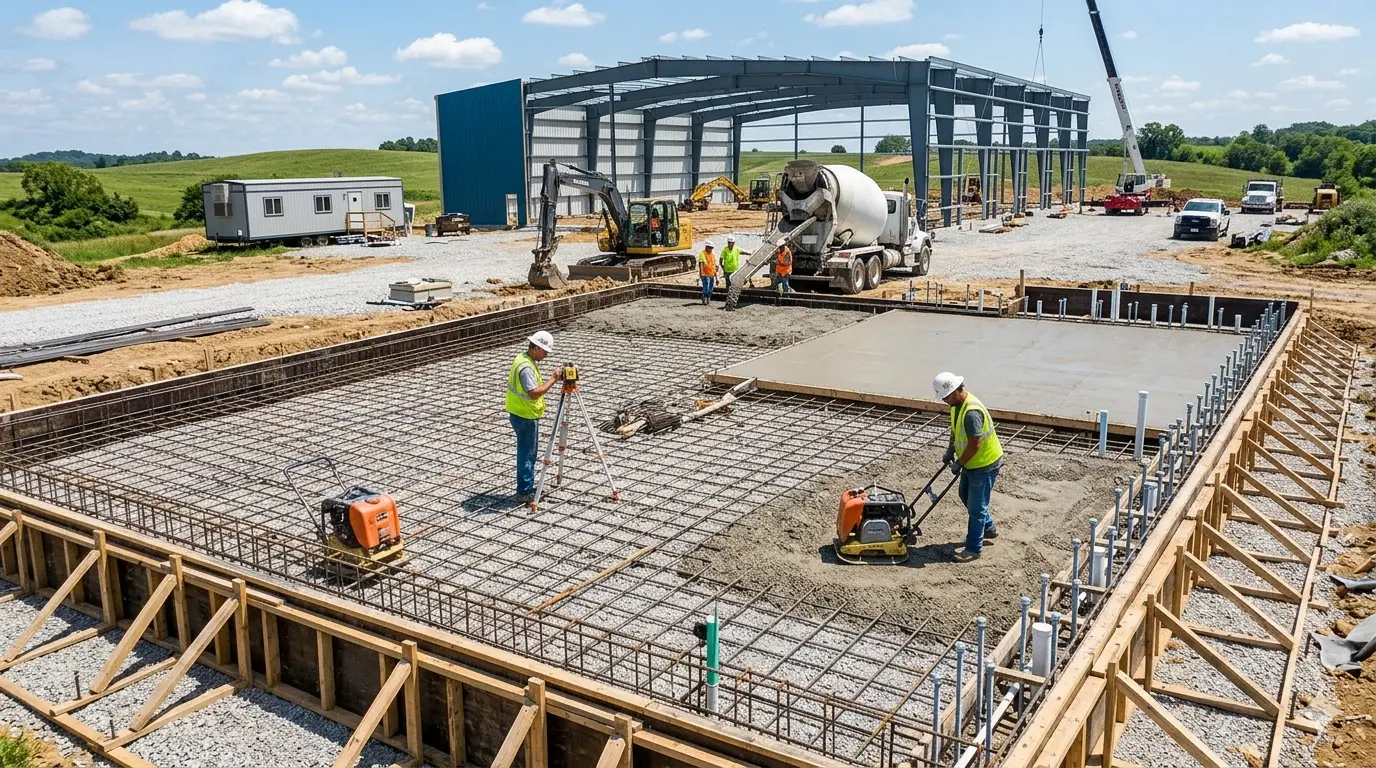
- Oversized Conduits: When pouring your slab or framing walls, run larger-than-necessary conduits. This makes it easy to pull new fiber-optic cables or higher-voltage wires in five years without tearing up the floor.
- Surface-Mounted Raceway: In the shop area, consider using wall-mounted electrical raceways. These allow you to add or move outlets in minutes as you buy new equipment or change your desk layout.
Key Design Takeaways for Remote-Work Metal Building Shops
Designing the perfect shop is a balance of logic and lifestyle. As you wrap up your planning, keep these “Golden Rules” in mind:
- Prioritize the Envelope: Spend the extra money on high-quality spray foam insulation and insulated doors. You can always buy a better desk later, but fixing a drafty building is expensive.
- Focus on the “Flow”: Keep your clean office and dirty workshop zones distinct. Your future self will thank you when your laptop isn’t covered in sawdust.
- Invest in “Smart Calm”: Use 2026 tech like occupancy sensors and circadian lighting. These small details reduce “decision fatigue” and keep you focused on your work.
- Separate to Elevate: Even if it’s just 20 feet from your back door, treat your shop like a destination. That mental separation is the secret to a long-term, successful remote-work lifestyle.
Ready to Start Building?
A metal building shop isn’t just a shed; it’s a productivity machine. By following these design principles, you’re creating a workspace that is as resilient and adaptable as the steel it’s built from. Use our 3D Builder to visualize your remote-work shop in real-time. No commitment required.