
You’ve Got Two Containers. Now What Goes Between Them?
You can picture it clearly with two containers, a covered space between them, your workshop or off-grid cabin finally taking shape.
Then you start searching for roof specs and find nothing useful. Forum posts from Texas. YouTube builds in California. Zero mention of Canadian snow loads.
Here’s the good news: the answers exist. They’re just not all in one place until now.
By the end of this article, you’ll know exactly what size steel roof you need for your container span, which variables matter most, and how to avoid costly mistakes before you order a single panel.
Let’s get into it.
It’s Not Just About Covering the Gap
Most people think the hard part is sourcing the containers. It’s not.
The hard part is what goes over them and getting it wrong has real consequences.
An undersized steel roof can sag, leak, or fail completely under a heavy Canadian snow load. Buying stock panels that don’t match your span wastes thousands of dollars. And a non-compliant structure can kill your insurance coverage, your permits, and your resale value.
This isn’t a decision to eyeball.
Before you get into specs, it helps to understand what you’re working with budget-wise. Here’s a full breakdown of shipping container cover costs so you can plan before you commit.
What “Span” Actually Means Here
Before anything else, let’s get the terminology straight.
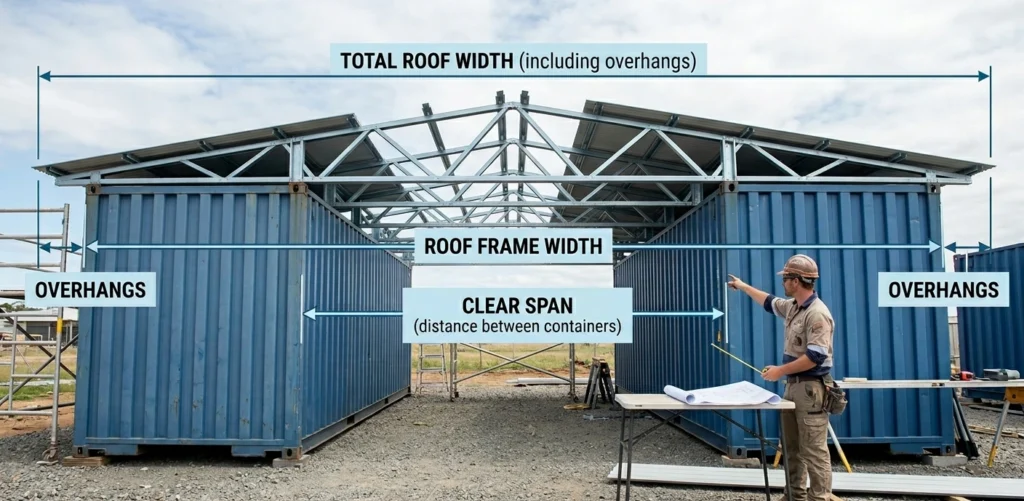
The clear span is the open distance between your two container walls , the gap you’re covering. That’s the number everything else is built around.
But your total roof width is larger than that. You need to account for overhangs on each side, plus however far the roof extends over the containers themselves.
Here’s why that matters: you could order panels sized for your gap and end up short. Or overorder and waste material. Getting the full picture clear span, total width, and overhang means ordering correctly the first time.
Canadian winters don’t leave much room for “close enough.”
How Far Apart Are Your Containers? Start Here.
The gap between your containers is the foundation of every decision that follows. Gauge, profile, framing, pitch it all starts here.
So let’s break down the most common configurations.
Standard Gap Sizes Between Two Containers
- Side-by-side with no gap (16ft–20ft total span) This is two standard 8ft-wide containers placed directly beside each other. The roof spans the full width of both no open middle section, but still a significant span to cover properly.
- Small gap (4ft–8ft) Common for a breezeway, utility corridor, or enclosed living space between containers. Manageable span, but framing and gauge still matter.
- Medium gap (10ft–16ft) This is the sweet spot for workshops, open-concept living spaces, and studio builds. Most container projects fall somewhere in this range.
- Wide gap (20ft or more) This is where structural engineering becomes less optional and more mandatory. More on that shortly.
What These Gaps Mean for Your Steel Roof
The span width directly affects three things: the gauge of steel you need, how you frame the roof underneath, and which panel profiles will actually perform.
- Spans under 12ft : Lighter gauge steel panels with standard purlin spacing can often handle this range, depending on your snow load zone.
- Spans from 12ft to 20ft : You’ll need heavier gauge steel and tighter purlin spacing. Cutting corners here is where projects go sideways.
- Spans over 20ft : A ridge beam or structural steel framing is typically required. This goes beyond panel selection into engineered support territory.
And here’s something most people miss: the span isn’t the only number that matters. Roof pitch, panel profile, and your local snow load all interact with that span measurement. Change one, and the others shift too.
We’ll cover each of those next.
Five Factors That Determine the Right Steel Roof for Your Span
Your span measurement is the starting point. But these five factors are what actually determine what you order.
Get one wrong and the whole system underperforms.
1. Snow Load , This Is Canada. It’s Not Optional.
Snow load is the single most important variable for Canadian container builds and the one most online guides completely ignore.
Ground snow loads vary dramatically across the country. Vancouver sits at one end of the spectrum. Edmonton, Northern Ontario, and the Quebec interior sit at the other. The National Building Code of Canada (NBC) sets the requirements, but your local municipality may have additional rules on top of that.
Snow load affects two things directly: the gauge of steel you need and how closely your purlins need to be spaced. A roof that performs fine in Kelowna could fail in Red Deer under the same design.
Getting this wrong isn’t a minor inconvenience. It’s a safety issue.
2. Steel Panel Profile
Not all steel panels span the same distance equally well.
Corrugated panels, R-panels, and standing seam profiles each perform differently over an open span. The key variable is rib height; deeper ribs mean more structural rigidity, which means the panel can handle more load over a longer unsupported distance.
For container builds, profiles with deeper ribs generally outperform shallow corrugated panels over medium and wide spans. The right profile for your project depends on your span width, your snow zone, and how you’re framing underneath.
3. Steel Gauge : Thickness in Plain Language
Steel gauge works backwards from what you’d expect. A lower number means thicker steel.
Here’s the range Metal Pro works with:
- 22 GA. : a solid starting point for shorter spans with good framing support
- 22/20 GA. : a hybrid option offering a step up in rigidity
- 20 GA. : mid-range strength, suitable for moderate spans and average snow load zones
- 20/18 GA. : increased durability for wider spans or heavier load requirements
- 18 GA. : heavy duty, built for serious Canadian snow loads and longer unsupported spans
- 18/15 GA. : near commercial-grade performance for demanding builds
- 15 GA. : the heaviest option, used where structural performance is the top priority
Thinner steel isn’t always cheaper once you factor in the extra framing required to support it. In many cases, stepping up one gauge saves money on the structural side.
For most Canadian container roof builds, the 20 GA. to 18 GA. range covers the majority of spans and snow load zones , but your specific configuration is what determines the right call.
4. Purlin Spacing and Framing
The steel panel doesn’t carry the load alone. The frame underneath it does most of the work.
Purlins are the horizontal members the panels attach to. The further apart they’re spaced, the more each panel has to span unsupported. Wider purlin spacing requires heavier gauge panels or risks deflection and leaking over time.
This is one of the most common DIY mistakes. People select the right panel but frame it incorrectly, and the roof underperforms from day one.
A good rule of thumb: tighter purlin spacing gives you more flexibility on panel gauge. Wider spacing demands heavier steel.
5. Roof Pitch
Pitch affects your project in two ways: snow shedding and panel length.
In Canada, a minimum pitch of 1:12 is generally required for steel roofing. But for most Canadian climates especially anywhere that gets serious snowfall a pitch of 3:12 or steeper is strongly recommended. Snow needs somewhere to go, and a flat or low-slope roof makes that harder.
Pitch also changes your total panel length. A steeper roof means longer panels to cover the same horizontal span. That affects your material order, your cost, and your installation approach.
Low-slope or flat roofs aren’t impossible but they require specific panel profiles and additional detailing to perform reliably in Canadian conditions.
Real Scenarios : What Would Metal Pro Recommend?
Numbers and variables are useful. But sometimes you just need to see your situation on the page.
Here are three real-world container roof scenarios the kind Metal Pro helps customers work through every day.
Scenario 1 : Weekend Cabin, 8ft Gap, Light Snow Zone (Southern BC)
The build: Two 20ft containers, 8ft apart. A covered middle space for a small living area or covered deck.
The conditions: Moderate rainfall, lighter snow load compared to most of Canada.
What works here:
- Panel profile: R-panel or corrugated with medium rib depth
- Gauge: 22 GA. to 20 GA. depending on purlin spacing
- Purlin spacing: 24 inches on centre is generally sufficient for this span and zone
- Pitch: Minimum 3:12 recommended for rain shedding in BC’s wet climate
What to watch for: Southern BC gets more rain than snow in many areas. Proper panel lapping and sealed fasteners matter as much as gauge here. Don’t let the lighter snow load make you careless about waterproofing.
Scenario 2 : Off-Grid Workshop, 12ft Gap, Heavy Snow Zone (Alberta)
The build: Two 40ft containers, 12ft apart. A functional workspace with vehicle access.
The conditions: Heavy snow loads, temperature swings from -30°C to +30°C, wind exposure.
What works here:
- Panel profile: R-panel or standing seam with deeper rib profile for added rigidity
- Gauge: 20 GA. to 18 GA. , don’t underspec this one
- Purlin spacing: 16 to 18 inches on centre to handle Alberta snow loads safely
- Pitch: 4:12 or steeper strongly recommended , snow needs to shed, not accumulate
What to watch for: Alberta’s freeze-thaw cycles are hard on fasteners and panel seams. Thermal movement is real at this temperature range. Your panel profile and fastener selection need to account for expansion and contraction over time.
Scenario 3 : Container Home Addition, 20ft Gap (Engineer Territory)
The build: Two 40ft containers, 20ft apart. An ambitious open-concept living space between them.
The conditions: Any Canadian climate, but the span itself is the main challenge here.
What works here:
- A 20ft clear span goes beyond what standard purlin-supported steel panels can reliably handle alone
- A structural ridge beam or engineered steel frame is typically required before panels are even selected
- Panel gauge and profile are still critical but they’re secondary to getting the structural frame right first
What to watch for: This is the scenario where skipping an engineer costs far more than hiring one. Metal Pro can help you select the right panels once your structural frame is confirmed and can point you toward the right professionals if you’re not there yet.
Where Container Roof Projects Go Wrong (And What It Costs to Fix Them)
There’s a moment in almost every container build where confidence turns into a shortcut.
“I’ll just figure it out as I go.” “It’s close enough.” “I’ll deal with it if there’s a problem.”
That moment is expensive.
The Most Common Mistakes And Their Real Consequences
- Buying panels before confirming the span and framing plan This is the number one mistake. Panels arrive, the measurements are off, and suddenly you’re either cutting material down or ordering more. Neither is cheap.
- Using American sizing guides for a Canadian build Most of the roofing content online is written for US climates and US building codes. Snow load requirements, minimum gauge recommendations, and pitch standards don’t always translate north of the border. Building to the wrong spec isn’t just a performance issue it can affect your permits and your insurance.
- Underestimating purlin spacing requirements A panel that’s rated for a certain span assumes proper framing underneath it. Space your purlins too far apart and the panel deflects, fasteners loosen, and leaks follow. The roof looks fine until the first heavy snowfall.
- Going too light on gauge to save money upfront Lighter gauge steel costs less per panel. But if it requires additional framing support to perform safely, the savings disappear fast. In some cases, stepping up one gauge actually reduces your total project cost.
- Skipping the permit conversation In most Canadian provinces, a permanent roofed structure between two containers requires a building permit. Skipping that conversation doesn’t make the requirement go away, it just means you find out at the worst possible time.
By the Time Most People Call Us…
They’ve already ordered the wrong panels. Or framed the roof without confirming purlin spacing. Or built in a snow zone they didn’t fully account for.
Fixing these mistakes after the fact costs two to three times what getting it right the first time would have.
This isn’t about scaring you away from your project. Container builds are absolutely achievable; people do them successfully across Canada every season. It’s about making sure your build gets finished the way you imagined it, not the way a rushed decision forced it to turn out.
This Is What Metal Pro Does Every Day
Metal Pro isn’t a big box store with a roofing aisle and a self-serve checkout.
We’re a Canadian metal roofing company that works directly with builders, DIYers, contractors, and everyone in between on projects exactly like yours.
We Know Canadian Builds
Canadian container projects have specific demands that generic roofing suppliers simply don’t account for. Snow loads, freeze-thaw cycles, NBC compliance, provincial permit requirements these aren’t afterthoughts for us. They’re the baseline of every conversation we have.
We don’t just sell panels. We help you figure out what you actually need before you spend a dollar.
That means asking about your span, your location, your framing plan, and your snow zone before we recommend anything. It means telling you when a project needs an engineer before it needs a roofing supplier. And it means making sure what you order actually works for your specific build.
What You Get When You Work With Metal Pro
- Custom cut-to-size steel panels No standard lengths that almost fit. Panels cut to your exact specifications mean less waste, cleaner installation, and no awkward gaps or overlaps.
- Expert guidance before you order Gauge, profile, purlin spacing, pitch recommendations we walk through all of it with you. You won’t hang up the phone wondering if you made the right call.
- Canadian-sourced materials, fast turnaround No waiting on cross-border shipments or dealing with customs delays. We stock and ship across Canada.
- A real person who picks up the phone Not a chatbot. Not a ticket system. A person who knows metal roofing and understands container builds.
Free Consultation : Before You Buy Anything
Not sure what you need yet? That’s exactly when to call.
Tell us your span, your location, and what you’re building. We’ll give you a straight answer: no pressure, no upselling, no runaround.
Whether you’re planning a weekend cabin in the BC interior or a working shop on the Alberta prairie, we’ve helped people just like you get it right the first time. Get My Free Consultation
Quick Reference Guide : Steel Roof Sizing for Container Spans
Use this table as a starting point for your container roof planning.
| Span Width | Recommended Gauge | Panel Profile | Purlin Spacing | Notes |
| Up to 8ft | 26 GA. – 24 GA. | Corrugated or R-Panel | 24″ on centre | Suitable for light to moderate snow zones with proper CFS framing. |
| 8ft – 12ft | 26 GA. – 24 GA. | R-Panel or deeper rib profile | 18″– 24″ on centre | Purlin spacing and CFS framing design become critical at this range. |
| 12ft – 20ft | 24 GA. | R-Panel or Standing Seam | 16″– 18″ on centre | Engineered CFS or I-Beam framing required. Do not underspec framing in high snow zones. |
| 20ft+ | 24 GA. | Standing Seam or Engineered Profile | Engineer specified | Structural I-Beam or engineered CFS frame required. Consult an engineer. |
Important: This table is a general guide only. Final specifications must be verified against your local snow load zone and the National Building Code of Canada. Panel profile, pitch, and framing design all interact with span width; no single number tells the whole story.
Metal Pro can help you confirm the right spec for your specific build before you order anything.
Your Build Deserves to Be Done Right
You started with a vision , two containers, a covered space between them, built to last a Canadian winter.
That vision is absolutely achievable. The builds that turn out right all have one thing in common: the right decisions, made in the right order.
The roof is not the place to guess.
You know the variables now. The next step is getting a real answer for your specific build, your span, your location, your vision. That’s exactly what Metal Pro is here for.
Straight answers. No pressure. No advice that ignores Canadian climate and code.