
Your first energy bill after opening a cold storage facility can be a gut punch.
Double what you projected. Condensation creeping along the walls. Products not holding temperature in the corners.
None of that is a refrigeration problem. It’s a building envelope problem and it traces back to decisions made before construction ever started.
That’s why insulated metal buildings have become the go-to choice for serious cold storage operators. Steel handles temperature cycling without warping or rotting. Modern insulation systems pair perfectly with metal framing. When engineered as a complete system, the performance is hard to beat.
This guide covers what insulation options work best for metal cold storage buildings, which design details actually matter, and how to find a builder who knows the difference.
Why Metal Buildings Work So Well for Cold Storage
Steel doesn’t rot, warp, or absorb moisture, three things that matter enormously in cold storage environments.
Temperature cycling puts constant stress on building materials. Steel handles that expansion and contraction without cracking or degrading over time.
Clear-span interiors eliminate internal columns, giving you unobstructed floor space for racking, forklifts, and proper airflow. As your operation grows, metal buildings can be extended without tearing down existing structure.
Construction is faster too. Prefabricated components arrive ready to install, cutting labor time and getting you operational sooner.
Long-term, maintenance stays low. Metal panels resist weather, corrosion, and wear keeping your facility running longer with less upkeep overhead.
The biggest advantage for cold storage specifically? Metal buildings are designed to be wrapped, lined, and sealed. Modern insulation systems bond directly to steel framing and panels, making it easier to achieve the air-tight, high-performance envelope that cold storage demands.
Metal isn’t just the budget choice anymore. It’s increasingly the performance choice.
The Insulation Challenge Unique to Metal Buildings
Steel is strong. But it’s also an excellent conductor of heat and that creates a real problem in cold storage.
Every steel column, girt, and purlin in your building can act as a direct pathway for heat to move through your walls and roof. This is called thermal bridging, and it quietly undermines your entire insulation system meaning the insulation you paid for isn’t delivering the performance you expected.
The financial impact is real. Thermal bridging in cold storage can cost thousands of dollars per year in additional electricity alone.
It doesn’t stop at energy bills either. When warm, humid air meets cold metal surfaces, condensation forms inside the wall assembly. Left unchecked, that means mold, degraded insulation, and structural damage all while the building looks fine from the outside.
This is why insulation system design matters more than insulation type alone. The building envelope walls, roof, floor, doors, and every penetration has to work together as one complete system.
Standard approaches used in wood-frame or concrete buildings don’t simply transfer to metal. The frame changes everything.
When thermal bridging is properly addressed, energy efficiency can improve dramatically. That’s the difference between a building that works for you and one that steadily costs you.
Insulation Systems for Metal Cold Storage Buildings
Not all insulation is created equal, especially in cold storage. Here’s what you need to know about each option.
Spray Polyurethane Foam (SPF)
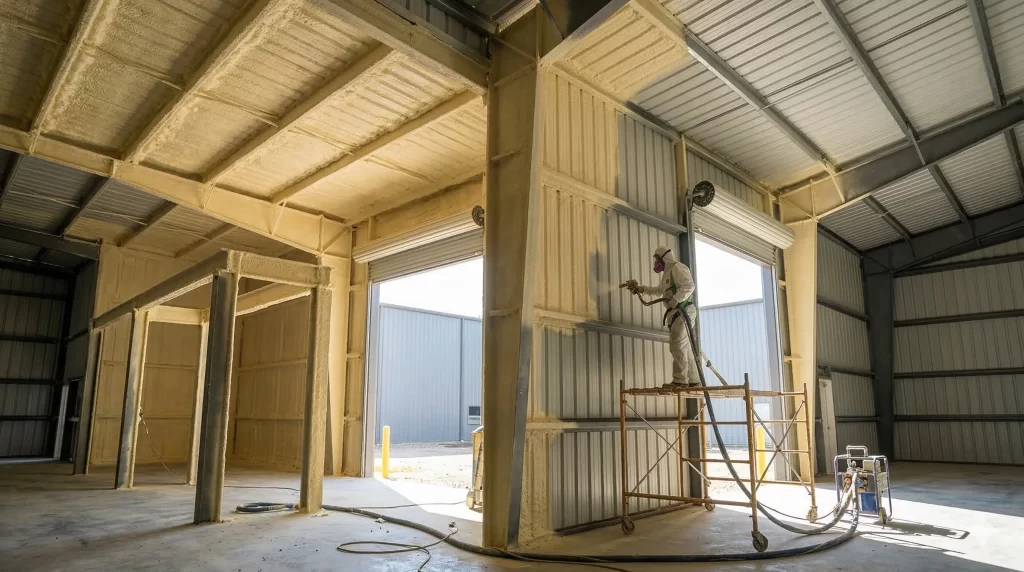
Closed-cell spray foam is applied directly to interior metal surfaces, filling every gap and seam as it expands.
It delivers an R-value of R-6 to R-8 per inch. More importantly, it acts as both insulation and vapor barrier in one application eliminating thermal bridging at the frame level and creating an airtight seal that other systems can’t match.
Best for: Freezer applications, extreme climates, maximum energy efficiency.
Consider: Higher upfront cost and requires professional installation.
Insulated Metal Panels (IMPs)
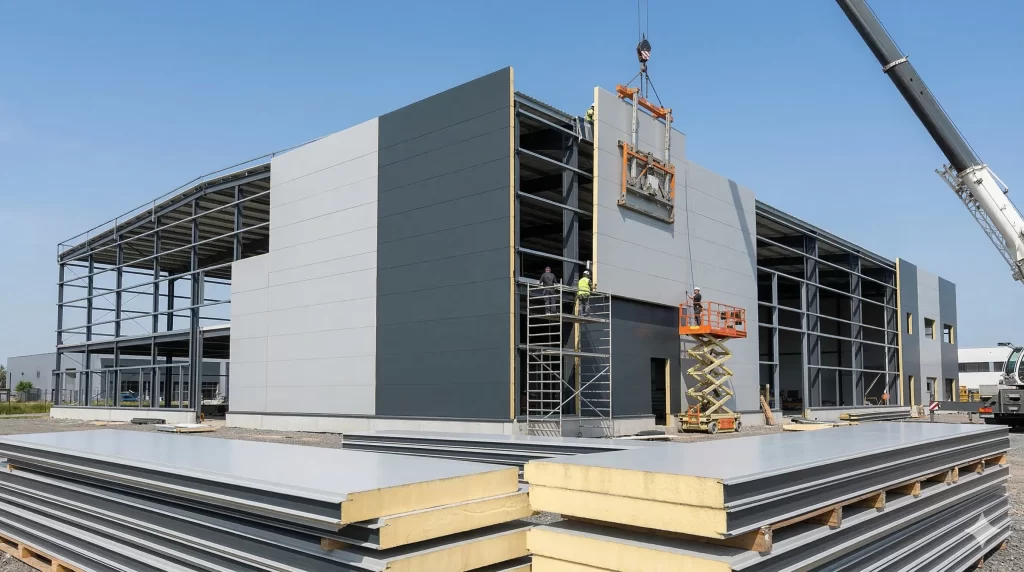
IMPs are factory-engineered panels with a rigid foam core bonded between two metal skins. They arrive on-site ready to install no separate vapor barrier, no guesswork.
Favored for warehouses and cold storage, these metal-skinned panels wrap around foam cores to create tough, insulated envelopes. The result is a clean interior finish with consistent, predictable performance.
Best for: New commercial construction, food-grade environments, high-volume cold storage.
Consider: Highest material cost of any option; requires heavy equipment during installation.
Rigid Board Insulation (Polyiso / XPS)
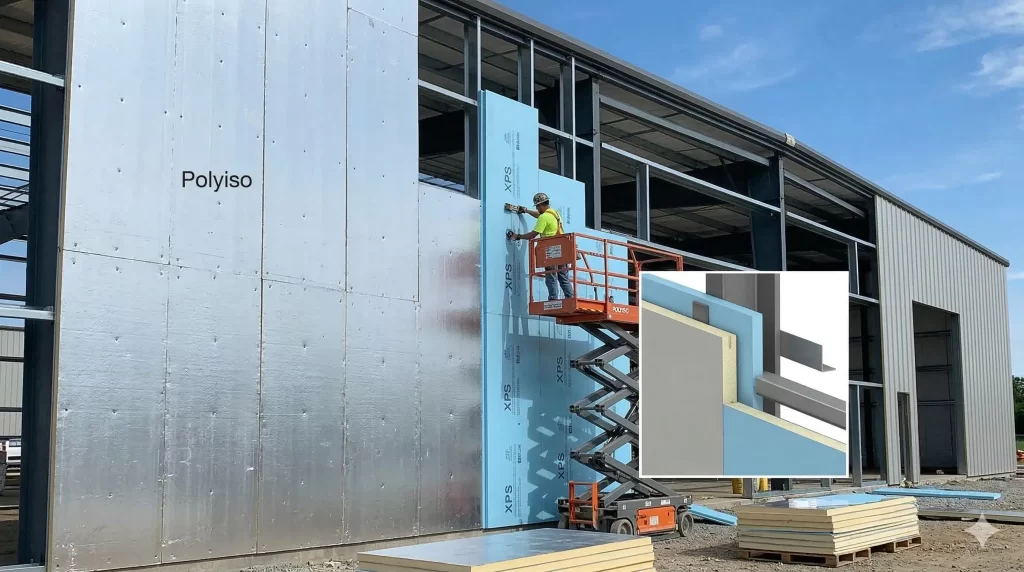
Rigid boards install against interior framing as a continuous insulation layer. Rigid foam insulation panels can provide an R-value of up to R-7 per inch, and do not absorb moisture which helps prevent mold growth and structural damage.
Joints and penetrations need careful sealing to prevent thermal bypass; this is where installation quality matters most.
Best for: Refrigerated (not frozen) applications, budget-conscious builds with strong installation oversight.
Consider: Requires detailed work at seams; less effective than SPF at eliminating thermal bridging.
Fiberglass Batt Insulation
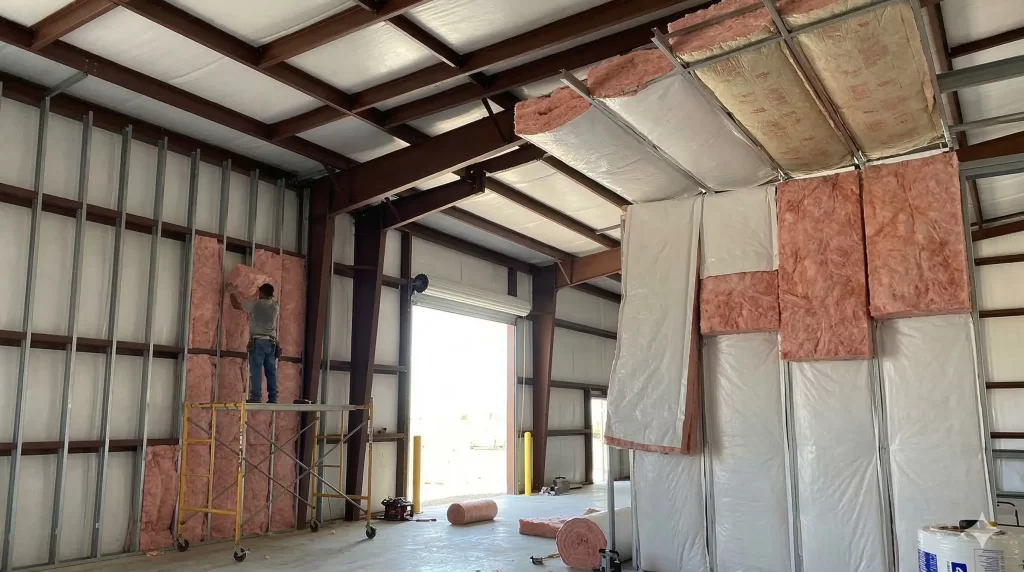
Fiberglass is the most affordable option and the most common insulation material overall. In standard construction, it works well. In cold storage, its limitations are significant.
Fiberglass absorbs moisture, loses R-value when wet, and does nothing to address thermal bridging at steel framing members. It is not recommended for freezer applications or high-humidity environments.
Best for: Basic refrigerated storage only, with a robust vapor barrier system in place.
Consider: Not suitable for freezer or deep freeze applications.
Quick Comparison
| Insulation Type | R-Value/Inch | Moisture Resistance | Thermal Bridge Control | Best Application | Relative Cost |
| Closed-Cell SPF | R-6 to R-8 | Excellent | Excellent | Freezers, extreme climates | High |
| Insulated Metal Panels | R-7+ | Excellent | Excellent | Commercial cold storage | Highest |
| Rigid Board (Polyiso/XPS) | R-5 to R-7 | Good | Good | Refrigerated storage | Medium |
| Fiberglass Batt | R-3 to R-4 | Poor | Poor | Basic refrigeration only | Low |
R-Value: What It Means and Why It’s Just the Starting Point
R-value measures how well insulation resists heat flow. The higher the number, the better the thermal performance.
But in cold storage, R-value is just the label on the box. What you actually live with is installed performance and those two numbers are often very different.
Here’s what the numbers should look like by application in Canada:
- Refrigerated storage (0°C to 13°C): Minimum R-30 for roof insulation; floor slabs typically insulated between R-18 and R-30
- Freezer storage (-18°C to -23°C): Wall insulation R-32 to R-48; roofing systems R-46 to R-57
- Deep freeze (-29°C and below): Minimum R-45 across the building envelope
These aren’t suggestions. Canada’s National Energy Code for Buildings (NECB) expresses insulation requirements based on climate zone and compliance must be maintained for the lifetime of the facility, not just at the time of construction.
Rated R-value and installed R-value diverge for several reasons. Gaps at joints, compressed insulation, and thermal bridging through steel framing all quietly eat into real-world performance. A wall rated R-40 can perform like R-28 if the details aren’t right.
Canada’s climate zones make this especially critical. The Canadian climate varies dramatically from coast to coast and many provincial building codes set different thermal resistance requirements for different climate zones, determined by heating degree days (HDD). A facility in Winnipeg faces fundamentally different thermal demands than one in the Fraser Valley or Southern Ontario.
Each province adopts and amends the National Building Code on its own timeline meaning your insulation requirements depend not just on what you’re storing, but on where in Canada you’re building.
Vapor barrier placement is equally critical. In cold Canadian climates, placing a vapor barrier on the warm interior side is essential to prevent condensation inside wall assemblies. Install it on the wrong side and you’re trapping moisture where you can’t see it damage that compounds quietly over years.
R-value is the number on the label. Building envelope performance is what you actually pay for every month, for the life of the facility.
Critical Design Details That Make or Break Performance
Getting the insulation type right is only half the battle. How the building is detailed and assembled determines whether that insulation actually performs.
Here are the areas that matter most.
Roof insulation is your single biggest source of heat gain. Roofing systems should achieve R-values between R-46 and R-57 for freezer warehouses, and R-34 to R-40 for coolers and processing areas. Undersizing here defeats everything else in the building.
Floor insulation is equally easy to overlook. Adding insulation beneath the concrete slab minimizes heat gain and protects the building from freeze-thaw damage. The foundation perimeter is a common cold-bridge location, heat travels through the slab edge if it’s not properly addressed.
Vapor barrier placement is where many builds go wrong. The warm side of the vapor barrier must always face the exterior in a cold storage environment. Install it on the wrong side and you’re trapping condensation inside the wall assembly , invisible damage that compounds over time.
Penetrations and transitions deserve obsessive attention. The highest-risk condensation areas include docks, wall penetrations, slab edges, and door frames; small leaks in these spots can become ice. HVAC lines, electrical conduit, drain penetrations, every one needs to be properly sealed and insulated.
Door systems are performance variables, not afterthoughts. Every opening cycle exchanges cold interior air for warm exterior air. Insulated doors, dock seals, strip curtains, and air curtains all work together to minimize that exchange.
Refrigeration unit placement needs to be integrated into the structural design from the start not bolted on as an afterthought after framing is complete.
Without a continuous vapor-tight envelope with insulation-to-insulation conditions at every transition, ice buildup and building failure become inevitable.
These details are where experience pays dividends. And where generalist contractors leave performance and money on the table.
What an Insulated Metal Cold Storage Building Actually Costs
Let’s address the question everyone asks first and why the answer is more nuanced than a single number.
Cold room construction in Canada typically runs between $100 and $300 CAD per square foot significantly more than standard commercial construction. The national average for commercial construction in Canada currently sits between $200 and $300 CAD per square foot overall , and cold storage pushes toward the higher end of that range due to specialized insulation, refrigeration, and envelope requirements.
Cost-per-square-foot figures mislead more than they inform. The variables that actually move the number are significant.
Temperature requirement is the biggest cost driver. A refrigerated cooler at 2°C is a fundamentally different engineering challenge than a deep freeze at -30°C. The lower the required temperature, the higher both the capital and long-term energy costs.
Other variables that shift the number significantly:
- Building size and clear-span width
- Insulation system selected
- Site conditions and foundation requirements
- Local permitting and provincial code compliance
- Geographic climate zone across Canada
That last point matters enormously here. Most Canadian climate zones fall within the “Very Cold” and “Subarctic” classifications meaning your building envelope already faces extreme external conditions before cold storage temperatures are factored in. A facility in Winnipeg faces fundamentally different thermal stress than one in the Fraser Valley.
Canadian energy regulations are designed to reduce heating demand, control air leakage, improve thermal efficiency, and lower long-term operating costs and for commercial steel buildings, compliance affects permitting approval, operational costs, and long-term asset value.
The real cost comparison isn’t build cost vs. build cost. It’s build cost vs. lifetime operating cost.
Cold storage facilities use three to five times more energy than standard warehouses, with monthly energy bills running considerably higher per square foot.
Every dollar saved on insulation during construction can cost several dollars in energy over a 20-year building life.
A steel building designed with optimized insulation can reduce heating and cooling costs by 30 to 40%, depending on size and occupancy. In Canada’s climate, that’s not a minor efficiency gain, it’s a significant annual operating advantage.
The cheapest building to construct is often the most expensive building to operate. Real value in a Canadian cold storage facility comes from an envelope engineered for your specific temperature requirements, your province’s energy code, and the climate realities of your region, not one that just cleared the budget on day one.
Choosing the Right Builder for Your Insulated Metal Cold Storage Building
Cold storage is a specialty. Not every metal building contractor is qualified to build one.
The insulation requirements, vapor dynamics, thermal bridging controls, and building envelope details go well beyond standard metal construction. Hiring a generalist contractor for a cold storage project is one of the most common and costly mistakes Canadian operators make.
All contractors and trade workers must understand the design of the envelope and how their tasks affect it. Cutting corners might be possible in other types of construction, but it can have really adverse consequences in a controlled environment building.
Questions to ask any prospective contractor before signing:
- What specific experience do you have with temperature-controlled metal buildings?
- How do you address thermal bridging in your building system?
- Who installs the insulation, your crew or a subcontractor?
- How do you handle vapor barrier detailing at wall-to-roof transitions and penetrations?
- What does your warranty cover on the building envelope specifically?
- Can you provide references from cold storage projects in similar Canadian climate zones?
It’s essential to compare the offerings of different contractors , consider the quality of building materials, the diversity of building solutions, and whether they offer professional services from site preparation through to construction completion .
Red flags to watch for:
- Vague or dismissive answers about vapor management
- No cold storage references or completed projects to show
- Insulation treated as a subcontracted afterthought rather than a core design element
- No familiarity with provincial building codes or Canadian climate zone requirements
A contractor who has worked across cold storage and temperature-controlled environments is often more adaptable and creative in solving engineering or zoning challenges specific to your property.
The right builder doesn’t just construct a metal building and hand you the keys. They engineer the entire envelope around your temperature requirements and stand behind it.
How Metal Pro Approaches Insulated Cold Storage Buildings
At Metal Pro Buildings, cold storage isn’t a side project. It’s a core discipline.
Established by industry veteran Herbert Broderick, Metal Pro Buildings brings over 30 years of personal experience and a leadership team with decades of combined expertise specifically in pre-engineered steel buildings designed for Canada’s demanding climate conditions.
Every cold storage project starts with your temperature requirements. Not the building dimensions. Not the budget. The temperature.
That single variable drives every decision that follows insulation system selection, vapor barrier placement, foundation design, door specifications, and refrigeration load planning. Metal Pro’s cold storage buildings use insulated metal panels, high-efficiency cooling systems, and smart building designs to reduce energy consumption while maintaining precise temperature control 24/7.
The building envelope is engineered as a complete system, not walls and a roof treated separately.
Metal Pro serves a wide range of Canadian industries including agriculture, food processing, craft beverage, floral, pharmaceutical, and logistics. Every project starts with your vision and ends with a strong, efficient, and future-ready steel structure made right for Canada.
All buildings are 100% Canadian CSA A660 Certified, manufactured using exclusively Canadian steel, and backed by a 50-year rust perforation warranty
The goal isn’t just a building that passes inspection.
It’s a building that holds temperature on the hottest day in August and the coldest night in January year after year, without you thinking about it.
The Right Insulation System Changes Everything
Let’s come back to where we started.
Energy bills that blindside you. Condensation creeping along walls. Products not holding temperature. Every one of those problems traces back to building envelope decisions made before construction began.
An insulated metal cold storage building done right isn’t just storage space, it’s a business asset that protects inventory, controls operating costs, and holds its performance through decades of Canadian winters without demanding constant attention.
The decisions made in the design phase determine everything that follows. Getting them right matters.
If you’re planning a cold storage facility and want expert eyes on your project talk to Metal Pro Buildings. No pressure. Just a straight conversation about what your operation actually needs.