
Your RV might be losing value faster than you think.
One harsh winter. One heavy snow load. One season of UV exposure. That’s all it takes to crack seals, fade panels, and create hidden damage that costs thousands to fix. Yet most RV owners still rely on tarps, fabric shelters, or open storage solutions that fail when conditions get serious.
Here’s the reality: an RV isn’t just a vehicle. It’s a major investment and the center of your travel lifestyle. Leaving it exposed year-round quietly chips away at both.
The good news? There’s a permanent fix.
A purpose-built steel RV storage shed gives your rig real protection against snow, sun, moisture, and long-term wear. It’s not just about storage. It’s about preserving value and removing constant worry.
In this guide, you’ll learn the best steel RV shed layouts, what works in Canadian conditions, and how to choose a design that actually fits your property and your RV.
Why Your RV Needs a Real Home (Not a Tarp, Not a Fabric Shelter)
Leaving your RV outside might seem fine until the damage shows up.
Sun exposure breaks down seals, fades panels, and weakens materials within a few seasons. What starts as cosmetic damage often turns into expensive repairs.
Winter makes it worse.
Freeze-thaw cycles force water into small gaps, then expand it. That’s how leaks start, slide-outs shift, and hidden damage builds up. Heavy snow can also stress the roof and awnings.
Moisture is another problem most owners underestimate.
Tarps and fabric covers trap condensation. Over time, that leads to mold, mildew, and interior damage that’s costly to fix.
Then there’s impact risk.
Hail, falling branches, and debris can easily cause thousands in damage in a single storm.
Some owners switch to paid storage. But at $150–$400 per month, you’re spending thousands every year without gaining real control or convenience.
And tarps? They fail fast.
They tear, sag, and degrade under UV exposure. They don’t protect well, and they don’t last.
What you’re left with is constant worry.
A proper steel RV storage shed removes that. It protects your RV, reduces long-term costs, and gives you peace of mind year-round.
Best Steel Layouts for RV Storage
The right layout depends on four things: your RV’s height, its length, how easy it is to park, and whether you want the building to do more than store one vehicle. Class A rigs can reach about 40 feet long, while many motorhomes and trailers sit around 11 to 13 feet high, so clearance planning is not optional. A too-small shed is a dumb mistake you pay for twice.
1. Single-Bay RV Shelter
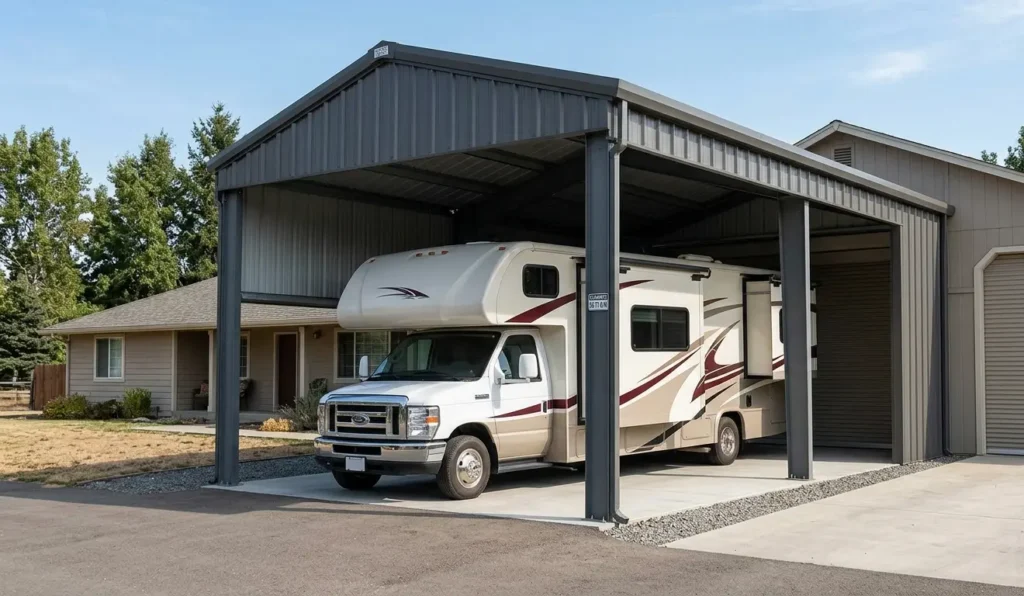
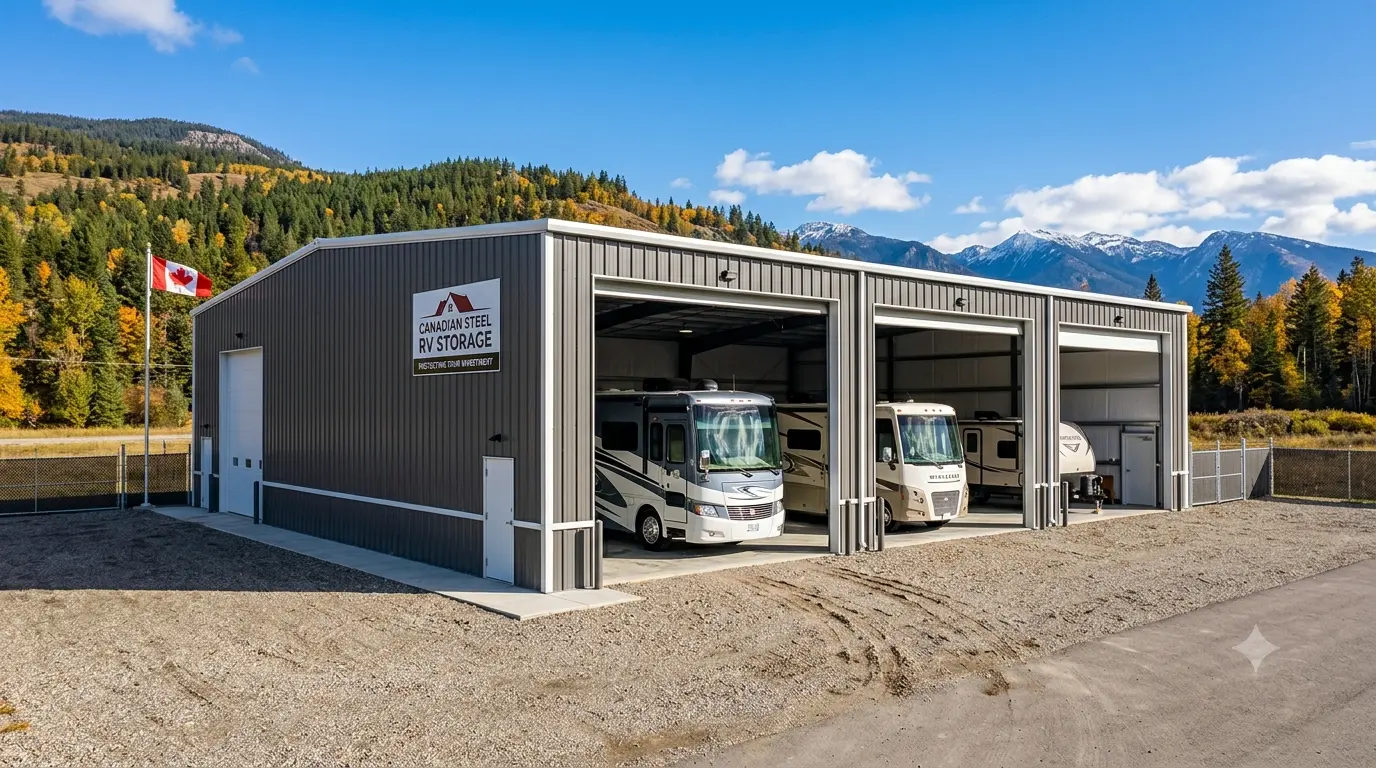
The simplest layout is a single-span steel shelter with a roof, side protection, and an open front. It works best for owners who mainly want protection from sun, rain, hail, and snow without paying for a full garage.
For many travel trailers, fifth wheels, and Class C units, a practical starting point is roughly 14 to 16 feet of height clearance, with width and length sized to leave room around the coach for mirrors, awnings, and walking space. That tracks with common RV height ranges: travel trailers are often around 10 to 11 feet tall, fifth wheels around 12 to 13 feet, Class C units around 11 to 12 feet, and Class A rigs around 12.5 to 13.5 feet.
This layout is the budget-friendly option. It solves the basic problem: your RV stops baking in the sun and sitting under snow.
2. Fully Enclosed RV Garage
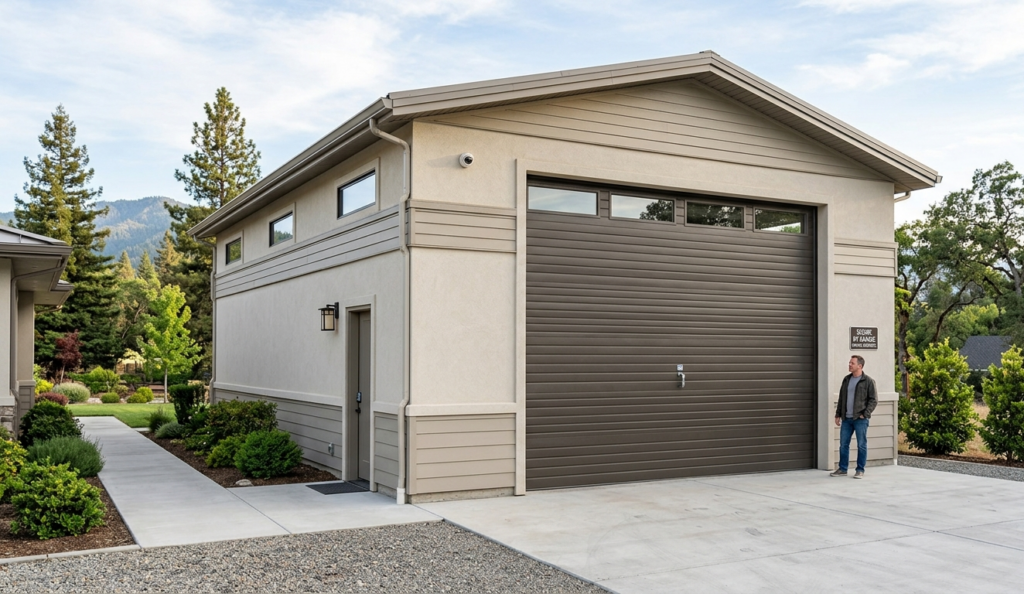
This is the best layout if you want full protection and real security. Four walls, one large RV door, and a locked shell give you protection from weather, theft, and debris.
A tall RV door is usually the make-or-break detail. For oversized vehicles, large commercial-style doors are commonly selected in taller dimensions, and many RV-focused guides treat a 14-foot-tall opening as the safe baseline for bigger motorhomes.
This layout makes the most sense for Class A owners, luxury fifth-wheel owners, or anyone parking a rig that costs enough that cutting corners is irrational.
3. RV + Workshop Combo
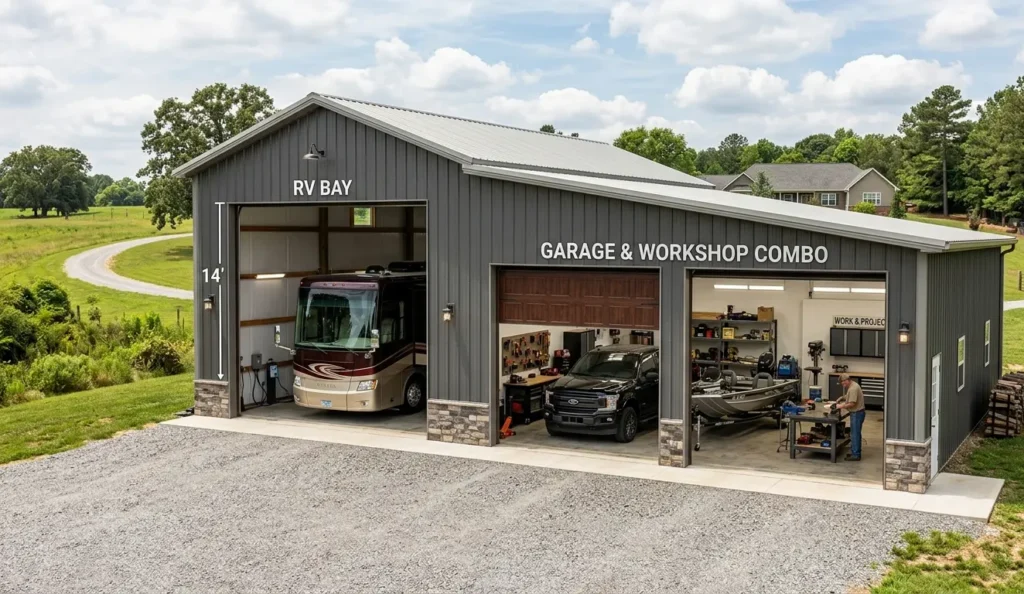
This is one of the smartest layouts because it makes the property more useful instead of just adding a giant parking box.
The idea is simple: one tall RV bay, plus one or two smaller bays for a truck, boat, tools, or a workshop. On larger sites, builders often step up to footprints like 40×60 or bigger when they need room for a large Class A, extra vehicles, and work space in one shell.
This layout works well for acreage owners and people with too much equipment to keep pretending one garage will handle it all.
4. Drive-Through Layout
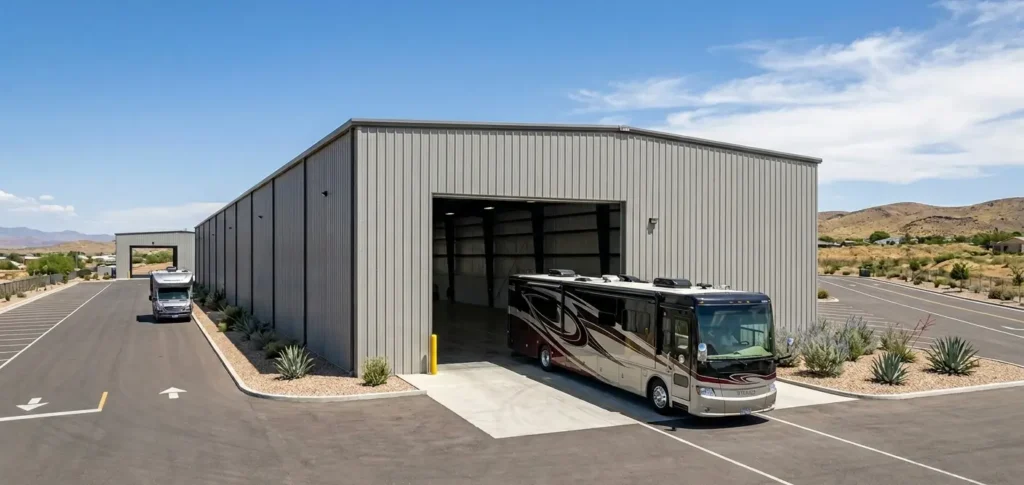
If backing in your RV is a miserable experience, stop designing around that problem and remove it.
A drive-through building puts a large door on both ends so you can pull straight through. That matters a lot with longer rigs, especially Class A coaches that can run up to about 40 feet.
This layout needs more lot depth, but it saves time, cuts stress, and reduces the chance of clipping a wall, track, or mirror every time you park.
5. Attached RV Add-On
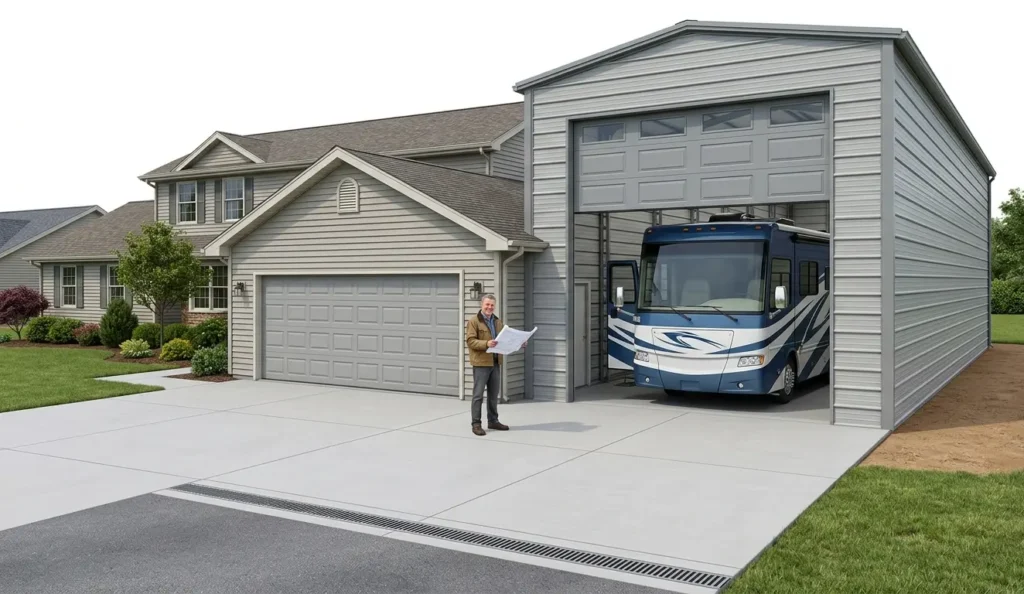
If you already have a garage or shop, an attached steel addition can be the most efficient layout.
Instead of building a separate structure, you extend what you already own with a dedicated tall bay. That can improve traffic flow on the property and create a cleaner overall look than scattering separate buildings across the lot.
It is only a good idea if the addition is engineered properly. Matching loads, foundations, and drainage is not optional just because you are “just adding on.”
What Actually Matters Most in Any Layout
Whatever layout you choose, three details matter more than the marketing brochure.
- First, get the height right. Many RVs sit in the roughly 10- to 13-foot range, and taller units need more than bare-minimum clearance.
- Second, plan for ventilation and condensation control. Metal buildings need airflow, and current guidance on steel-building ventilation consistently stresses ventilation, insulation, and vapor control to reduce condensation problems. Ignore that, and you risk moisture dripping onto the RV or creating a damp interior environment.
- Third, leave room to move. A shed that technically fits the RV but gives you no clearance for mirrors, service access, or opening compartments is badly designed.
Best Pick by Owner Type
- If you want the cheapest real protection, choose the single-bay shelter.
- If you want the best overall protection, choose the enclosed RV garage.
- If you want the most useful building, choose the RV-plus-workshop combo.
- If access is the headache, choose the drive-through layout.
- If you already have a shop or garage, the add-on layout is often the smartest use of money and land.
Canadian Design Considerations You Can’t Ignore
Designing an RV storage shed in Canada goes beyond choosing a layout. Local climate and regulations directly affect how well the structure performs.
Snow load is a key factor. Heavy winter snowfall requires a building engineered to handle regional weight limits. Wind also matters, especially in prairie provinces, where strong gusts demand proper anchoring and structural design.
Foundation choice depends on soil and frost depth. Common options include concrete slabs, perimeter foundations, or helical piers. The right choice helps prevent shifting and long-term damage.
Condensation control is also important. Without proper ventilation or insulation, moisture can form inside the building and damage your RV over time.
Finally, most municipalities require permits and enforce zoning rules such as setbacks and height limits. Planning for these early helps avoid delays.
Taking these factors into account ensures your steel RV shed performs reliably in Canadian conditions.
How Metal Pro Simplifies the Process
Building an RV storage shed can quickly get complicated without the right guidance. From design to permits, small mistakes can turn into costly delays.
That’s where Metal Pro makes the difference.
Instead of generic kits, Metal Pro offers custom steel buildings designed for your RV, your property, and your local climate. The process is straightforward consultation, custom design, engineering, permit support, and installation.
The result is a structure that fits properly, meets Canadian requirements, and performs long-term without guesswork.
Request your free quote today and see what the right steel RV storage building could look like on your property.