
A truck pulls into your driveway. A woman with a clipboard steps out.
She skips the house. She heads straight for the building you spent a year planning and paying for.
Ten minutes from now, she’ll decide one thing. Is it an asset or just a shed?
Most owners can’t say. Nobody explains how appraisers treat outbuildings. Nobody mentions what lenders ask for when you sell.
This guide walks the property with her. You’ll see what she sees, stop by stop. You’ll learn how a steel building affects your appraisal and resale in Canada. You’ll also learn what adds value, what hurts it, and what to document.
Still picking a material? Start with steel vs. wood and steel vs. concrete. This one is about what happens after you build.
Quick Answer: Does a Steel Building Add Value in Canada?
Does a steel building add value in Canada? It can, with conditions. A permitted, well-built steel building on a proper foundation can raise appraised value and buyer interest. This is most true on farms, acreages, and commercial lots. Results depend on permits, engineering, foundation, finishing, and fit. A local appraiser makes the final call.
The 10-Minute Walk-Through: What an Appraiser Notices at Each Stop
How do appraisers in Canada value a steel building? They look at it the way a buyer would, one stop at a time.
Here is the route. Each stop shows what they notice, what it tells them, and how you can prepare.
Stop 1: The Approach
They notice: How the building sits on the lot. Does the colour match the house? Is the driveway clear and the site tidy?
It tells them: Whether the building was planned as part of the property or dropped on it as an afterthought.
You can prepare by: Matching trim or roof colours to the house. Keep the access path clean. Grade the ground so water flows away from the walls.
Stop 2: The Outside Walls and Roof
They notice: Cladding condition, trim, gutters, and drainage. They also look for dents, rust spots, and loose fasteners.
It tells them: How well the building has been looked after. Small signs of care suggest low upkeep costs ahead.
You can prepare by: Fixing minor damage now. Touch up scratches and clear debris from the roof and gutters. Keep a simple maintenance log.
Stop 3: The Floor and Foundation
They notice: Is the building on a poured slab or footings? Or is it sitting on gravel or a temporary base?
It tells them: Whether the building is a permanent improvement or something movable. This is often where that call gets made.
You can prepare by: Keeping foundation drawings and pour records. If you haven’t built yet, plan the foundation for the long term. See our foundation guide for options.
Stop 4: The Inside
They notice: Is the interior insulated and finished, or bare? They check lighting, power, heat, and ceiling height.
It tells them: Whether a new owner could use the space on day one or would need to spend more first.
You can prepare by: Finishing the parts you’ll actually use. Make sure electrical work is done by a licensed pro and inspected. Our savings article covers insulation options.
Stop 5: The Paperwork
They notice: The clipboard moves to the file. They look for permits, inspection records, and drawings.
It tells them: Whether the building is a documented part of the property. Missing papers can slow down a sale.
You can prepare by: Gathering everything in one place. Our permits and zoning guide explains what to ask your municipality for.
Sidebar: Behind the Clipboard
Appraisers in Canada usually weigh a property in three ways:
- Cost approach: What would it cost to replace the building, minus wear and age?
- Sales comparison: What did similar properties with similar buildings sell for nearby?
- Income approach: Does the building help the property earn money, such as farm or rental income?
Outbuildings are often weighed differently by property type. On a farm, a building that supports the operation may count for more. On a home lot, a shop may add less than it cost. On a commercial lot, usable space and income potential often matter most.
An appraiser makes the final call, and methods vary by property and region.
Same Building, Two Different Outcomes: An Illustrative Story
Do steel buildings increase property value? Sometimes yes, and sometimes no. The same building can go either way.
Illustrative scenario, not real customers. The details are simplified to show how choices add up.
Meet Owner A and Owner B
Two owners buy the same size of steel building. Both want a shop. Both spend similar money upfront.
Owner A skips the stamped drawings to save time. The slab is thin, and the crew pours it fast. The interior stays bare, and the permit papers end up lost in an old email account.
Owner B does the opposite. The drawings are engineer-stamped and rated for local snow and wind. The slab is properly prepared. The interior is insulated, wired, and finished. Every record goes into one folder.
Five years later, both owners decide to sell.
What Happens at Sale Time
| Owner A | Owner B | |
| What the appraiser sees | A bare building on a basic slab. No drawings to confirm the design. Hard to count as a permanent improvement. | A finished, usable shop with a solid foundation and a complete file. Easier to count as part of the property. |
| What the buyer’s lender asks | “Where are the permits and drawings?” Nobody can answer quickly. The lender may pause or ask for more. | “Here is the folder.” Questions get answered in a day, not a month. |
| How the listing reads | “Steel shed on property.” | “Engineered, insulated steel shop, permits and drawings on file.” |
The Cost of Cutting Corners
Owner A saved money. Owner A also spent six months explaining why.
Buyers asked questions. The lender asked more. The appraiser had little to work with. Every gap in the paperwork became a reason to offer less.
Owner B did not get a guaranteed premium. No one can promise that. But Owner B gave buyers fewer reasons to hesitate.
The Honest Takeaway
Steel did not decide either outcome. Both owners chose the same material.
Quality, fit, and documentation made the difference. A well-built steel building holds up well. A poorly planned one does not, no matter what it is made of.
What Owner B Did, and How Metal Pro Builds It In
The things Owner B did are the things Metal Pro builds into the process:
- Engineer-stamped drawings for your local snow and wind loads
- Made in Canada fabrication
- CWB certification to CSA A660
- A published warranty you can show a future buyer
These do not replace local permits or inspections. They do give you strong paperwork to start your resale file with.
Meet the Five Buyers Who Want Your Steel Building
Who buys a property with a steel building? And how does that building affect resale?
It depends on who walks through the gate. Each buyer checks different things first. Know them, and you can plan for them.
1. The Farmer
What they check first: Clear span, door size, and how well the building handles weather. Will it hold equipment, animals, or grain without trouble?
What makes them say yes: A sturdy, open interior and doors that fit their largest machine. Less upkeep is a bonus.
See our Farm Storage and Livestock Barns pages for designs built for this buyer.
2. The Tradesperson
What they check first: Power, floor, ceiling height, and heat. Can they park a truck inside and start work Monday?
What makes them say yes: A shop that is ready on day one. Wiring is done, the slab is flat, and the space is warm in winter.
Browse Workshops to see layouts that suit this buyer.
3. The Hobbyist and RV Owner
What they check first: Door clearance. Will the RV, boat, or project car fit with room to spare?
What makes them say yes: A finished, clean feel. Good lighting and an easy-to-open door make the space feel ready to enjoy.
Our Garages page shows options for this buyer.
4. The Home-Business Owner
What they check first: Permits, insurance, and zoning. Can they legally run a business from this space?
What makes them say yes: Clear paperwork. A building with the right approvals saves them from renting space elsewhere.
Zoning rules vary by municipality, so buyers often check with the local office. Your resale file helps them move faster.
5. The Commercial or Industrial Buyer
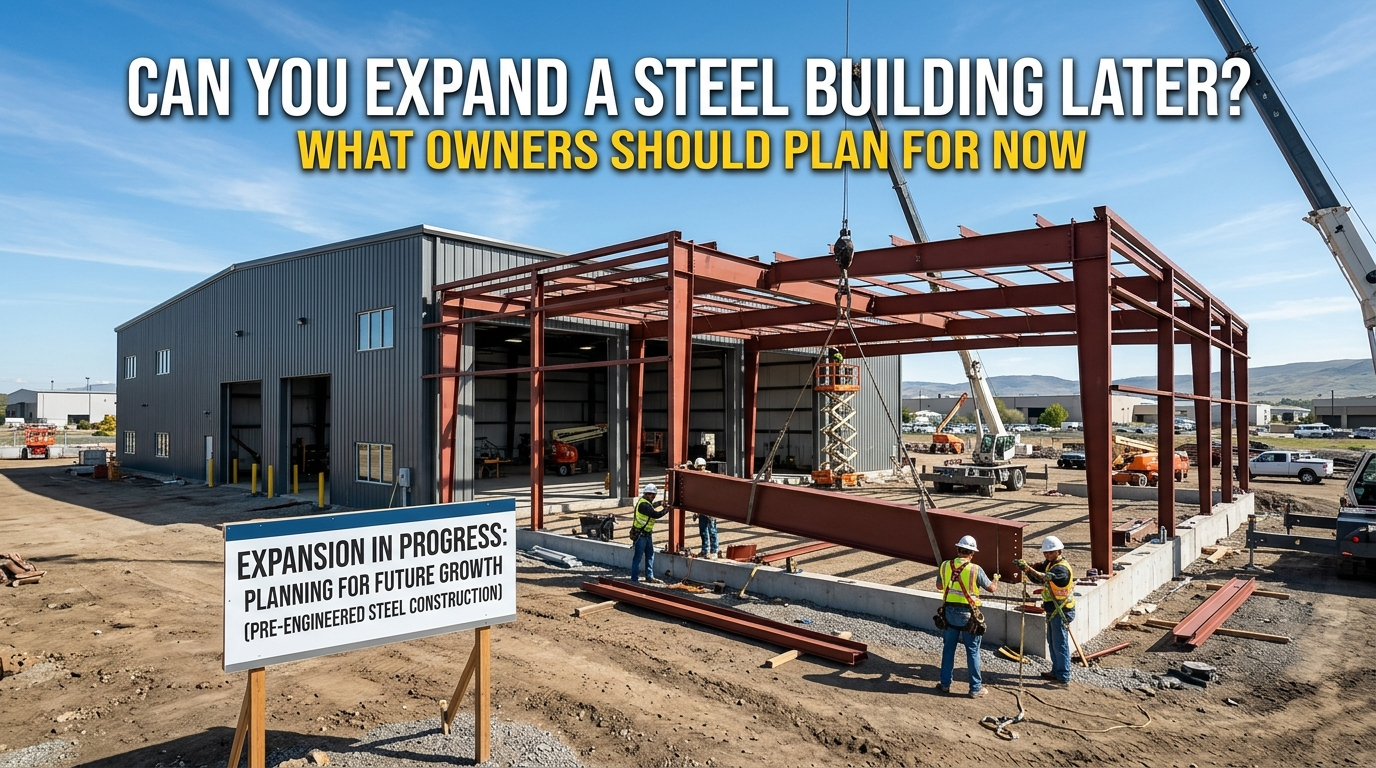
What they check first: Documents and room to grow. Is the building engineered, permitted, and easy to expand?
What makes them say yes: A documented asset that a lender is comfortable with. Expansion potential adds to the appeal.
Read our expansion article to see how steel buildings can grow with a business.
The Building That Feels Like a Head Start
Picture a buyer unlocking the door for the first time. The slab is clean and the lights work. Everything they need is already there.
That buyer is not just buying a building. They are buying months of saved time. It feels like a head start, and someone else built it for them.
You can be the one who built it.
The “Tin Shed” Myth, Honestly
Do steel buildings hurt resale value? Some buyers still think “tin shed” when they hear “steel building.” Is that fair?
Sometimes, yes. Often, no. Here are five common beliefs and what is closer to the truth
Myth vs. Reality
| The Myth | The Reality |
| “Steel buildings look cheap.” | Looks depend on design and finish. Colour-matched trim, clean lines, and good cladding can look sharp. A bare box on gravel will not. |
| “Steel rots and gets eaten by pests.” | Steel does not rot, and termites and carpenter ants do not eat it. Inspectors and buyers notice this. See our steel vs. wood framing guide. |
| “Steel is a fire risk.” | Steel does not burn. Fire safety depends on the whole building, including insulation and wiring. Local codes still apply. |
| “Steel buildings are temporary.” | A building on a proper foundation, with permits and drawings, reads as permanent. A building on gravel with no papers does not. See our steel vs. concrete guide for foundation context. |
| “Steel costs more to keep up.” | Many owners find upkeep is lower. A yearly check of the roof, fasteners, and gutters often covers it. |
Insurance: Ask Before You Assume
Steel’s fire and pest resistance may help with insurance premiums. It might not. Insurers set rates based on use, location, contents, and more.
Ask your broker before you build. Get the answer in writing. A lower premium is a nice bonus, but never count on it.
Where the Stigma Is Earned
Let’s be fair. The “tin shed” reputation did not come from nowhere. Some buildings earn it.
The problem is usually one of these:
- Low-quality kits with no engineering. Nobody checked if the design fits local snow and wind.
- Poor finishing. Gaps, dents, mismatched panels, and bare interiors.
- No documentation. No drawings, no permits, no records.
None of these are about steel. They are about shortcuts. A buyer who sees them will wonder what else was skipped.
The Takeaway
The material is rarely the problem. Quality and paperwork are. Build it well, finish it well, and keep the records. The stigma loses most of its power.
Where to Save, Where to Splurge
Can saving money on your steel building hurt its resale value? Yes, if you cut in the wrong places.
Some savings are smart. Others show up later as lower offers and slow sales. Here is how to tell them apart.
Save Here, Don’t Cut There
| Save here (good for budget and resale) | Don’t cut here (it shows up at resale) |
| Simple rectangular design. Fewer corners mean less material and less labour. | Engineered drawings. Get them stamped and rated for your local snow and wind loads. |
| Standard sizes. Common widths and lengths cost less than custom ones. | Slab and soil prep. A weak base cracks and settles, and buyers can see it. |
| Pre-engineered kits. The design work is already done and tested. | A finished interior. If you’ll use it as a shop or office, finish it. |
| Buying at the right time. Ordering in a slower season can lower the price. | Inspections and records. Skipped inspections leave gaps a buyer will question. |
| Complete paperwork. Avoid any discounted building that comes without full stamped drawings and local code compliance. |
Want more ways to trim the budget? Read how to save money when buying a steel building .
Why These Savings Are Safe
A simple shape and standard sizes lower cost without lowering quality. The building is still engineered. It is still permitted. A buyer will not notice what you saved, because nothing is missing.
Why These Cuts Are Risky
Cut the drawings, and you lose proof the design fits your area. Cut the slab prep, and problems appear in a few years. Cut the records, and you cannot show any of it.
These shortcuts hide well on day one. They show up when someone else is looking closely.
The One-Line Test
Before you cut any cost, ask yourself:
“Will the next owner be able to see that this was done right?”
If the answer is yes, the saving is probably safe. If the answer is no, think twice.
For more on what to avoid, see common mistakes to avoid.
The Resale File: One Folder That Can Make a Buyer Trust You
Can an unpermitted steel building affect selling your property? It can. Buyers, lenders, and insurers all want proof.
The easiest fix is a folder. Build it now, and you won’t have to scramble later.
A Scene Every Seller Should Avoid
A buyer likes your property. Their lender asks for the building documents.
Now you have two options. You hand over a neat folder in five minutes. Or you dig through old emails, call a contractor you haven’t talked to in years, and hope the papers turn up.
Buyers notice which seller they’re dealing with. One feels safe. The other feels like a gamble.
The Resale File Checklist
Put these in one folder. Keep a digital copy and a paper copy.
- Stamped drawings. The engineer-sealed plans for your building.
- Permit and inspection records. Every approval and sign-off from your municipality.
- Completion or occupancy certificate. Proof the project was closed out, where your area requires one.
- Foundation details. Slab drawings, soil notes, and pour records.
- Warranty documents. For the building, the cladding, and any major systems.
- Receipts for upgrades. Insulation, wiring, heating, doors, and finishing.
- Dated photos of the build. Footings, framing, and wiring before walls close up. They show work no one can see later.
Tip: Take photos while the work happens. You can’t photograph a buried footing after the slab is poured.
What Can Happen Without a Permit
Rules differ by province and municipality. Still, a building with no permit on file can raise questions.
- Lenders may hesitate or ask for more documents before approving a buyer’s loan.
- Insurers may question coverage for a structure that was never approved.
- Buyers may offer less, or walk away, if they fear surprises.
- Municipalities may ask for retroactive approval, which can mean extra cost, inspections, or changes.
None of this is certain. Each case is different. If you’re unsure about your building, talk to a local realtor or a real estate lawyer. They know how your province handles it.
For what to ask your municipality, see our permits and zoning guide .
Write Your Future Listing Before You Build
What will your listing say when you sell? Write it now. It’s a fast way to spot weak spots in your plan.
Buyers read listings in seconds. They look for clear facts. This exercise shows you which facts you’ll have, and which you won’t.
Fill in the Blanks
Copy this line and fill it in:
[Size] engineered steel [shop / barn / garage] on [foundation type], [insulated / heated / finished], built to [local snow and wind load], with [permits and drawings on file], [expansion possible].
Here is an example:
40′ x 60′ engineered steel shop on a poured concrete slab, insulated and heated, built to local snow and wind loads, with permits and stamped drawings on file, expansion possible.
Now read it out loud. Does it sound like a building you’d want to buy?
What Each Blank Tells a Buyer
Every blank connects to something you’ve already read:
| Blank | What it tells a buyer | Where it came from |
| Size | Will my equipment, vehicles, or inventory fit? | Stop 1 and the five buyers |
| Building type | Is this built for a real purpose? | The five buyers |
| Foundation type | Is this permanent? | Stop 3 |
| Insulated / heated / finished | Can I use it on day one? | Stop 4 |
| Local snow and wind load | Was it designed for this area? | Engineered drawings |
| Permits and drawings on file | Can my lender trust this? | Stop 5 and the Resale File |
| Expansion possible | Can it grow with me? | The commercial buyer |
The Test: Can You Fill Every Blank Proudly?
Try it with your own plan. Be honest.
Can you write “poured slab” and mean it? Can you write “permits on file” and hand over the folder? If a blank makes you hesitate, that’s a signal.
Now is the time to fix it. Changes on paper are cheap. Changes after the build are not.
Test Your Layout Before You Commit
Not sure about size, door placement, or expansion room? Try the layout first.
Metal Pro’s 3D Designer lets you see your building before you buy. Move the doors, change the size, and check how it fits your property. It’s an easy way to catch problems while they’re still free to fix.
Resale-Readiness Scorecard: How Ready Is Your Building?
How ready is your steel building for an appraiser or a buyer? Answer eight yes/no questions. Be honest. Nobody is grading but you.
Give yourself 1 point for each “yes.”
The Eight Questions
| # | Question | If you answered “no,” do this |
| 1 | Are permits on file? Do you have the approvals and inspection records from your municipality? | Contact your municipality and ask what’s on record. See our permits and zoning guide . |
| 2 | Do you have stamped drawings? Are the engineer-sealed plans in your records? | Ask your supplier or builder for a copy. Store it in your resale file. |
| 3 | Is the building on a proper slab? Is it a permanent foundation, not gravel or a temporary base? | Plan a permanent foundation. See our foundation guide . |
| 4 | Is it rated for local snow and wind loads? Do the drawings show your area’s ratings? | Check the drawings with your engineer or supplier. Fix gaps before you sell. |
| 5 | Is the interior finished for its use? If it’s a shop or office, is it insulated, wired, and lit? | Finish the parts you use most. See our savings article for insulation options. |
| 6 | Have you started a resale file? Are drawings, receipts, and photos in one folder? | Start today with the Resale File Checklist above. |
| 7 | Is there a plan for expansion? Is there room, and do the plans allow for it? | Mark the expansion side on your site plan. See our expansion article . |
| 8 | Does it have curb appeal? Is it tidy, with colours that suit the house and clean walls? | Touch up damage, match trim, and clear the approach. See Stop 1 and Stop 2. |
Your Score
| Score | Result | What it means |
| 7-8 | Ready | Your building is in strong shape. Keep records current and maintain it. |
| 4-6 | Nearly there | You have a good base. Close the gaps before you list. |
| 0-3 | Fix these first | Start with permits, drawings, and the foundation. Those matter most to appraisers and lenders. |
What to Do Next
Pick your lowest-scoring item and fix it this week. Small steps add up. A folder, a few photos, and a phone call can change how a buyer sees your property.
Not sure where to start? A local realtor or real estate lawyer can help with permit questions. They know your province’s rules.
Frequently Asked Questions
Future You, Standing in the Driveway
A truck pulls into the driveway. A woman with a clipboard steps out.
She walks toward the building. This time, you’re ready. The slab is solid and the drawings are stamped. The permits are in a folder, and the folder is in your hand.
She asks a question. You have the answer. Ten minutes later, she’s nodding.
That’s the goal. Build something that works for you today and sells for you tomorrow.
You don’t have to figure it out alone. Talk with a Metal Pro expert about a design that fits your property.