
Three vehicles. A snowblower, a lawn tractor, and a pile of gear with nowhere to go. And another winter closing in.
If you’re researching a 3-car steel garage, you already know the frustration. What you don’t know yet is what it actually costs, what size you truly need, or who to trust when every contractor gives you a different number.
That’s exactly what this guide fixes.
No vague estimates. No bait-and-switch pricing. Just honest, practical information built for Canadian homeowners from sizing and foundations to permits and real all-in costs.
How to Size Your 3-Car Steel Garage ?
Most homeowners size their garage around their vehicles. That’s the first mistake.
You need space to open doors without dinging the wall. Room to walk around. A corner for tools, a shelf for seasonal gear, maybe a workbench. None of that fits in a “just big enough for three cars” footprint.
Here’s the good news: going bigger at the planning stage costs a fraction of what you’d pay to expand later. A few extra feet of width now can save you thousands and years of frustration.
Standard 3-Car Garage Dimensions in Canada
| Configuration | Width | Depth | Best For |
| Compact Triple | 30 ft | 22 ft | Three small vehicles, tight lots |
| Standard Triple | 36 ft | 24 ft | Most Canadian homeowners |
| Comfortable Triple | 40 ft | 30 ft | Trucks, SUVs, storage wall |
| Premium Triple | 44 ft+ | 32 ft+ | Workshop, lift, full storage zone |
Most Canadian homeowners with full-size trucks or SUVs are happiest with the 36×24 or larger. The 30×22 works on paper but feels cramped fast.
For a quick comparison of how a three-bay footprint stacks up against one- and two-car options, see our Standard Garage Sizes guide , it includes a side-by-side cheat sheet with comfortable dimensions for every configuration.
Vehicle Clearance Guide
Clearance is where plans fall apart. These are the minimums worth knowing before you finalize dimensions:
Door openings:
- Standard car: 9 ft wide door minimum
- Full-size truck or SUV: 10 ft wide door recommended
- Lifted truck or roof rack: 10–12 ft height clearance
Side clearance:
- Between vehicles: 24–30 inches to open doors comfortably
- Between vehicle and wall: 18–24 inches minimum
Oversized vehicles:
- RVs and boat trailers: often need 14 ft height clearance and 40+ ft depth
- Always measure your longest vehicle with the hitch attached
Skipping this step is how people end up with a garage their truck fits in but can’t maneuver inside.
Thinking Beyond the Vehicles
A well-planned 3-car garage does more than park cars. Think about how you’ll actually use the space:
- Workshop or hobby area : even a 10×12 ft corner changes everything
- Storage wall : shelving, cabinets, seasonal gear off the driveway
- Mechanical lift : requires ceiling height of 12 ft minimum, ideally 14 ft
- Multi-use space : home gym, hockey gear, hunting and fishing equipment
Plan for how you live now and what you might want in five years.
Future-proofing worth adding at rough-in stage:
- EV charging conduit (cheap now, expensive to retrofit)
- Sub-panel wiring for a workshop
- Mezzanine-ready structural framing
Metal Pro’s Free Sizing Consultation
Not sure what size actually fits your property and your life? Metal Pro offers a free, no-pressure sizing consultation. Our team starts with how you live , not just what fits on a lot plan.
Get your free sizing consultation → Contact Metal Pro
What Does a 3-Car Steel Garage Really Cost in Canada?
You’ve seen the ads. “3-car garage starting at $18,000.”
Then you call. And slowly, the real number emerges.
Delivery isn’t included. Neither is the foundation, the permit, the labour, or the electrical. By the time you get a real installed price, that $18,000 kit is a $55,000 project and nobody warned you upfront.
At Metal Pro, we do things differently. Every quote we provide reflects the honest, all-in picture. No ambush invoices. No surprises halfway through your build.
Price Ranges by Configuration
Building Kit Only :
| Size | Kit Price Range |
| 30×22 | $14,000 – $18,000 |
| 36×24 | $18,000 – $24,000 |
| 40×30 | $26,000 – $34,000 |
| 44×32+ | $34,000 – $45,000+ |
What’s typically included in a Metal Pro kit:
- Engineer-stamped steel frame
- Roof and wall steel panels
- Doors and windows per your spec
- Fasteners and trim
- Stamped engineering drawings
- Delivery to your site
What’s not included in any kit price (from any supplier):
- Foundation work
- Permit fees
- Site grading and prep
- Professional installation labour
- Electrical and plumbing rough-in
Metal Pro provides full transparency on all of these costs upfront so your quote reflects what you’ll actually spend.
Foundation Costs Breakdown
Foundation is one of the most variable costs in any garage project. Your soil type, climate zone, and how you’ll use the space all drive the decision.
| Foundation Type | Estimated Cost (CAD) |
| Gravel pad | $2,000 – $5,000 |
| Concrete slab (standard) | $8,000 – $16,000 |
| Insulated concrete slab | $12,000 – $22,000 |
| Perimeter frost wall | $15,000 – $28,000 |
| Helical piers | $6,000 – $14,000 |
Costs vary significantly by province, site access, and soil conditions. We’ll cover each foundation type in detail in the next Section .
Permitting & Site Prep Costs
Permits aren’t optional for a structure this size. Here’s what to budget across major provinces:
| Province | Typical Permit Cost |
| Alberta | $800 – $2,500 |
| British Columbia | $1,200 – $3,500 |
| Ontario | $1,000 – $3,000 |
| Saskatchewan | $600 – $1,800 |
| Manitoba | $700 – $2,000 |
Site grading and drainage: $1,500 – $6,000 depending on slope, soil, and access.
Metal Pro includes stamped engineering drawings with every build the document most municipalities require before issuing a permit.
Total Installed Cost Estimates (All-In)
This is the number that matters. Here’s what Canadian homeowners realistically spend on a complete, installed 3-car steel garage :
| Configuration | All-In Range (CAD) |
| 30×22 standard | $32,000 – $48,000 |
| 36×24 standard | $42,000 – $62,000 |
| 40×30 upgraded | $58,000 – $82,000 |
| 44×32+ premium | $75,000 – $110,000+ |
These ranges account for foundation, permits, installation, and standard finishing. Insulation, electrical, and interior upgrades move the number higher.
Factors That Move the Price Up or Down
No two projects are identical. Here’s what shifts costs most:
- Province and municipality : labour rates vary significantly across Canada
- Site accessibility : difficult access adds delivery and equipment costs
- Snow and wind load engineering : heavier engineering requirements in high-load zones
- Insulation level : unheated vs. fully heated garage is a significant cost difference
- Door, window, and colour upgrades : premium options add $2,000–$8,000+
- Interior finishing : drywall, liner panels, and floor coatings are add-on costs
Financing Options for Canadian Homeowners
Most Canadian homeowners finance their garage build one of three ways:
HELOC (Home Equity Line of Credit) : the most common route. Low interest, flexible draw schedule that matches your build timeline.
Home improvement loan : fixed-rate option through your bank or credit union. Good for homeowners who prefer predictable monthly payments.
Builder financing : some projects can be structured with staged payments tied to project milestones.
The ROI framing worth considering:
A quality 3-car steel garage adds measurable value to your property. Compare the monthly financing cost against what you’re currently spending on storage units, outdoor equipment exposure, and depreciation on unprotected vehicles. For most homeowners, the math isn’t close.
Navigating Permits and Building Codes for Your Steel Garage in Canada
Do You Always Need a Permit?
For a 3-car steel garage, the answer is almost always yes.
Any structure over a certain square footage typically 10 m² (107 sq ft) in most Canadian municipalities requires a building permit. A 3-car garage clears that threshold by a wide margin.
Thinking about skipping the permit? Here’s what that decision actually risks:
- Insurance voidance : your home insurer can deny claims tied to an unpermitted structure
- Resale complications : unpermitted buildings must be disclosed and can kill a sale
- Demolition orders : some municipalities will order removal at your expense
- Liability exposure : if someone is injured in an unpermitted structure, you carry the risk
The permit process exists to protect you. Working with Metal Pro means you’re never navigating it alone.
Provincial Code Highlights
Canada uses the National Building Code (NBC) as a baseline. But every province amends it , and those amendments matter.
Alberta
- Rural and acreage properties have more flexibility on setbacks
- Agricultural exemptions exist but are property-specific , confirm before assuming
- Wind load requirements are significant on the prairies
British Columbia
- Seismic load engineering is required in most of the province
- Snow loads vary dramatically , coastal vs. interior vs. northern BC are very different builds
- Municipal requirements in Metro Vancouver are among the most detailed in Canada
Ontario
- Municipal variance rules are strict in urban and suburban areas
- Lot coverage maximums are tightly enforced
- Detached accessory structures have specific height and size restrictions by zoning class
Prairie Provinces (SK, MB)
- Extreme wind load is the defining engineering factor
- Frost depth requirements drive foundation decisions more than almost anywhere else in Canada
- Rural municipalities often have simpler permit processes than urban centres
Snow Load & Wind Load Engineering
This is where Canadian garage builds are fundamentally different from anywhere else.
A steel garage kit designed for Georgia or Texas will not pass a Canadian permit application ,and shouldn’t. The structural requirements here are in a different category entirely.
Why it matters:
- Snow loads in parts of Canada exceed 100 lbs per square foot
- Wind speeds in prairie and coastal zones require specific frame engineering
- A building that isn’t engineered to your region’s spec is a liability and a safety risk
What Metal Pro does differently: Every Metal Pro building is pre-engineered to provincial specification. That means your stamped drawings reflect the actual snow and wind loads for your location, not a generic national average.
Questions to ask any supplier before signing:
- Are the engineering drawings stamped by a licensed Canadian engineer?
- Are loads calculated for my specific municipality , not just the province?
- Will these drawings be accepted by my local building department?
If a supplier can’t answer all three clearly, keep looking.
Setback Requirements & Lot Coverage
Setbacks define how close your garage can sit to property lines, your home, and neighbouring structures. Every municipality sets its own rules.
Typical setback ranges (confirm with your municipality):
- Side yard: 1.2 m – 1.8 m (4–6 ft) from property line
- Rear yard: 1.0 m – 3.0 m (3–10 ft)
- Distance from principal dwelling: varies by zoning class
Lot coverage: Most residential zones cap total lot coverage , your home plus all accessory structures at 40–50% of the lot area. A 3-car garage on a smaller urban lot can push those limits quickly.
Rural vs. residential: Acreage and agricultural properties typically have more flexibility. But don’t assume , confirm with your county or rural municipality before finalizing your size.
HOA and strata considerations: If your property falls under an HOA or strata agreement, additional restrictions may apply on top of municipal requirements. Review your covenants before submitting a permit application.
How Metal Pro Handles the Permit Process
Permits are one of the biggest sources of stress for homeowners planning a garage build. Metal Pro removes that stress.
Here’s what’s included with every Metal Pro project:
- Stamped engineering drawings prepared by a licensed Canadian engineer
- Complete drawing package ready for municipal submission
- Step-by-step permit guidance from our team
- Support if the municipality requests revisions or additional documentation
Typical permit timelines by province:
| Province | Typical Permit Timeline |
| Alberta | 3 – 6 weeks |
| British Columbia | 6 – 12 weeks |
| Ontario | 4 – 10 weeks |
| Saskatchewan | 2 – 5 weeks |
| Manitoba | 3 – 6 weeks |
Timelines vary by municipality and season. Starting your permit application early is one of the most important things you can do to keep your project on schedule.
Have questions about permits in your area? Talk to the Metal Pro team. We’ve navigated this process across Canada. Contact Metal Pro
Choosing the Right Foundation for Your 3-Car Steel Garage
The Foundation Mistake That Costs Thousands
Most homeowners spend weeks researching the building itself. The foundation gets five minutes of thought.
That’s backwards.
A steel building can last 50 years. If the foundation underneath it shifts, cracks, or heaves, the entire structure pays the price. Repairs are expensive, disruptive, and completely avoidable with the right decision upfront.
Three factors drive your foundation choice:
- Soil type : clay, sand, rock, and fill all behave differently under load and frost
- Climate zone : frost depth in northern Alberta is not the same as southern Ontario
- Intended use : a heated workshop demands a different foundation than seasonal equipment storage
Get this decision right and your garage performs for decades. Get it wrong and you’ll know about it within a few winters.
Gravel Pad : The Budget Option
A compacted gravel pad is the most affordable foundation option. It works well in the right conditions but the right conditions matter.
When a gravel pad makes sense:
- Rural or acreage properties with good natural drainage
- Seasonal or unheated storage buildings
- Lighter vehicle loads no heavy equipment or lifts
- Municipalities that permit it for accessory structures
Limitations to understand:
- Not suitable in frost-prone regions without proper depth and drainage
- Offers no moisture barrier for a heated or finished interior
- Some municipalities won’t approve it for a structure this size
Proper gravel pad specs:
- Minimum 6–8 inches of compacted crushed gravel
- Geotextile fabric layer underneath to prevent migration
- Graded for positive drainage away from the building
A gravel pad done properly costs less upfront. But if your use case or climate zone doesn’t fit, it will cost you more in the long run.
Concrete Slab : The Gold Standard
For most Canadian homeowners building a 3-car garage, a concrete slab is the right answer.
It’s the most common foundation choice across the country and for good reason. A properly poured slab gives you a level, durable, moisture-resistant floor that works for vehicles, workshops, and finished interiors alike.
Thickness requirements:
- Standard residential slab: 4 inches minimum
- Vehicle traffic and heavy loads: 5–6 inches recommended
- Mechanical lift installation: consult your lift manufacturer for point load specs
Insulated vs. standard slab: If you’re heating the garage, an insulated slab is worth the investment. It reduces heat loss through the floor significantly lowering your long-term heating costs and making the space genuinely comfortable year-round.
Drainage slope: A properly formed slab includes a slight slope typically 1/8 inch per foot toward a floor drain or the door opening. This keeps meltwater and wash water from pooling inside.
Perimeter Frost Wall Foundation
In parts of Canada where frost depth exceeds 4 feet, a perimeter frost wall foundation becomes necessary and in some municipalities, mandatory.
How it works: A continuous concrete footing is poured below the frost line. Walls are built up to grade, and a slab is poured inside. The footing anchors the structure below where the ground moves seasonally.
Where it’s most relevant:
- Northern Alberta, Saskatchewan, and Manitoba
- Northern Ontario and Quebec
- Any site with clay-heavy soil prone to frost heave
Cost vs. slab: A frost wall foundation adds $5,000–$12,000 over a standard slab depending on frost depth, perimeter length, and local labour rates. In regions where it’s required, there’s no workaround and attempting one creates structural problems within a few freeze-thaw cycles.
Helical Piers : The Modern Alternative
Helical piers have become an increasingly popular foundation solution in Canada , particularly on challenging terrain.
How they work: Steel screw piles are mechanically driven into the ground below the frost line. The building frame sits on top of the pier heads. No concrete pour required.
Why Canadian homeowners choose them:
- Faster installation , no curing time, no weather delays waiting on concrete
- Cost-effective on rocky, sloped, or difficult-to-excavate sites
- Excellent performance in freeze-thaw conditions when installed to proper depth
- Can be installed in shoulder seasons when concrete pours aren’t practical
Best use cases in Canada:
- Sloped or uneven lots where grading would be expensive
- Remote or rural sites with limited concrete truck access
- Late-season builds where frost is approaching
- Sites with poor bearing soil at shallow depth
Helical piers aren’t the right answer for every project. But on the right site, they offer a faster, cleaner solution than traditional concrete work.
Metal Pro’s Foundation Guidance
Metal Pro doesn’t just sell you a building and wish you luck on the foundation.
Our team helps you match the right foundation to your property based on your soil conditions, climate zone, frost depth, and how you plan to use the space. We’ve worked across every province and have seen what holds up and what doesn’t.
We also maintain a trusted network of concrete and foundation contractors across Canada. If you need a referral to someone who does quality work in your area, we can help with that too.
Not sure which foundation is right for your property? Let’s talk through it. Contact Metal Pro
Customizing Your 3-Car Steel Garage , What’s Worth It and What Isn’t
Door Options
The doors you choose affect how you use your garage every single day. This decision deserves more than an afterthought.
Sectional overhead doors: These are the standard choice for Canadian garages and for good reason. They’re reliable, well-insulated, and available in sizes that fit everything from a compact car to a lifted pickup.
Key specs to know:
- Standard car: 9 ft wide × 7 ft tall
- Full-size truck or SUV: 10 ft wide × 8 ft tall minimum
- Lifted truck or roof rack: 10–12 ft tall clearance recommended
Insulated sectional doors (R-12 to R-18) make a meaningful difference in a heated garage. The upgrade cost is modest. The comfort payoff over a Canadian winter is not.
Smart openers with battery backup are worth adding. A power outage shouldn’t strand your truck inside.
Double-wide vs. three single doors: Three individual doors give you flexibility open one bay without exposing the others to weather. A double-wide plus single configuration works well when two vehicles are regularly parked side by side.
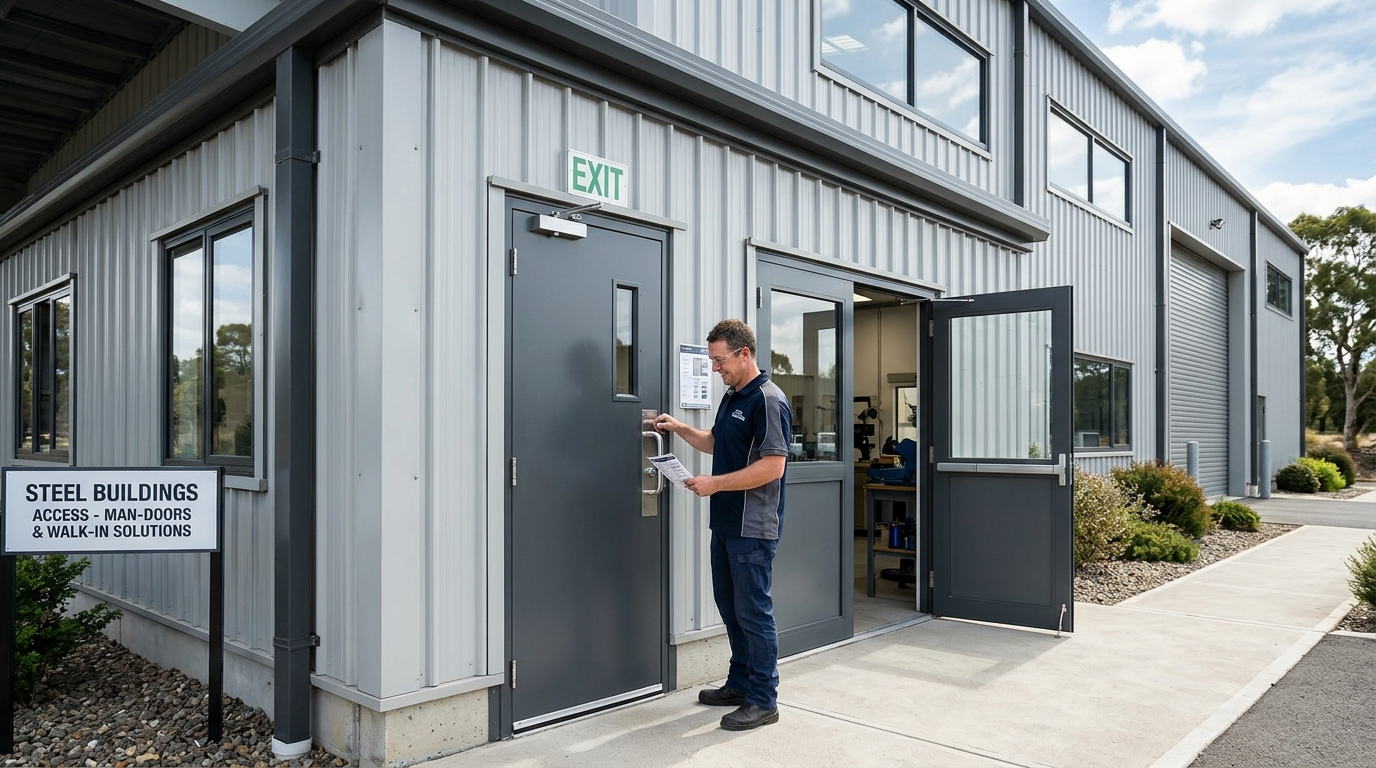
Walk-through man doors: Place at least one man door on the side or rear wall. Daily foot traffic shouldn’t require raising an overhead door every time.
Drive-through configuration: For workshop or farm use, a rear door aligned with a front bay creates a drive-through lane. Practical for trailers, large equipment, and through-traffic workflows.
Windows and Natural Light
A garage without natural light is a space you tolerate. One with good light is a space you actually enjoy using.
Placement considerations:
- Side walls are the safest bet for window placement in high snow load zones
- Avoid north-facing windows if heat retention matters
- Position windows above workbench height for task lighting where it counts
Snow load and windows: Window headers in a steel structure need to be properly engineered especially in high snow load regions. Metal Pro buildings account for this in the structural design.
Skylight options: Translucent roof panels are a cost-effective way to flood a steel garage with daylight. They’re integrated into the roofline ; no structural compromise, no leaking curb details to worry about.
Insulation : Do You Need It?
This is the question that changes everything else about your build.
Heated vs. unheated , two completely different projects: An unheated storage garage needs minimal insulation. A heated workshop, hobby space, or year-round garage is a different structure entirely with different wall assemblies, vapour barriers, and mechanical requirements.
R-value recommendations by Canadian climate zone:
| Zone | Walls | Ceiling |
| Mild (Southern BC, Southern ON) | R-12 – R-20 | R-20 – R-30 |
| Moderate (AB, SK, MB south) | R-20 – R-28 | R-30 – R-40 |
| Cold (Northern prairies, Northern ON) | R-28 – R-40 | R-40 – R-60 |
Not sure what R-value your climate zone requires? Use R-Value Insulation Chart to find the right target for your region before you finalize your build specs.
Spray foam vs. batt insulation in steel structures: Spray foam is the preferred choice for steel buildings. It adheres directly to the steel frame, eliminates thermal bridging, and acts as a vapour barrier in one step. Batt insulation requires a separate vapour barrier and careful installation to avoid condensation problems inside the wall assembly.
Not sure which insulation type is right for your garage? full comparison of spray foam, batt, and bubble insulation for metal structures breaks down the pros, cons, and costs of each option in detail.
The upfront cost difference between spray foam and batt is real. The long-term performance difference is bigger.
Interior Finishing Options
How you finish the interior defines what the space becomes.
Wall finish options:
- Unfinished : exposed steel frame and panels. Fine for basic storage. Not ideal for a heated or workshop space.
- Steel liner panels : durable, moisture-resistant, and easy to clean. A practical choice for garages that see heavy use.
- Drywall : best finish quality, required if you want a painted interior. Adds fire separation value between the garage and any attached living space.
Electrical: Rough-in your electrical at build time , not after. Key decisions:
- Sub-panel sizing: 100-amp minimum for a workshop, 200-amp if you’re running heavy equipment or EV charging
- Circuit placement: plan outlet locations around your workbench, lift, and storage wall before walls are closed
Plumbing rough-in: If there’s any chance you’ll want a utility sink, in-floor heat, or a bathroom in the future, rough in the drain lines now. Cutting concrete later is expensive and disruptive.
Floor coating and drainage: A quality epoxy or polyurea floor coating transforms the look and durability of a concrete slab. Apply it after the slab has fully cured, typically 28 days minimum. Pair it with a floor drain for wash water and snowmelt.
Colour and Exterior Finish
Your garage is a significant structure on your property. How it looks matters.
Metal Pro offers a full range of exterior colours and finishes designed to complement your home rather than compete with it.
Popular choices:
- Matching your home’s siding or roofline colour
- Contrasting trim for a clean, defined look
- Wainscoting panels on the lower third of the wall for added visual weight and curb appeal
Paint and finish warranty: Metal Pro’s steel panels carry a manufacturer-backed finish warranty. The colour won’t peel, chalk, or fade the way painted wood does and it won’t require repainting every five years.
Add-Ons Worth Considering
Some upgrades are cheap at rough-in and expensive to retrofit. These are the ones worth adding now:
EV charging rough-in Run a 240V conduit to at least one bay. EV adoption in Canada is accelerating. Even if you don’t own one today, the next buyer of your home will notice.
Mezzanine storage level A structural mezzanine above one bay adds significant storage square footage without expanding your footprint. Best planned at the design stage when framing can be sized accordingly.
Lean-to addition A covered lean-to off one side wall creates sheltered space for equipment, firewood, or an outdoor workspace. Cost-effective to add during the original build.
Security and camera rough-in Conduit for cameras and a security panel is a minor cost at build time. Retrofitting through finished walls is not.
Your 3-Car Steel Garage Project Timeline , What to Expect From Start to Finish
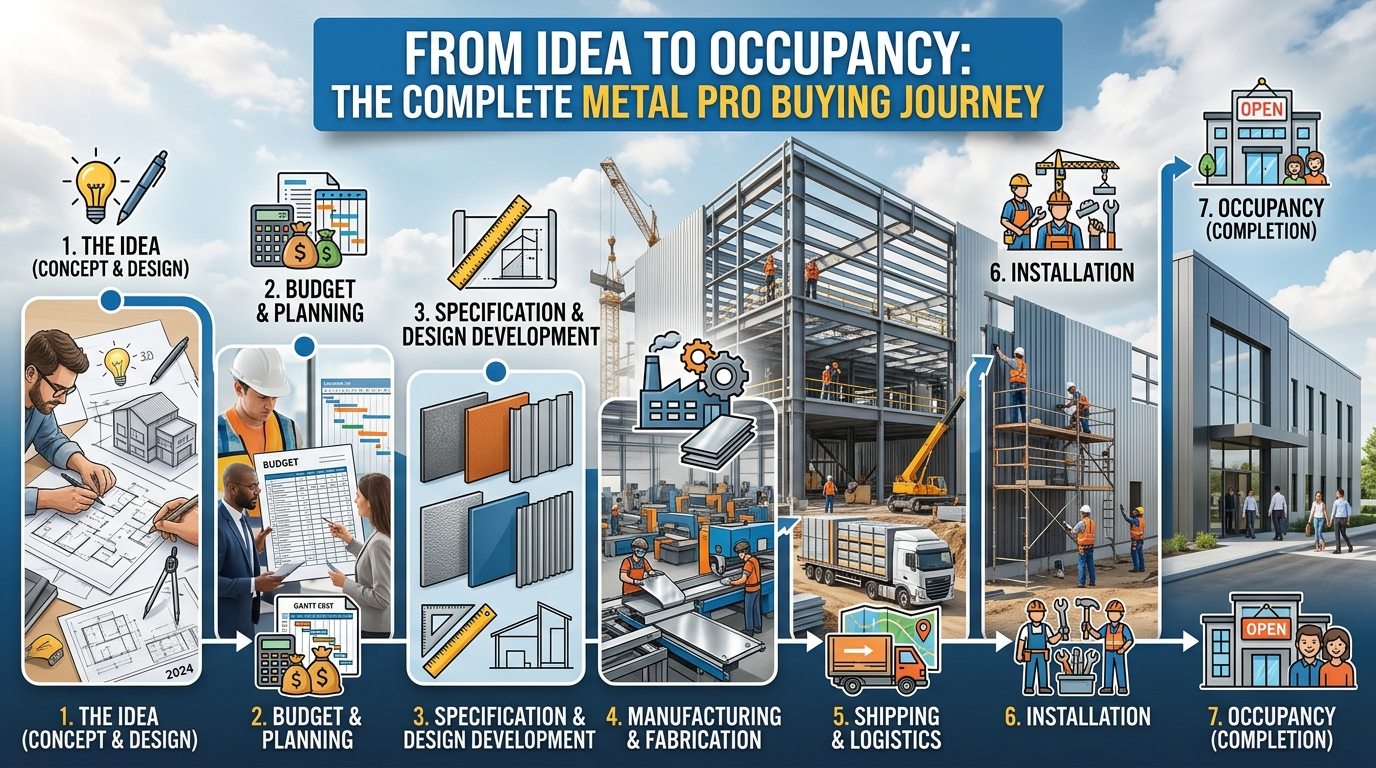
Before diving into the details, here’s what a typical Metal Pro garage project looks like from first conversation to finished build:
| Phase | Typical Duration |
| Initial design & quote | 1 – 2 weeks |
| Permit application & approval | 2 – 12 weeks (province-dependent) |
| Manufacturing & delivery | 4 – 8 weeks after permit |
| Site prep & foundation | 1 – 3 weeks |
| Steel building installation | 3 – 7 days |
| Finishing work (electrical, insulation, etc.) | 1 – 4 weeks |
| Total (typical range) | 3 – 6 months start to finish |
The biggest variable is permit approval time. Everything else can be planned around it.
How to Avoid the Most Common Delays
Most project delays are predictable and preventable. Here are the four that derail Canadian garage builds most often:
- Starting permits too late in the season
This is the most common mistake. Homeowners decide in July they want a garage built before winter. By the time permits are approved, the concrete window has closed.
Start your permit application the moment your design is finalized. Don’t wait until the building is ordered.
- Site access not ready for delivery
A steel building kit arrives on a flatbed. That truck needs a clear, firm path to your site. Soft ground, low-hanging branches, narrow laneways, and locked gates all create expensive delays.
Confirm your site access before your delivery date is scheduled , not after.
- Skipping soil testing on new land
On an established residential lot, soil conditions are usually predictable. On raw land, acreages, or recently filled sites, they’re not.
An unexpected layer of fill, soft clay, or high water table discovered at excavation changes your foundation plan and your budget. A basic soil assessment before breaking ground costs very little compared to a mid-project redesign.
- Missing the concrete pour window before freeze-up
Concrete can’t be poured in freezing temperatures without heated enclosures and additives both of which add significant cost. In most of Canada, that window closes somewhere between late October and mid-November depending on your region.
If your foundation isn’t poured before freeze-up, your project pauses until spring. Plan your timeline backward from that date.
Best Time of Year to Build in Canada
Canada’s climate creates real constraints on construction scheduling. Here’s how each season plays out:
Spring (April – June) : Ideal
The best time to break ground. Frost is out of the ground, concrete crews are available, and you have the full building season ahead of you. Permits applied for in January or February put you in a strong position for a spring start.
Summer (July – August) : Strong
Still excellent for building. Longer days and dry weather make for fast, clean installations. The risk is that popular contractors book up quickly ,secure your trades early.
Fall (September – October) : Possible but tight
A fall build is doable if your permit is already in hand and your foundation is poured before Thanksgiving. The margin is thin. One delay cascades into a winter problem fast.
Winter (November – March) : Limited
Foundation work in most of Canada is either impossible or significantly more expensive in winter. Steel erection can proceed in cold weather, but trades for finishing work slow down. Some homeowners use winter to permit and plan then hit the ground running in April.
The smart move:
Plan and permit in the fall. Lock in your Metal Pro quote and design. Start your permit application before the snow flies. When spring arrives, you’re ready to build while your neighbours are still getting quotes.
Working Backward From Your Target Date
If you want your garage usable by a specific date, work backward through the timeline:
Target: usable garage by October 1
- Finishing work complete by Sept 25 → start finishing work by Sept 1
- Steel installation by Aug 25 → foundation complete by Aug 15
- Foundation poured by Aug 1 → site prep start July 15
- Building delivered by July 30 → order placed by June 1
- Permit approved by May 30 → application submitted by April 1
- Design finalized by March 15 → start your Metal Pro consultation now
The timeline isn’t complicated. It just requires starting earlier than most people think.
Ready to map out your project timeline? Metal Pro’s team can walk you through exactly what to expect in your province. Contact Metal Pro
The timeline isn’t complicated. It just requires starting earlier than most people think.
Curious what ownership actually looks like after year one? Read what real Canadian homeowners experience with their steel garages , the seasonal realities, maintenance, and whether it delivered the value they expected.
The 3 Costly Mistakes to Avoid When Planning a 3-Car Steel Garage
These aren’t edge cases. They’re the mistakes Metal Pro sees repeatedly from homeowners who did their research, got multiple quotes, and still got burned. Knowing them in advance is the difference between a smooth build and an expensive lesson.
Mistake #1: Buying a Kit Without Engineering for Your Region
It’s easy to find cheap steel garage kits online. Some are priced attractively. Most are engineered for somewhere that isn’t Canada.
Here’s what that means in practice:
A kit designed to generic North American standards may not account for your municipality’s specific snow load, wind load, or seismic requirements. When you submit it for a permit, one of two things happens: the application gets rejected, or worse, it gets approved by an overworked inspector and you end up with a structure that wasn’t built for your climate.
What engineer-stamped means and why it’s non-negotiable:
An engineer-stamped drawing is a document prepared and signed by a licensed Professional Engineer registered in your province. It certifies that the structure has been designed to meet the specific load requirements for your location.
Without it, most Canadian municipalities won’t issue a permit. Full stop.
With a cheap imported kit, getting that stamp often means hiring your own engineer to review and certify someone else’s design at significant additional cost, with no guarantee they’ll approve it as-is.
What Metal Pro does instead:
Every Metal Pro building comes with stamped engineering drawings prepared to your provincial and municipal specifications. The engineering is built into the product not an afterthought you chase down after purchase.
Mistake #2: Forgetting the True All-In Cost
This is the mistake that causes the most financial stress on garage projects across Canada.
A homeowner sees a building kit advertised at $18,000. They budget $25,000 to be safe. By the time the project is complete, the invoice is $55,000 and the shock is real.
Here’s where the gap comes from:
| Cost Item | Often Missing From Advertised Price |
| Delivery to your site | ✗ Rarely included |
| Foundation work | ✗ Never included |
| Permit fees | ✗ Never included |
| Site grading and prep | ✗ Never included |
| Professional installation labour | ✗ Often excluded |
| Electrical rough-in | ✗ Never included |
| Insulation | ✗ Rarely included |
None of these are optional. All of them cost real money.
The Metal Pro difference:
When you get a quote from Metal Pro, it reflects the real project ,not just the kit. We walk through every cost category with you upfront so your budget is accurate before you commit to anything.
No ambush invoices. No “that’s extra” conversations halfway through your build.
Mistake #3: Undersizing for Real Life
“We’ll make it work.”
It’s the most expensive phrase in garage planning.
Homeowners size their garage for three vehicles and forget everything else. The snowblower. The lawn tractor. The chest freezer. The workbench. The bikes, the hockey gear, the seasonal tires, the camping equipment.
Six months after move-in, the garage is full and two of the three vehicles are still outside.
The math that makes this mistake painful:
At the planning stage, going from a 36×24 to a 40×30 adds roughly $4,000–$8,000 to the total project cost. That’s a meaningful number ,but it’s a fraction of what you’d spend demolishing and rebuilding, or what you’ll pay in storage unit fees over the next decade.
The width you skip at planning stage isn’t just square footage. It’s the workbench you never get. The storage wall that never gets built. The third vehicle that spends every winter outside.
How Metal Pro approaches sizing:
Our consultation doesn’t start with what fits on a lot plan. It starts with how you actually live, what you own, how you work, what you might want in five years.
The goal is a garage you’re still happy with a decade from now. Not one you’re already wishing was bigger by the second winter.
Avoiding these mistakes starts with the right conversation. Metal Pro’s team has guided hundreds of Canadian homeowners through exactly this process. Get your free consultation → Contact Metal Pro
Why Hundreds of Canadian Homeowners Choose Metal Pro for Their Steel Garages
Not all steel buildings are created equal and in Canada, that distinction matters more than anywhere else.
Many suppliers sell imported kits engineered to American standards. The specs look similar on paper. But Canadian snow loads, wind loads, frost depths, and seismic zones operate in a different category entirely. A building that meets Georgia’s requirements won’t meet Alberta’s. And it won’t pass a Canadian permit application.
Every Metal Pro building is engineered specifically for Canadian conditions designed and stamped to meet the requirements of the province and municipality where it will be built. Not adapted. Not approximated. Engineered for where you actually live.
That distinction protects your investment, your permit application, and the people and equipment inside the building.
What’s Included in Every Metal Pro Project
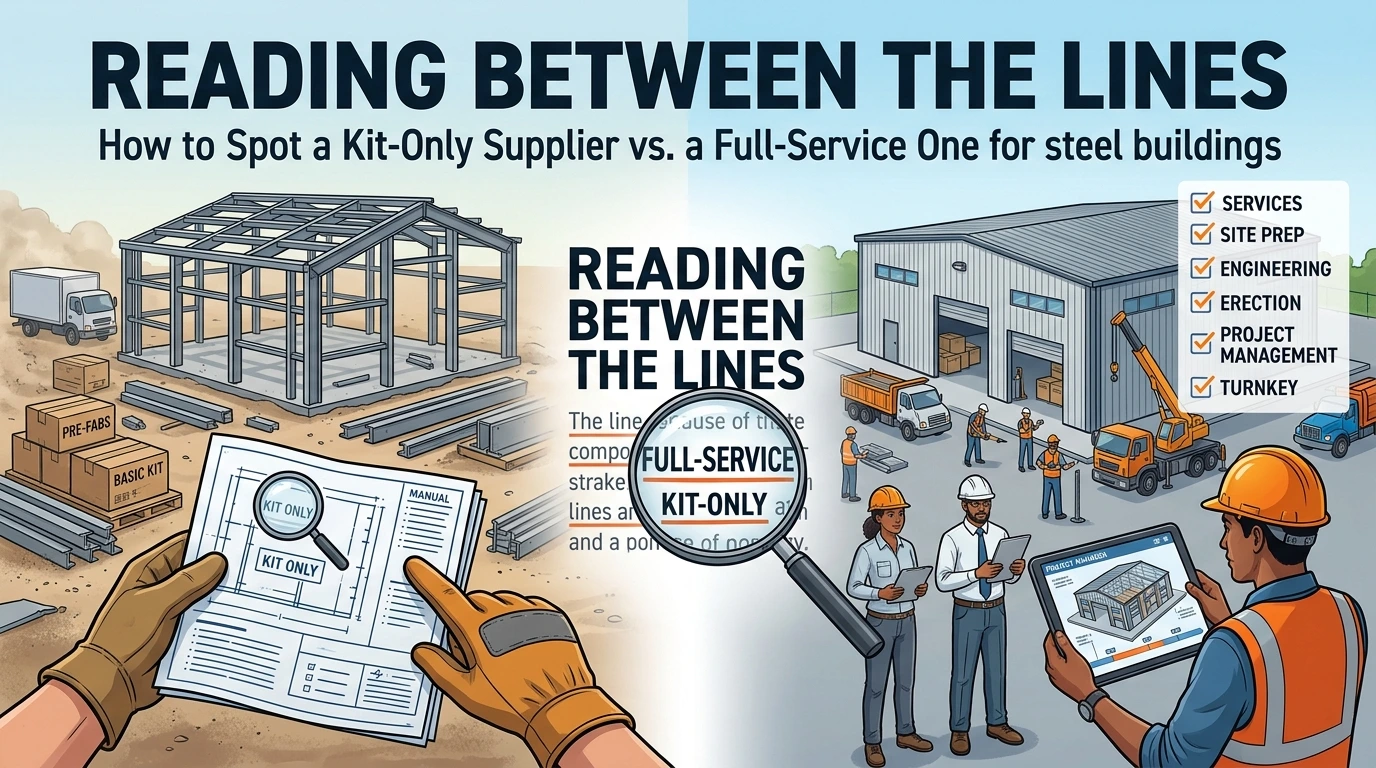
Metal Pro isn’t a kit supplier that hands you a pile of steel and wishes you luck. We manage the full project from first design conversation to the day you pull your truck inside.
Every Metal Pro project includes:
- Engineer-stamped drawings : prepared by a licensed Canadian Professional Engineer, specific to your province and municipality
- Full permit support : we prepare your complete drawing package and guide you through the municipal submission process
- Manufacturing to your spec : your building is fabricated to your approved design, not pulled from generic inventory
- Delivery to your site : coordinated and confirmed, with site access requirements reviewed in advance
- Professional installation : experienced crews who build Metal Pro structures, not general labourers figuring it out on your property
- Post-build support and warranty : we don’t disappear after the last panel goes up
From the first call to the finished build, you have a real team behind the project.
Metal Pro’s Promise
We built this company on a straightforward idea: Canadian homeowners deserve honest pricing, real engineering, and a team that actually answers the phone.
That means:
- Transparent pricing from day one : your quote reflects the real project, not a number designed to win the bid and grow from there
- No surprise invoices : every cost category is discussed upfront, before you commit to anything
- Engineering built in : stamped drawings are included, not an add-on you chase down separately
- A real team behind your project : not a call centre, not a web form, not an automated quote generator
When you work with Metal Pro, you’re working with people who have built steel garages across every province in this country. We know what the permit office in your municipality wants to see. We know what foundations hold up in your frost zone. We know what sizing decisions homeowners regret and which ones they’re glad they made.
That experience is what you’re getting when you call us.
Ready to Build the Garage Your Property Deserves?
You’ve been putting it off. Another winter with vehicles exposed, gear piled in corners, and a driveway that never quite looks or works the way it should.
That changes with the right build.
A properly planned 3-car steel garage protects what you’ve worked hard to own. It reclaims your space. It adds real value to your property. And built right, it’s there for decades without asking much in return.
The complexity of getting there (sizing, permits, foundations, pricing, contractors ) is exactly what Metal Pro exists to remove.
You get transparent pricing from day one. Engineer-stamped drawings built for your province. A real team that picks up the phone. And a finished garage you’re proud to pull into.
The best time to start was last fall. The second best time is today.
Get your free, no-pressure quote from Metal Pro and find out exactly what your project looks like, start to finish.
Get Your Free Quote → Contact Metal Pro